Care Over Blood: Wuhan Court Lets a Devoted Partner Inherit a 5-Million-Yuan Estate
A man who cared for his late girlfriend's mother through old age and burial has defeated the woman's niece in a 5-million-yuan inheritance lawsuit in Wuhan. The ruling shows how Chinese courts rank contracted care above bloodline — a question China's ageing one-child generation is increasingly forcing.
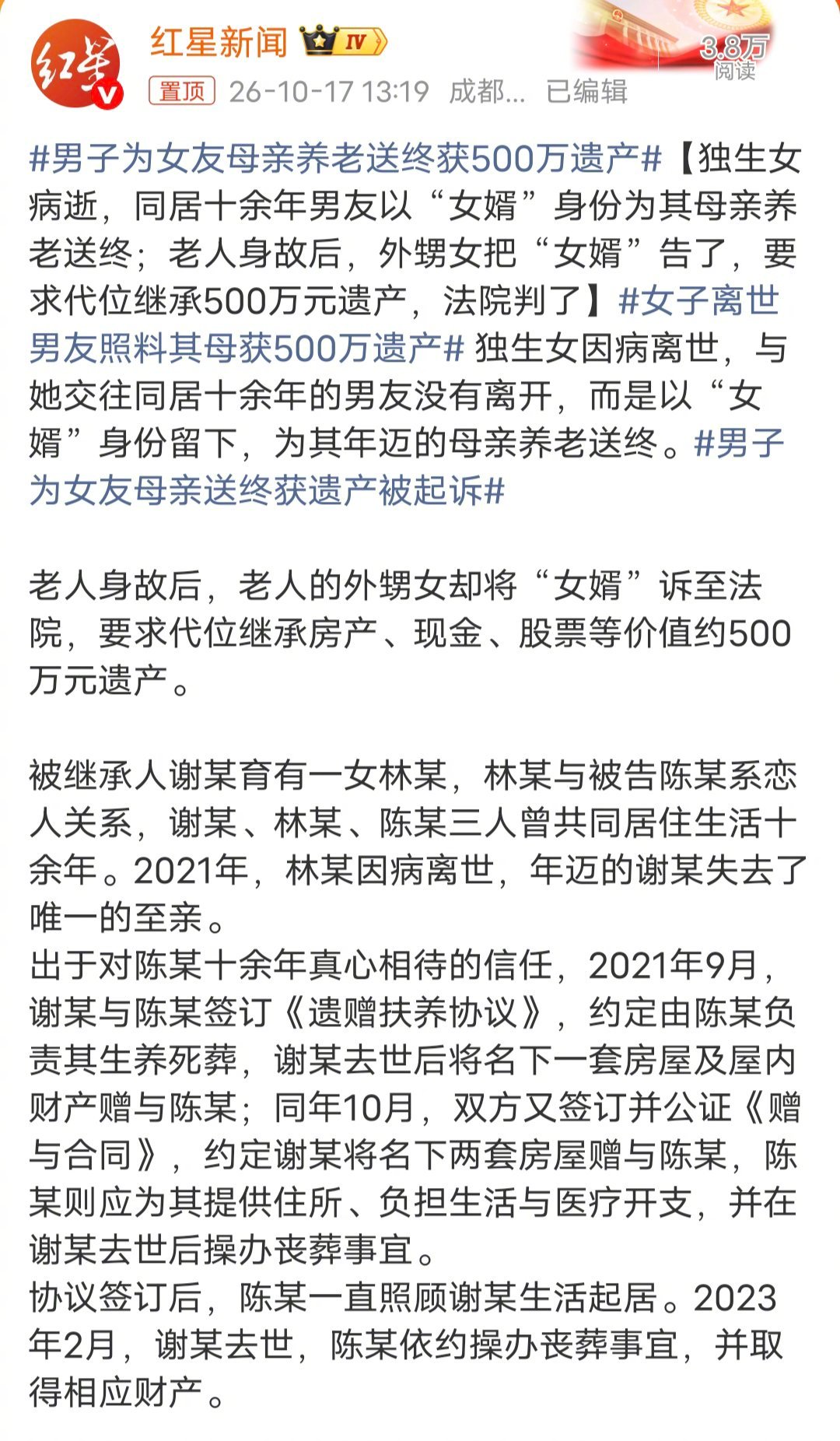
For more than a decade, three people shared a home in Wuhan: Xie, her only daughter Lin, and Lin's long-term partner, Chen. When Lin died of illness in 2021, Xie was left elderly and alone. Chen, whom she had known as a son-in-law in everything but paperwork, stayed.
Within months the two signed what Chinese law calls a bequeath-and-support agreement (遗赠扶养协议): Chen would look after Xie for the rest of her life — housing, living costs, medical bills — and arrange her funeral when the time came; on her death, her house and its contents would pass to him. A notarized gift contract followed that October, adding two apartments on the same terms. Chen performed all of it, through her death in February 2023, including the funeral.
Then Xie's niece sued. Zheng, who had visited her aunt from time to time, went to the Wuchang District People's Court seeking to inherit by operation of law, invoking subrogated succession (代位继承) — the device that lets a relative step into a deceased heir's place — and arguing that her visits and help in the old woman's final years gave her the claim. The estate at stake: apartments, cash and shares worth roughly 5 million yuan, about 700,000 dollars.
The court saw it differently. As Legal Daily's account, carried by Red Star News, recounts: the agreements were notarized and the signing recorded on video; Chen had paid medical bills, hired carers and buried Xie — the obligations performed in full. Under Article 1123 of the Civil Code and the Supreme People's Court's inheritance interpretation, a bequeath-and-support agreement outranks both statutory inheritance and a will. Zheng produced no will in her favor. Her claim was dismissed.
The verdict, which charted on Baidu's hot board and spread across Weibo this week, was received less as a curiosity than as an answer to a demographic question. China's one-child generation is running into arithmetic its parents never planned for: one adult child, two ageing parents and, in the unluckiest cases like Xie's, a child who dies first. The bequeath-and-support agreement — an instrument that lets an elderly person trade the estate for a guaranteed carer — is the legal system's tool for exactly that gap. The ruling landed the same week China's first national standard for hospital escort workers took effect, another sign that care for the elderly, once assumed to be a family's in-house duty, is being written into contracts, standards and price lists.
On Weibo, the response was overwhelmingly on the court's side. One widely shared post put it as "the law protects genuine devotion" (法律守护真心付出) — blood, the argument ran, is not the only standard for inheritance (post).
Zheng's case died on the evidence: the court noted she could point to no will from Xie, and that visits are not performance. The two apartments — and everything else Xie signed away — stay with the man who buried her.