Chinese Court Dismisses Husband’s Compensation Claim After Wife’s Abortion, Upholding Women’s Bodily Autonomy
In a courtroom in Yinchuan, a husband’s bid to be compensated for the emotional distress caused by his wife’s decision to abort a pregnancy was thrown out, reinforcing a legal principle that, in China, a woman’s right to control her own body outweighs a husband’s claim to a “reproductive right.” The case, formally known as Liu Hui v. Wen Jing, reached a decisive moment on April 30, 2018, when the intermediate people’s court ruled that the wife’s unilateral termination of the pregnancy did not constitute an infringement on her husband’s legal interests.
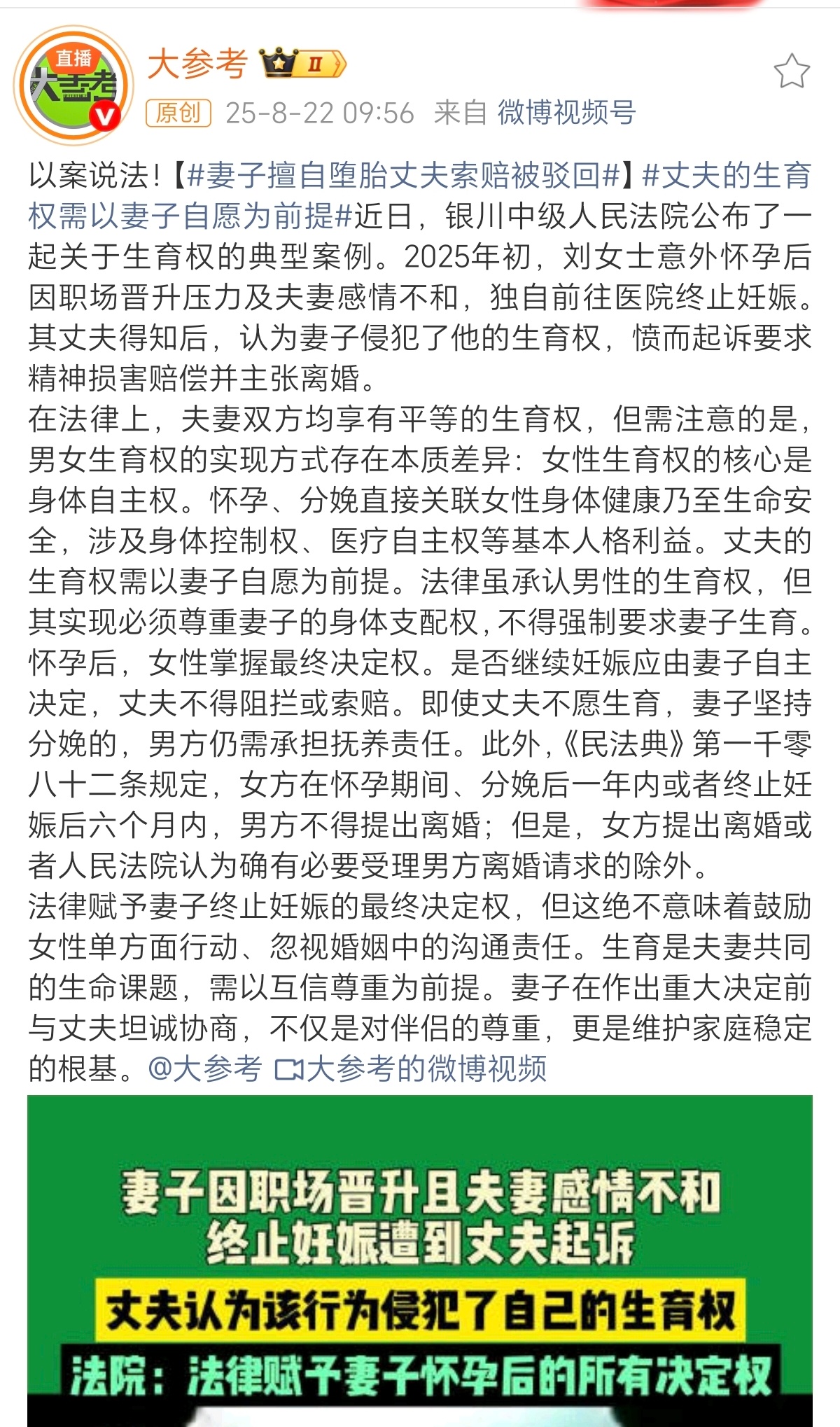
The plaintiff, Liu Hui, argued that by ending the pregnancy without his consent he had been denied the chance to become a father and that the emotional and psychological damage sustained by him should be compensated. He also suggested that the hospital and the physicians who performed the procedure bore some responsibility, alleging they had not taken the husband’s wishes into account. The defense, however, rested on two pillars of Chinese law: the primacy of bodily autonomy under the Marriage Law’s Judicial Interpretation III, and the acknowledgment that reproductive rights, while theoretically shared by spouses, are in practice exercised through the person who physically carries the fetus.
Chinese jurisprudence has long held that a wife’s decision to terminate a pregnancy is a private matter, rooted in the recognition that pregnancy and childbirth impose unique physical risks and burdens on women. Judicial Interpretation III of the Marriage Law, issued by the Supreme People’s Court, explicitly states that a husband cannot claim damages simply because his partner chose an abortion without his agreement. The ruling in Liu Hui’s case echoed this stance, emphasizing that the “right to procreate” for a man is contingent upon the voluntary participation of his spouse, and that any claim to the contrary would amount to an intrusion into a woman’s bodily integrity.
The decision was not merely a legal technicality. It unfolded against a backdrop of intense public debate on Chinese social media, where the hashtag #妻子擅自堕胎丈夫索赔被驳回# (husband’s compensation claim rejected after wife’s unauthorized abortion) sparked a flood of comments. Many netizens expressed relief that the courts had upheld women’s autonomy. A typical Weibo reaction read, “Can a man give birth? If not, what reproductive rights are you talking about?” Others highlighted the physical and emotional toll of pregnancy, noting that “whether pregnant or breastfeeding, women bear irreplaceable hardships and risks; therefore, the freedom not to bear a child should be protected first.” The consensus was clear: the law’s endorsement of the woman’s choice resonated with a broader societal shift toward gender equality and the protection of women’s health.
The discussion also touched on the marital dynamics that often precipitate such legal battles. Several commenters criticized the husband’s behavior, suggesting that his demands for a child despite a strained relationship or inadequate support contributed to the wife’s decision to terminate. One user wrote, “He’s not good to his wife and still expects her to have a child; then he has the nerve to demand compensation.” These observations reflect an understanding that reproductive decisions are rarely made in a vacuum; they are intertwined with trust, communication, and mutual respect within a marriage.
Beyond the courtroom, the case resonates with other provisions of China’s Civil Code, notably Article 1082, which restricts a husband’s ability to file for divorce during certain periods surrounding pregnancy and childbirth. The intent of the provision is to protect women from being pressured into divorce at moments when they are most vulnerable physically and emotionally. Together with the judicial interpretation, these statutes form a legal framework that prioritizes the health and autonomy of the pregnant woman over competing claims from a spouse.
Legal scholars have pointed out that while the concept of “reproductive rights” can be invoked by both men and women, Chinese law interprets it through the lens of bodily autonomy. In other words, a man cannot claim a right to force a partner to continue a pregnancy because he does not share the biological consequences. This distinction is reflected in the court’s language: the wife’s “private abortion” does not damage the husband’s “reproductive right.” The phrasing underscores a legal acknowledgement that the right to conceive is inextricably linked to the right to decide whether to see that conception through to birth.
The Liu Hui decision has not, as of now, inspired a wave of similar lawsuits. Instead, it seems to have set a clear precedent that such claims are unlikely to succeed. Lawyers specializing in family law report a decline in cases where husbands seek financial compensation for abortions performed without their consent. The emphasis has shifted toward mediation and counseling, encouraging couples to discuss reproductive expectations before marriage or early in the union, rather than resorting to litigation after the fact.
International observers note that the Chinese courts’ handling of this issue aligns with global trends that increasingly recognize women’s reproductive autonomy as a fundamental human right. In many jurisdictions, the legal principle that a woman alone can decide whether to terminate a pregnancy has been cemented through statutes and precedent. What remains distinctive in China’s context is the explicit reliance on the Marriage Law’s judicial interpretations and the civil code’s protective measures for pregnant women, which together form a cohesive legal shield against spousal claims.
For the parties involved, the outcome carries personal weight. Liu Hui’s appeal was dismissed, leaving him without the compensation he sought, while Wen Jing – the wife – retained the privacy of her medical decision. The hospital and physicians, initially named in the lawsuit, were also cleared of liability, reinforcing the notion that medical professionals are guided primarily by the patient’s consent.
The case illustrates the evolving balance between personal liberty and marital responsibilities in contemporary China. As the nation continues to grapple with demographic challenges, such as low birth rates and an aging population, the legal system is careful not to conflate demographic goals with individual rights. The court’s refusal to treat an abortion as a breach of a husband’s reproductive entitlement signals a commitment to safeguarding personal autonomy, even amid broader societal pressures.
In the end, the court’s verdict did more than settle a singular dispute; it reaffirmed a principle that, in matters of pregnancy, the decision-maker is the person whose body bears the pregnancy. The public’s reaction—largely supportive of the woman’s right to choose—suggests that Chinese society, at least in this forum, is ready to accept that principle. As couples navigate the complex terrain of family planning, the Liu Hui case serves as a reminder that the law stands on the side of bodily autonomy, and that attempts to translate reproductive desire into legal claims of compensation are unlikely to find favor in Chinese courts.