Desperate Indian Husband Binds Late Wife to Motorcycle to Return Her Home, Police Intercept Him.
A tragic scene that has captured the attention of users on China’s biggest social platform, Weibo, unfolded on the streets of Nagpur, India, in early August. On 9 August, a 35‑year‑old woman identified in local reports as Girija—sometimes rendered as “Geelsi” in Chinese translations—was struck and run over by a truck. The driver fled the scene, leaving Girija dead and her husband, Amit Yadav, alone amidst the wreckage.
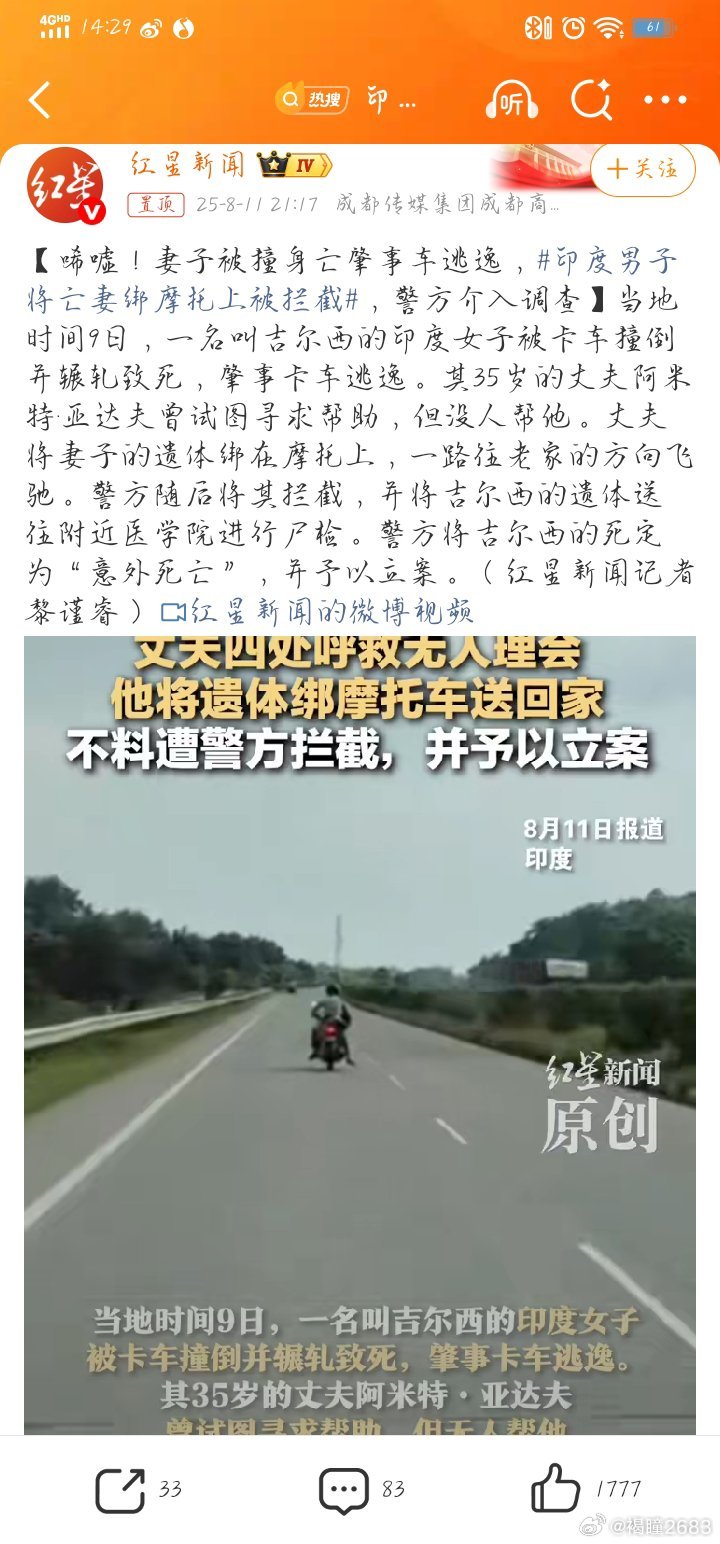
According to statements gathered from neighbours and by‑standers, Yadav frantically sought help from passing traffic and pedestrians, but no one stopped to assist. Facing the prospect of leaving his wife’s body on the road, and driven by the desire to give her a proper burial in their native village, he made a desperate decision. He bound his wife’s lifeless form to his motorcycle and set off toward home, hoping to transport her for a traditional funeral rite.
The journey was short-lived. Police officers who were patrolling the area intercepted Yadav before he could reach his destination. The officers took the motorcycle and the body into custody, transferred Girija’s remains to a nearby medical college for a mandatory post‑mortem, and formally recorded her death as an “accidental death” while opening a case to investigate the hit‑and‑run.
The incident has resonated far beyond the borders of Maharashtra. Chinese netizens, who have taken to the hashtag #印度男子将亡妻绑摩托上被拦截, have expressed a mixture of sorrow, outrage and cultural reflection. Many posts lament the “heart‑breaking” desperation that drove Yadav to tie his wife to a motorbike, describing the act as “too heartbreaking” and “full of despair.” Others criticize the apparent indifference of those who passed the scene, echoing sentiments that “no one responded to his pleas for help” and urging society not to let such tragedies be compounded by coldness.
Calls for justice dominate the discussion. Users demand that the fleeing truck driver be identified and “severely punished,” while also urging authorities to support Yadav in seeking “fair redress.” The police’s procedural response—sending the body for an autopsy and classifying the death as accidental—has been noted, though the prevailing tone remains sympathetic toward the grieving husband rather than confrontational toward law enforcement.
Cultural references have added an extra layer of resonance. Chinese commenters invoked the phrase “落叶归根” (fallen leaves return to their roots), drawing a parallel between Yadav’s wish to bring his wife back to their native soil and a deeply rooted Asian belief in the importance of returning one’s body to its place of origin. Others invoked “生死不离” (never separated in life or death), underscoring the perceived depth of Yadav’s loyalty and love.
The story also underscores broader concerns about road safety and the prevalence of hit‑and‑run incidents in India. While the investigation into the truck driver continues, the episode has ignited a conversation on social media platforms about the need for swift assistance to accident victims, better enforcement of traffic laws, and more compassionate community responses.
In the weeks since the incident, the police have not released further details about the driver who fled the scene, nor have they disclosed whether Yadav will face any charges related to the transport of his wife’s body. What remains clear is the profound emotional impact of the episode, which has transcended language and geography to provoke empathy and debate among thousands of online observers.
Amit Yadav’s desperate act, though shocking to many, reflects a profound human impulse: the desire to honor a loved one in death even when faced with bureaucratic and societal indifference. As the investigation proceeds, the story serves as a stark reminder of the fragile intersection between personal grief, cultural tradition, and the systems designed to protect public safety.