Dove's 'Sweetheart, I Cheated for Chocolate' Ad Draws Outrage in China
A Dove flagship-store video built around a woman receiving a chocolate gift box from a secret admirer while her boyfriend was away has triggered a boycott-style backlash in China, where the brand plays on a reputation for romantic devotion. The episode shows how quickly a marketing script can collide with the moral expectations of its biggest market.
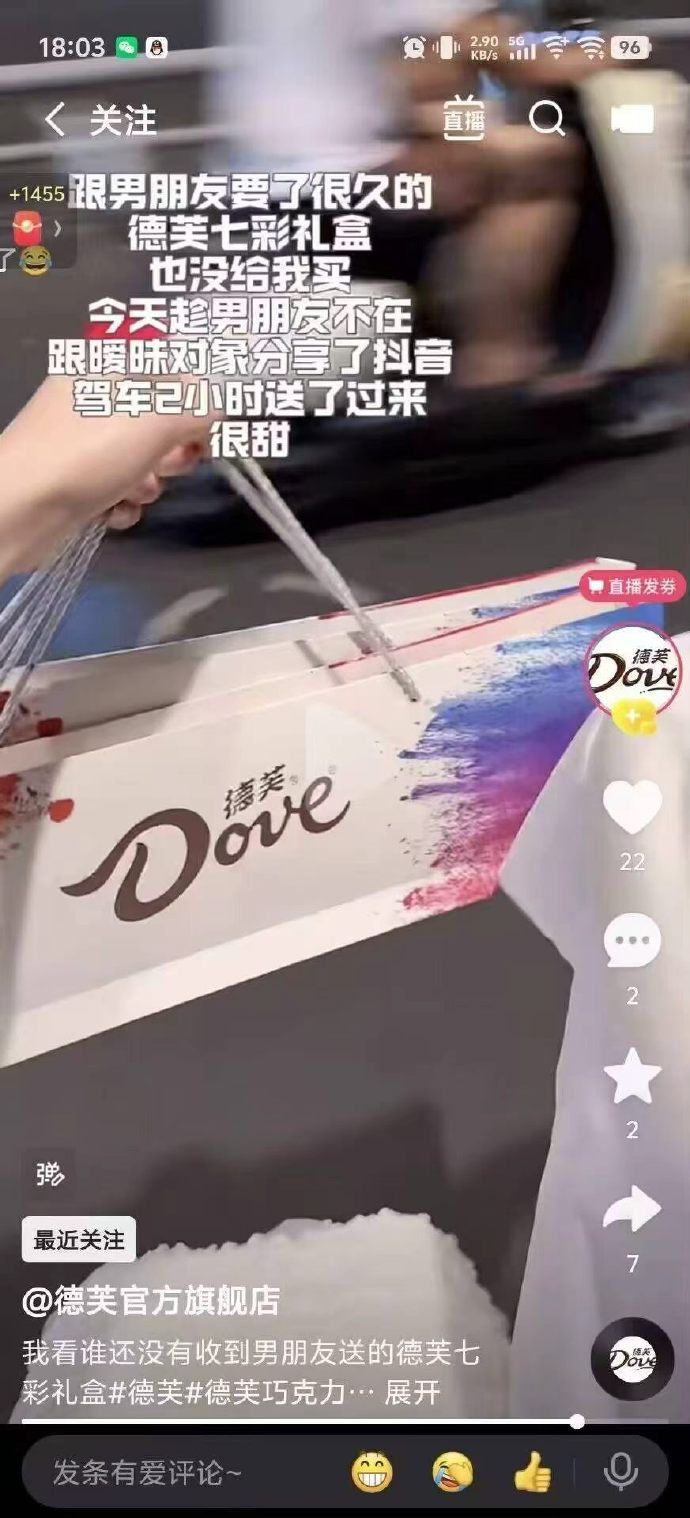
Dove has spent decades pitching itself as the chocolate of devotion in China, the market where its silk-textured squares and heart-shaped boxes are a standing shorthand for romantic love. Its latest short video managed to undercut that promise in roughly ten seconds.
The script, posted by Dove's official flagship store, opens in the voice of a woman: she asked her boyfriend over and over for the Dove Rainbow gift box, but he never bought it. So one day, while he was out, she shared a Douyin post with someone else. That other man drove two hours to deliver the box. "Very sweet," the caption ends.
The problem was obvious to almost everyone who saw it except, apparently, the brand's marketing team. Audiences read the line as a confession that the woman was keeping a romantic partner on the side — the euphemism "暧昧对象" signals an undefined, more-than-friends connection — and that the moral of the ad was that disloyalty earns you chocolate. The framing was especially jarring during Qixi, the Chinese Valentine's festival built around an old legend of two lovers reunited once a year, when Dove's sales push was in full swing.
What poured fuel on the fire was the response from Dove's own customer service. First, the brand said the video was personal creative expression and did not represent the company. Then, a customer-service reply added: "It's clearly stated to be just a script; if you don't like it, you can scroll past." Telling a paying audience to keep scrolling turned a routine ad misfire into a small public-relations disaster, and by Monday several outlets had picked up the exchange. Dove later issued an apology, but the two-step path — first disowning the content, then scolding the viewers — had already become the story.
The backlash operates in a familiar register for foreign brands in China. Chinese consumers frequently police corporate messaging for anything that appears to cheapen relationships, family, or loyalty, and companies that rely on those values are expected to defend them even in an imaginary script. A Weibo post mockingly suggested the copy should add: after eating the chocolate, her boyfriend's hat will be even greener — a reference to the Chinese idiom for being cuckolded, 绿帽子. Others made the point plainly: chocolate is supposed to carry love, and the marketing used infidelity as a selling point.
What makes the episode noteworthy is not that an advertisement was clumsy, but that the brand's first move was to retreat from it. Chinese consumers have grown fluent at spotting the difference between a joke that failed and a company that refuses to own its output, and the customer-service line became the proof they were looking for. For Dove, a box designed to express love is now, at least for a week, associated with the opposite — and with a level of brand management that its own audience, quite visibly, did not find very sweet.