The 'Regret Pill' Myth: Health Educators Push the Science of Emergency Contraception Timing
Geng Hongwei, the science blogger whose misconduct exposés have toppled senior academics, has been hired as a specially appointed lecturer by Zhejiang Media University. The hire is being debated as either the professionalization of online accountability — or its domestication.
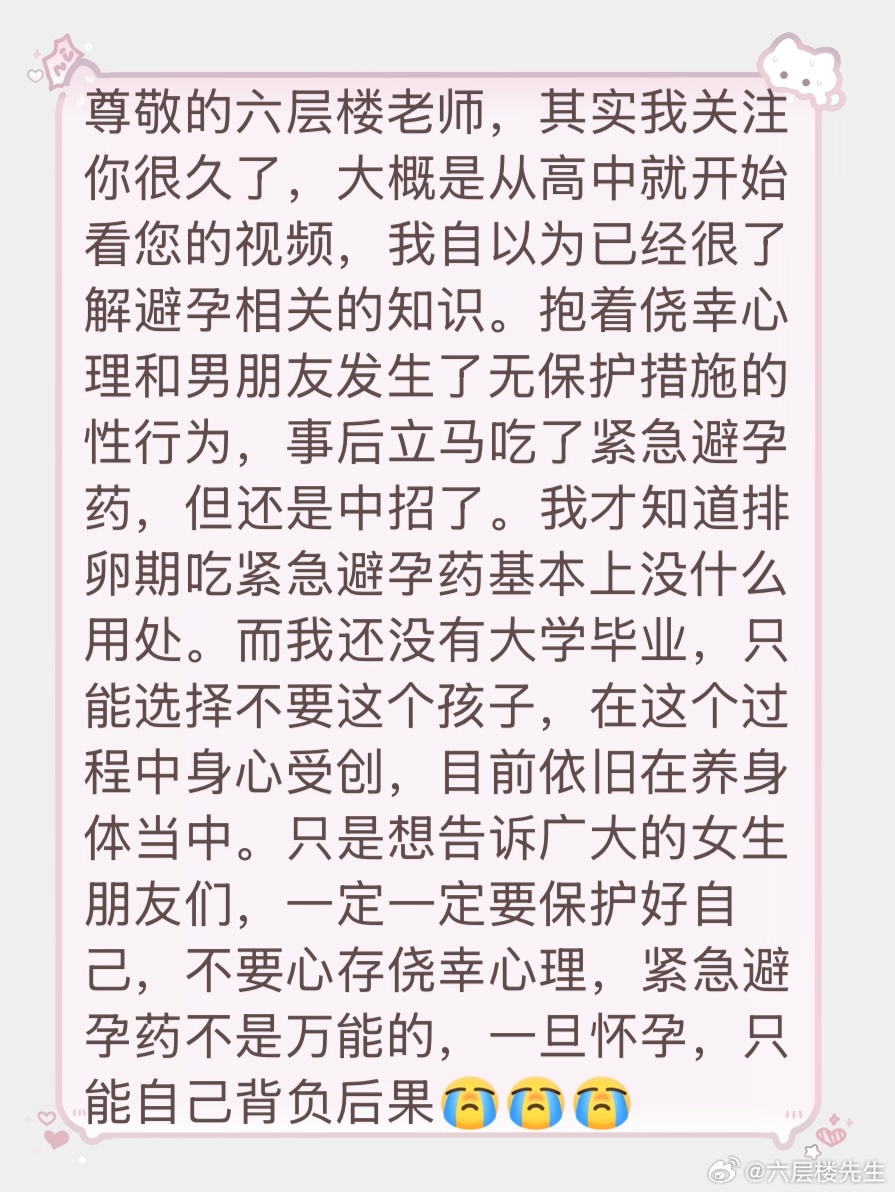
A trending hashtag this week, “the timing of the emergency contraceptive pill really matters,” began with a failure. A college student wrote to one of China's best-known women's-health educators with a personal account: she had taken the morning-after pill, and became pregnant anyway. He posted her testimony — with her identity withheld — alongside a frank admission that reading it stung: the knowledge had been out there, and it had not reached her at the moment she needed it.
The educator, who writes to a vast following as 六层楼先生 (“Mr. Sixth Floor”), used the moment to explain the biology that public-health campaigns often compress into a slogan. Emergency contraception, he wrote, works as an emergency brake on ovulation — and it only brakes an egg that has not yet been released. If ovulation has already happened by the time the pill is swallowed, sperm that can survive three to five days may still do their work; in that window, the failure rate can climb to 30 to 50 percent.
A second viral post, by health communicator 甜枣枣T, laid out the arithmetic of delay. Levonorgestrel, the most common pill — sold over the counter in Chinese pharmacies under brands such as Yuting — is effective within 72 hours, but roughly 90 percent effective if taken within a day, 78 percent at two days, and 57 percent at three. Ulipristal acetate, sold as Ella, extends the window to 120 hours but requires a prescription. For women with a BMI over 30, levonorgestrel loses potency; the copper IUD, fitted within five days by a hospital, remains the most effective option of all, cutting the pregnancy risk to 0.1 percent.
The discussion has resonated because access in China was never the problem — the morning-after pill sits on open pharmacy shelves nationwide, no prescription needed. What lags is precision: the pill is sold without any required conversation about how it actually works, and that gap is increasingly filled by private educators rather than public campaigns, who build large followings by answering the questions schools and families left unasked.
Mr. Sixth Floor's closing reflection doubled as a theory of that trade. No educator, he wrote, can stand beside each person at the moment of a decision; the job is to hand over “a set of tools” — knowledge, logic, judgment — that people internalize and carry. “Everyone must ultimately face the choices on their own road,” he wrote. “When that time comes, I will be there in my absence.”