People's Daily Rebukes Hit Medical Reality Show Over a Trainee's 'Blind-Guessed' Diagnosis
The return of a popular Chinese medical reality show backfired when a trainee guessed a brain tumor on camera and bragged about grade-4 surgery, drawing an unusually pointed rebuke from People's Daily and rare public agreement from working doctors.

A reality-television show about young doctors has found itself corrected by the Communist Party's flagship newspaper. In a commentary published this week, People's Daily told the producers of the newly returned eighth season of "The Exciting Offer" — which this year followed medical trainees rather than law clerks — that clinical work is not a stage set, and that medicine cannot tolerate what one contestant did on camera: "blind-guessing" a diagnosis.
The contestant at the center of the storm is Li Ziqi, a handsome trainee whom fans had already nicknamed "the neurosurgical heartthrob." In a film-reading assessment he announced he would blind-guess that the scan showed a craniopharyngioma, a rare tumor near the pituitary gland, and was corrected on camera by his supervising physician, who reminded him that no diagnosis rests on a guess. His offhand remarks landed worse: writing medical records, he said, was "just a routine you could learn in a day," and he claimed he had done no clinical work during his PhD. Meanwhile his résumé — ten papers in the SCI index, participation in grade-4 surgery, China's designation for the most complex and highest-risk operations — was packaged by the show as a personal credential.
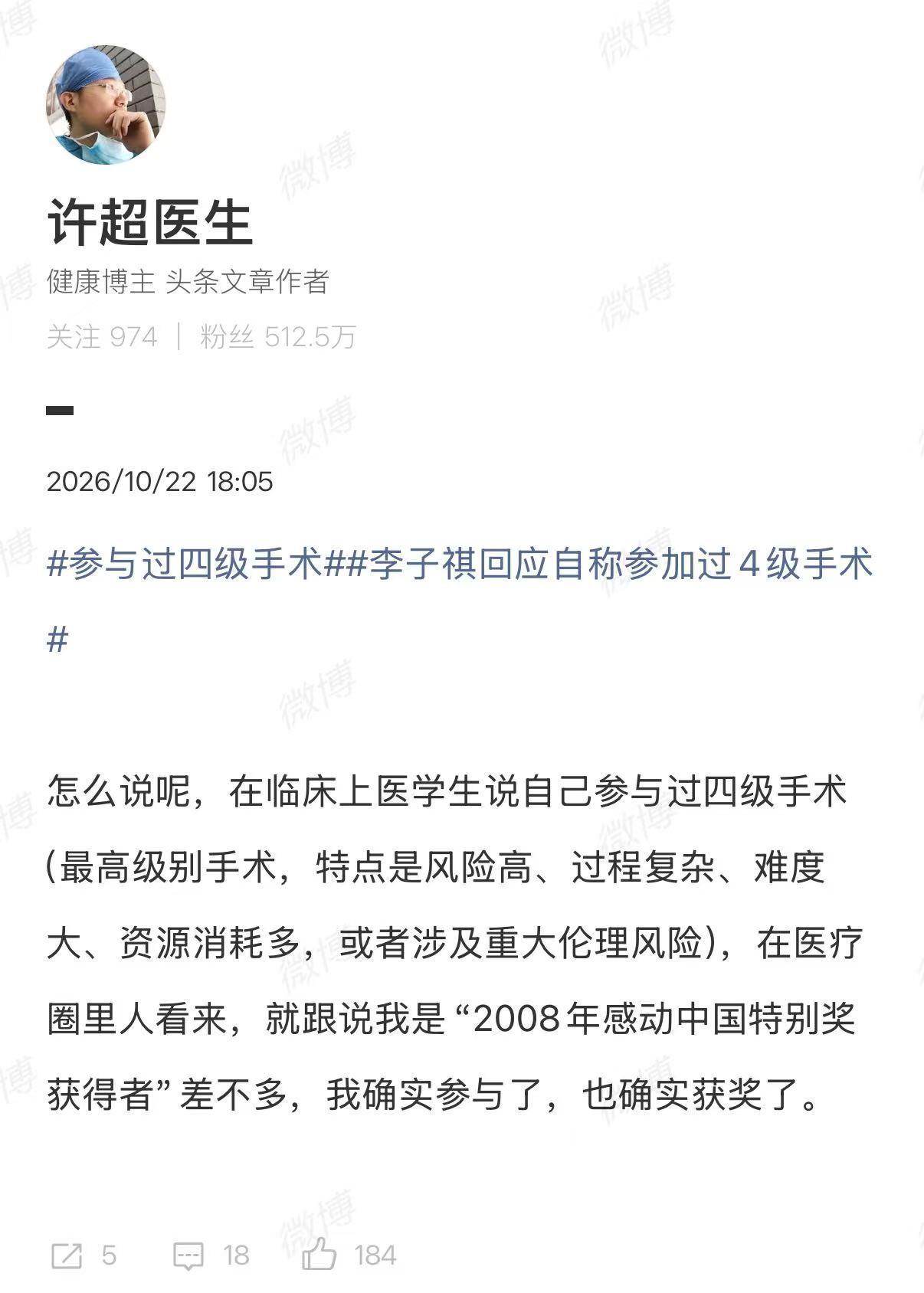
That is the part working doctors found hardest to swallow. Grade-4 surgery demands years of specialized training and formal authorization to lead; a trainee "participating" is an assistant, not a surgeon. On Thursday, Dr. Xu Chao, a health blogger with more than five million followers, offered the profession's verdict with a joke that spread widely: for a medical student to say he participated in grade-4 surgery is, to anyone in medicine, "about the same as saying you're a recipient of the 2008 Touch China special award — you really did take part, and you really did win."
The show's origins made the friction sharper. "The Exciting Offer" is a workplace-observation franchise that once tracked aspiring lawyers and returns to medicine after five years, promising viewers they would "see the weight of being a doctor." Instead, its first episodes delivered a contestant who flinched at clinical basics while carrying an impressive paper trail — and medical students reacted with what Chinese internet slang calls heartburn. A post from the newspaper itself carrying the critique drew more than 7,000 likes within hours, and the story pushed four separate entries onto Baidu's trending board, including one titled "This medical variety show has enraged the medical profession."
Li Ziqi's university, Fujian Medical University, moved quickly to contain the damage, saying his remark about skipping clinical work during his doctorate was a misstatement and that he had in fact completed eighteen months of clinical rotations; the school's discipline committee said it had received no reports of academic fraud.
The editorial's deeper argument was about how the profession is sold to the public. Real clinical training, it said, is case notes, night shifts and rotations — unglamorous "dumb work" that cameras don't favor — while a glossy edit can manufacture the illusion that doctors are speed-crafted from high grades and publication counts. The paper's standard for who deserves the lens was quietly demanding: not an all-powerful "great god," but someone who treats every uncertain judgment as if standing over an abyss. The show can chase ratings, the commentary concluded, but the trust between doctor and patient rests on a plain belief — that the person across the desk takes a life seriously — and that trust cannot be worn away by entertainment.