Family Financial Transparency: A Cautionary Tale
Title: Revealing Personal Wealth: A Cautionary Tale
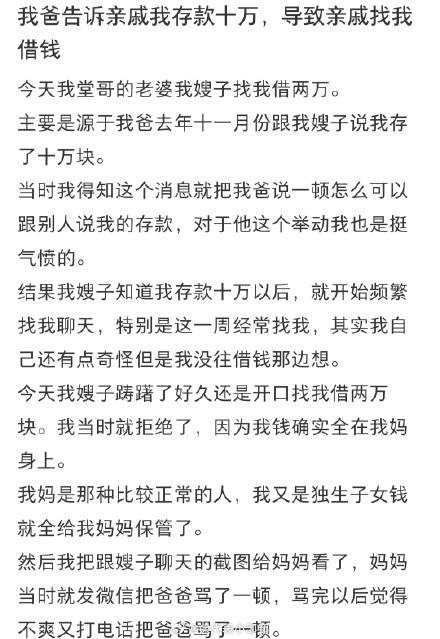
A recent social media post about a father disclosing his son's savings to relatives has sparked a wave of reactions and discussions on Weibo, with many questioning the father's decision and advising against sharing personal financial information.
The original post, shared by the son, detailed how his father revealed to their extended family that his son had saved 100,000 RMB (around $15,000) in the bank. This revelation led to several family members approaching the son to borrow money, causing embarrassment and frustration for the young man.
Weibo users expressed their surprise and disbelief at the father's decision to share his son's financial information, with many pointing out that such disclosure is not only unnecessary but can also lead to undesirable consequences.
One user commented, "I don't understand why parents feel the need to tell relatives about their children's savings. It's not like it's a large sum of money that everyone can share. Personal finances should be kept private."
Another user shared their advice, "Do not talk about your savings with others, especially with those who might take advantage of the information. Keep your financial matters to yourself."
Some users criticized the extended family members for expecting the son to lend them money just because they knew about his savings. They emphasized the importance of responsible borrowing and repayment, as well as the need to maintain healthy financial boundaries with relatives.
The story also prompted discussions on financial wisdom and the importance of protecting one's personal wealth. Many users shared their own money-saving tips and habits, offering advice on how to manage and grow personal savings.
One user discussed the concept of "storing your wealth" or "keeping your money low-key." They emphasized the importance of not flaunting one's financial success and keeping personal wealth under wraps to avoid attracting unwanted attention from opportunistic relatives or friends.
Another user shared a popular method of dividing income into three portions: one for essential living expenses, one for savings, and one for discretionary spending, with a strong emphasis on building up savings.
As the discussion continued, some users highlighted the importance of seeking financial advice and education to make informed decisions about managing personal wealth. Many recommended checking out reputable online resources or consulting with financial professionals to learn more about saving, investing, and budgeting.
The father's decision to share his son's savings information with their extended family has drawn strong criticism and opened up an important conversation about the dangers of oversharing personal financial information. As one Weibo user put it, "Before you discuss your savings with others, ask yourself: 'Is this really necessary?' If not, it's better to keep your financial matters to yourself."
As this case demonstrates, being transparent about one's personal wealth can have unintended consequences, provoking unwanted borrowing requests from relatives or even leading to potential financial exploitation. As such, it is crucial for individuals to maintain discretion in their financial dealings and prioritize the protection of their personal wealth.
In conclusion, the recent Weibo post serves as a reminder of the importance of maintaining financial privacy and the potential dangers of oversharing personal wealth information. It highlights the need for responsible financial management and the critical role that confidentiality plays in safeguarding one's financial future.
As the old adage goes, "A penny saved is a penny earned"—and one might add, "A penny kept private is a penny protected."