A Man Forgot a 10,000-Yuan Deposit for 30 Years, and a Court Says the Bank Still Has to Pay
A Henan court has ordered a bank to repay a 10,000-yuan fixed deposit made in December 1995 and forgotten for thirty years, rejecting the statute-of-limitations defence and ordering interest paid in segments — the agreed rate for the certificate's term, then demand rates for the decades since.
A county court in Henan has ordered a bank to honour a fixed deposit its customer made in December 1995 and then forgot about for thirty years — a ruling that ends one man's long wait, and a small lesson in what a bank certificate actually promises.
The man, a Mr Li from Neixiang county, deposited 10,000 yuan on 9 December 1995 at what was then a local credit cooperative, taking a one-year certificate at a monthly interest rate of 9.15 thousandths — more than 10 percent a year, a figure that dwarfs anything Chinese savers see today — and, by his own account, simply forgot it existed. He resurfaced the certificate this February while sorting through old papers after a stay in hospital. When he took it to the bank in March, staff confirmed the deposit had never been reported lost and never withdrawn, but said that after so many years the interest could not be calculated, and suggested he take the matter to court.
The bank fought back with two arguments that will sound familiar to anyone who has contested an old contract. It claimed the statute of limitations had run out, and that even if the certificate stood, it could only pay demand-deposit rates from December 1996 onward. It also noted the institution had been restructured so many times since the mid-nineties that its 1995 archives were still being searched — with a reservation that if the records ever showed the money had been paid out, it reserved the right to claw the sum back.
The Neixiang County People's Court, which issued its first-instance verdict at the end of August, rejected the substance of all that. The deposit contract, it held, was legally formed and binding on both parties, and the bank has a statutory duty to repay principal and interest. The ruling, first reported by Hongxing News, orders the bank to return the 10,000 yuan and pay interest in segments: the agreed fixed rate for the certificate's one-year term, then the much lower demand-deposit rates, year by year, for the decades since.
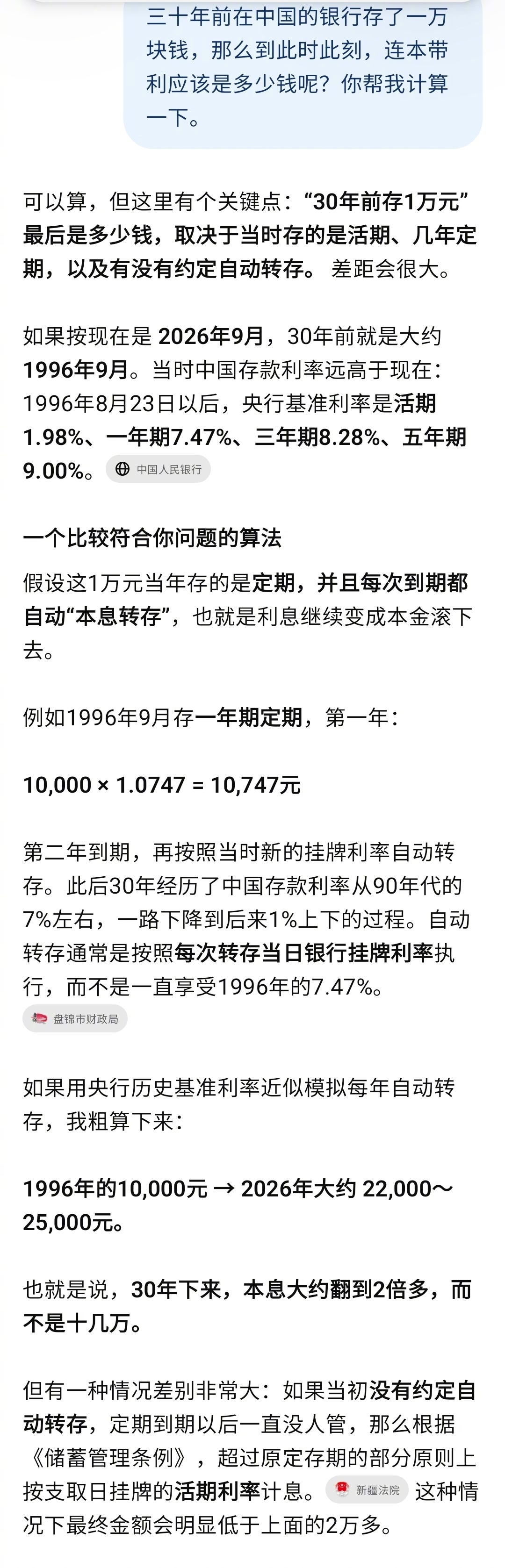
The verdict's release this week sent the case up Baidu's trending board — "the court has ruled" — and set off a burst of arithmetic on Weibo. Commenters conjured fantasies of nineties compound interest, in which double-digit rates roll over for thirty years; a screenshot circulating on Weibo showed an AI assistant patiently explaining that even with automatic renewal the certificate would come to roughly 22,000–25,000 yuan today, not the hundreds of thousands some had imagined. The reality is blunter: without an auto-renewal instruction on file, a matured certificate earns demand rates, a detail summary posts have been flagging as the actual lesson — dig out your old certificates, and set the rollover.
What the case quietly establishes is more durable than the internet's interest calculations. A paper certificate from a credit cooperative that no longer exists, carried through multiple restructurings, still binds the bank that inherited it — a deposit does not expire. Whether the segment-based payout adds up to anything like what 10,000 yuan bought in 1995 is a different question, and the one part of the story no court can fix.