The Studio Behind 'Small Town Remedy' Is Suing Its Loudest Critic
Ningmeng Film & TV, the producer of the hit Chinese medical drama 'Small Town Remedy', has filed a defamation suit against the doctor-turned-blogger 'White Coat Mountain Cat' — reopening the question of where criticism of a TV show ends and an attack on a company begins.
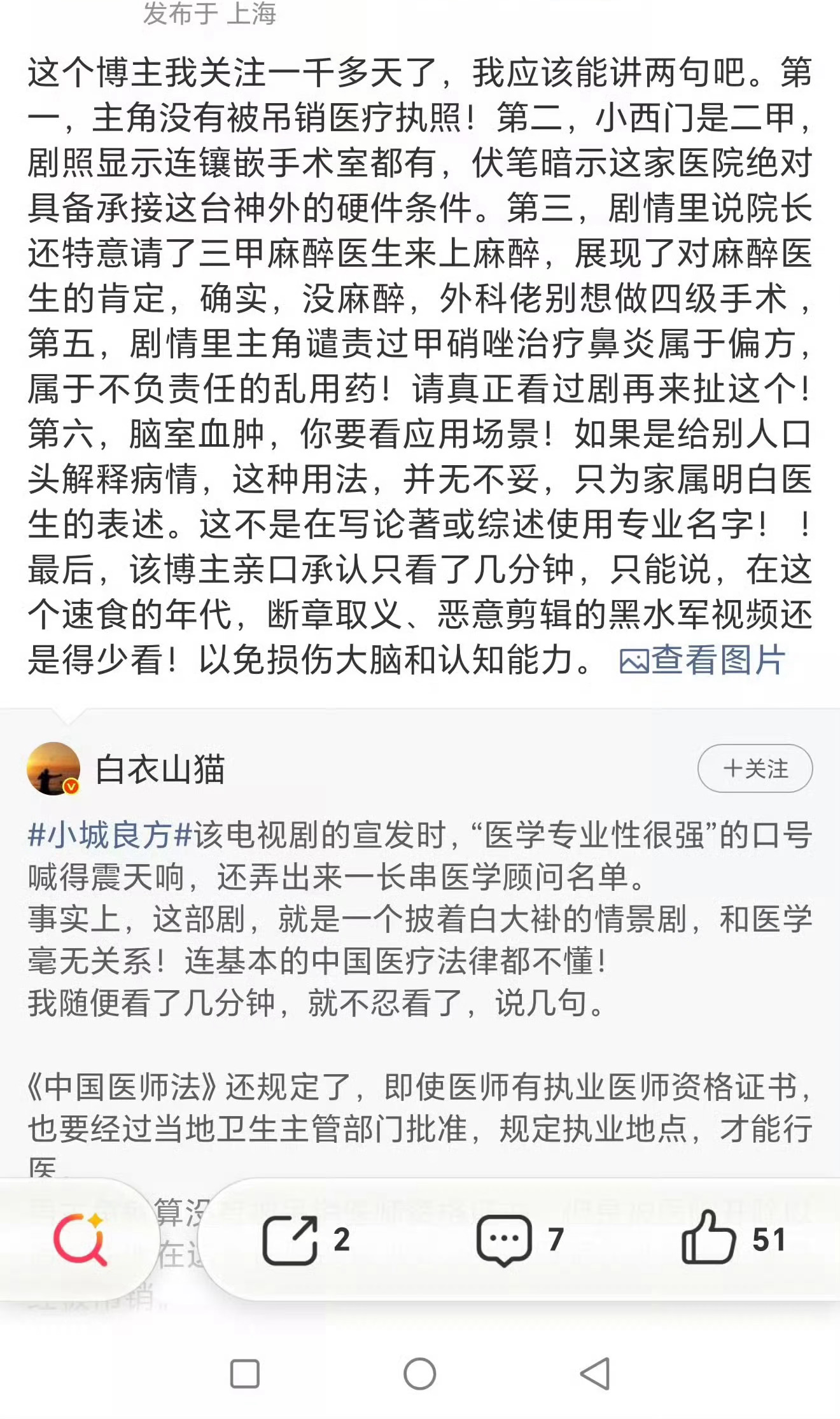
Less than a month after viewers began putting it frame by frame on trial, the Chinese medical drama 'Small Town Remedy' (《小城良方》) has gone on the offensive. On October 30, Beijing Xingquan Law Firm announced it had formally started a defamation suit on behalf of Shanghai-based producer Ningmeng Film & TV against a Weibo user posting as "White Coat Mountain Cat" (白衣山猫), a verified account run by a blogger who presents himself as a former doctor and has been among the show's most persistent critics.
The law firm's notice says the user published "false statements" that misled viewers about the drama's plot and "value orientation", damaged the show's reputation, and caused Ningmeng's commercial credibility to fall. Because the defendant is a pseudonymous account, the firm has submitted case-filing materials and will pursue the named individual once the court orders the platform to disclose their identity — then seek a public apology and damages. It added that it is "continuing to monitor" other accounts, an implicit warning that this may not be the last critic served. The drama's official account reposted the notice with the message "Rights protection continues ✊ — everyone's welcome to discuss rationally and enjoy the show" (维权继续中✊,欢迎大家理性讨论,快乐追剧~), a post that drew more than 49,000 likes.
The show itself is a county-hospital drama that won its audience by taking medical detail seriously — and, as with the brand-financed free screenings that kept it at the top of the ratings, that very seriousness made it a target. 'Small Town Remedy' has been picked apart over hospital-grading rules, anesthesiology procedure and clinical terminology, and the suit alleges the critic watched only minutes of footage before writing a sweeping indictment. One Weibo user sympathetic to the studio argued that "the bigger the account, the more carefully that reach should be used — no person, and no work, should be wronged", noting that practising doctors without large followings rarely get their corrections seen at all.
The legal debate is where the story gets interesting for anyone watching Chinese internet speech. Li Zhenwu, an entertainment-law commentator who had publicly urged viewers to go easy on the show, said he was nonetheless "a little surprised" by the suit, and his widely read analysis frames what is at stake. Chinese courts, he noted, treat a company's defamation claims with extreme caution: a corporation has no personal dignity to injure, only commercial goodwill, and a TV drama — a work of creative expression — must tolerate an especially wide range of commentary, complaint and professional nitpicking. What turns criticism into a potential tort, in his view, is the slide from "this scene is wrong" to "the studio deliberately faked it to fool audiences" — judging a work is protected; defining a company's intent as fraud is not. He condensed the line he hopes the case will draw as: criticize the drama, not the people; the work, not the company (对剧不对人,对作品不对企业).
Whether a court agrees will now be tested in earnest. Either way, the suit is set to become a reference point for the loose boundary every Chinese industry drama — and every critic with a large audience — has been navigating: how hard a hit show can be hit, and by whom.