Frame by Frame: Chinese Viewers Are Putting Their Hit Dramas on Trial
A viral clip of a TV doctor grinding antibiotics into nasal powder has China arguing over 'frame-by-frame trials' — the forensic viewing culture that can make or break a drama, and that productions now answer with 76-person medical consultant rosters.
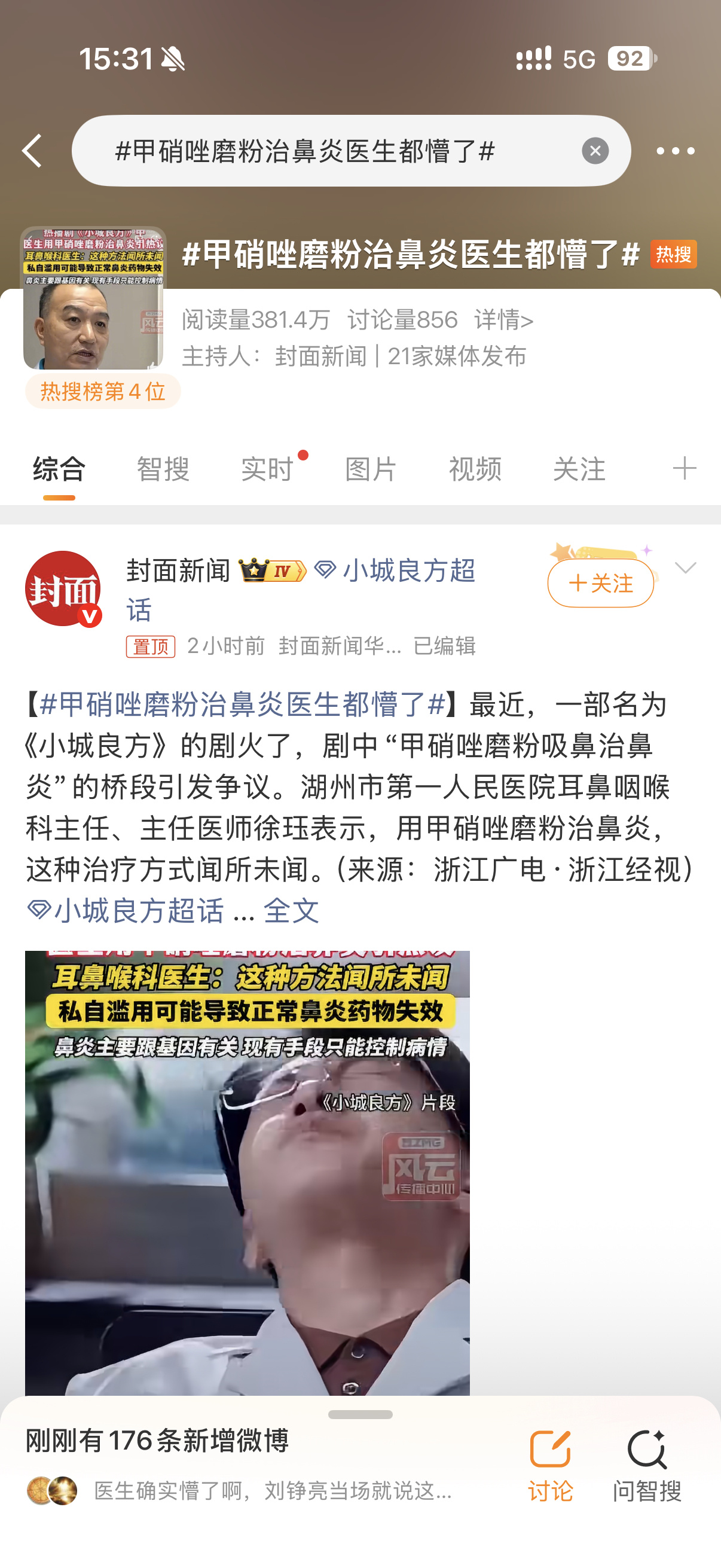
The clip that set off the week's argument lasts a few seconds. In an episode of "The Small Town Remedy" (《小城良方》), a doctor grinds metronidazole tablets into a powder and treats a patient's rhinitis with it. Asked for a professional verdict, Xu Jue, an ear, nose and throat chief physician at a Huzhou hospital, gave one: "I have never heard of such a treatment." Her bafflement became a trending topic of its own — metronidazole powder for rhinitis, "even the doctors are baffled" (甲硝唑磨粉治鼻炎医生都懵了).
The show at the centre of it is the season's biggest hit, a CCTV-8 medical drama starring Xiao Zhan, and by Friday its most litigated text. Its defenders point to what the clip leaves out. The powder scene is staged as a cautionary tale inside a subplot about dangerous folk remedies, in which an old man who trusts them ends up with a bacterial infection. "A crowd of people who never watched the show are piling on with out-of-context cuts," one viewer wrote in a post liked more than a thousand times.
The production's armour is visible because it was built for exactly this kind of inspection: 76 consultants from top-tier hospitals, including Beijing Tiantan and Peking University International Hospital, vetted the procedures, and a Tiantan neurosurgeon judged the surgery scenes "pretty well done." Fudan University's obstetrics hospital endorsed the series with a pun — "no melodrama, all heart" (不烧心,纯走心) — in a roundup of doctors' verdicts posted Friday. State-broadcaster commentary offered the line now quoted on both sides of the fight: "Seeking truth is precious; judgment has its limits" (求真可贵,审判有度).
The scrutiny has a name in Chinese fan discourse — "frame-by-frame trial" (逐帧审判) — and it is now a condition of making television in China. Productions anticipate the pause-button juries with consultant rosters. The same show's ninth-episode plot about an ant-farming scheme was recognised, rightly, as one of the cruellest frauds in modern Chinese memory. The same frame-checkers sank a medical reality show last month after its trainee doctors fumbled scan readings and surgical knots. Even Xu Jue's debunking was itself clipped and recirculated as ammunition.
Costume dramas are tried by the same jury on aesthetics. Actress Meng Ziyi used an interview this week to admit that her Tang-court romance "Princess Shang" had underperformed: "Even now, we all have regrets. We all think the show deserved better," she said, after choking up during a promotional livestream. The towering hairpiece that got her mocked frame by frame had become her own punchline by then. Her defenders argue she is being judged by a hostile pre-load — the "industrial sweetness" marketing that was the flop's core complaint last week — and that her performance stands on its own once the noise is stripped away.
There is a counterexample worth naming. On Zhihu, the most-discussed question about "The Small Town Remedy" this week was not the powder at all but a single line about funerals — "funerals are held for the living" — and what it says about how China mourns. Scrutiny, aimed well, sometimes lands on what a show is actually about.
A screenshot circulating with one fan's post showed the metronidazole topic ranked fourth on Weibo's hot list, with 3.8 million reads. The show, the same day, crossed 300 million streams.