Intel's Worst Day Since 1974 Wipes Out Nearly $150 Billion and Drags the Chip Sector Down With It
Intel's weak profit guidance triggered the largest single-day share fall in the chipmaker's modern history — erasing nearly $150 billion in market value and dragging the global semiconductor sector down with it — while Chinese investors watched their own tech-heavy market sink in sympathy.
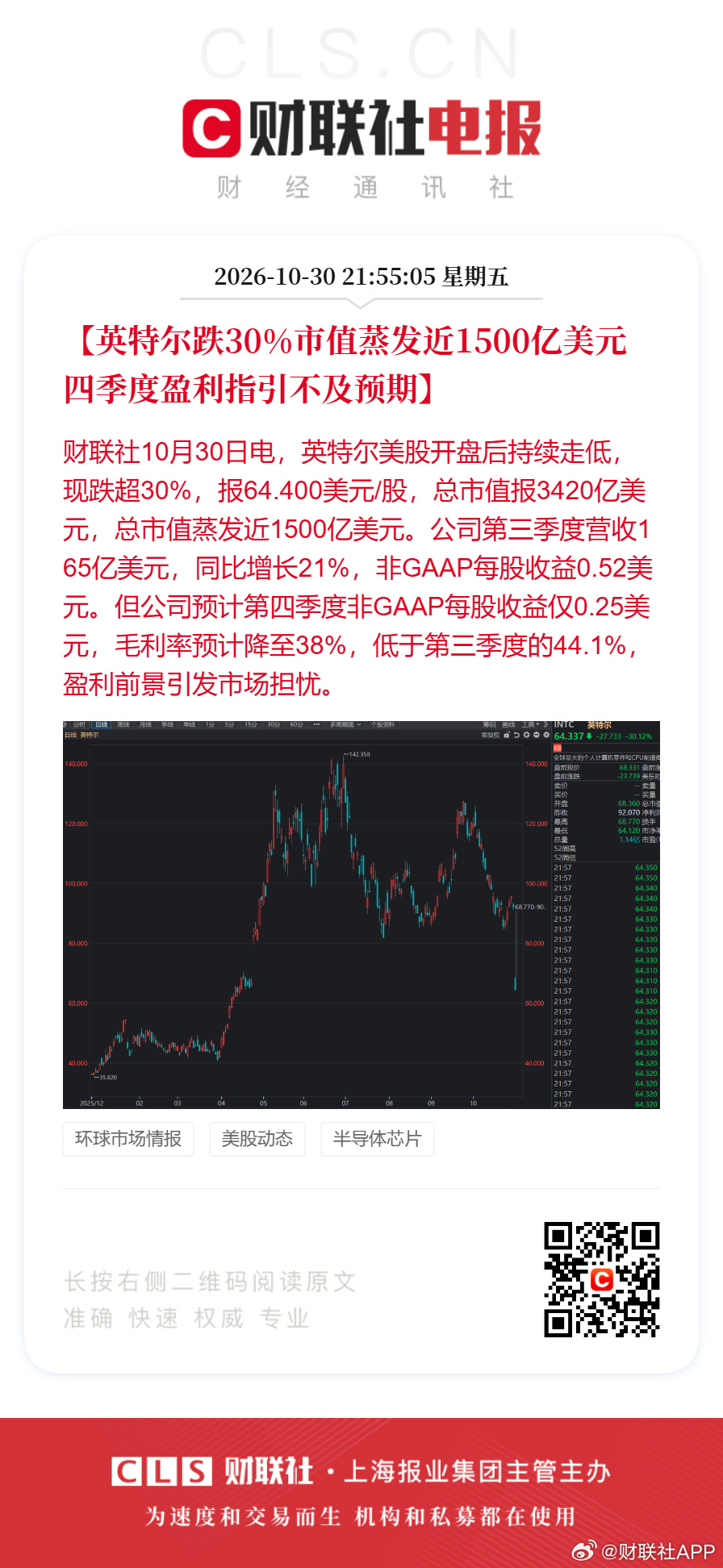
Intel has had bad days before. It had not had one like this. The chipmaker's shares fell more than 30 percent at one point during the session of October 30 — on track to be the company's largest single-day drop since 1974 — after weak profit guidance convinced investors that the AI boom's spending wave is not lifting the companies that make the ordinary chips of the PC era. Nearly $150 billion of market value disappeared.
The trigger was an earnings report with good news in it. Third-quarter revenue of $16.5 billion was up 21 percent from a year earlier, and the quarter's non-GAAP earnings per share came in at $0.52. The problem was the outlook: Intel guided fourth-quarter earnings down to $0.25 a share and told investors to expect gross margins to fall from 44.1 percent to 38 percent. Financial news service Yicai, citing the company, reported that revenue at Intel's client-computing and physical AI division had fallen 5 percent year on year to $8.1 billion — the PC market, still the company's core business, is slowing.
The selling did not stay contained. The Philadelphia Semiconductor Index closed down 7.20 percent. AMD fell 10.88 percent, Qualcomm 11.30 percent, Arm 10.70 percent, SanDisk 11 percent, and SK Hynix 7.95 percent, with equipment makers Applied Materials and Lam Research each down more than 6 percent. At the closing bell, the Dow was down 1.09 percent, the S&P 500 1.82 percent and the Nasdaq 2.86 percent.
"Even during the internet bubble or the 1970s, Intel had never seen a drop like this," as one finance-focused Weibo account put it, in a post that captured how far the story has travelled into Chinese market commentary.
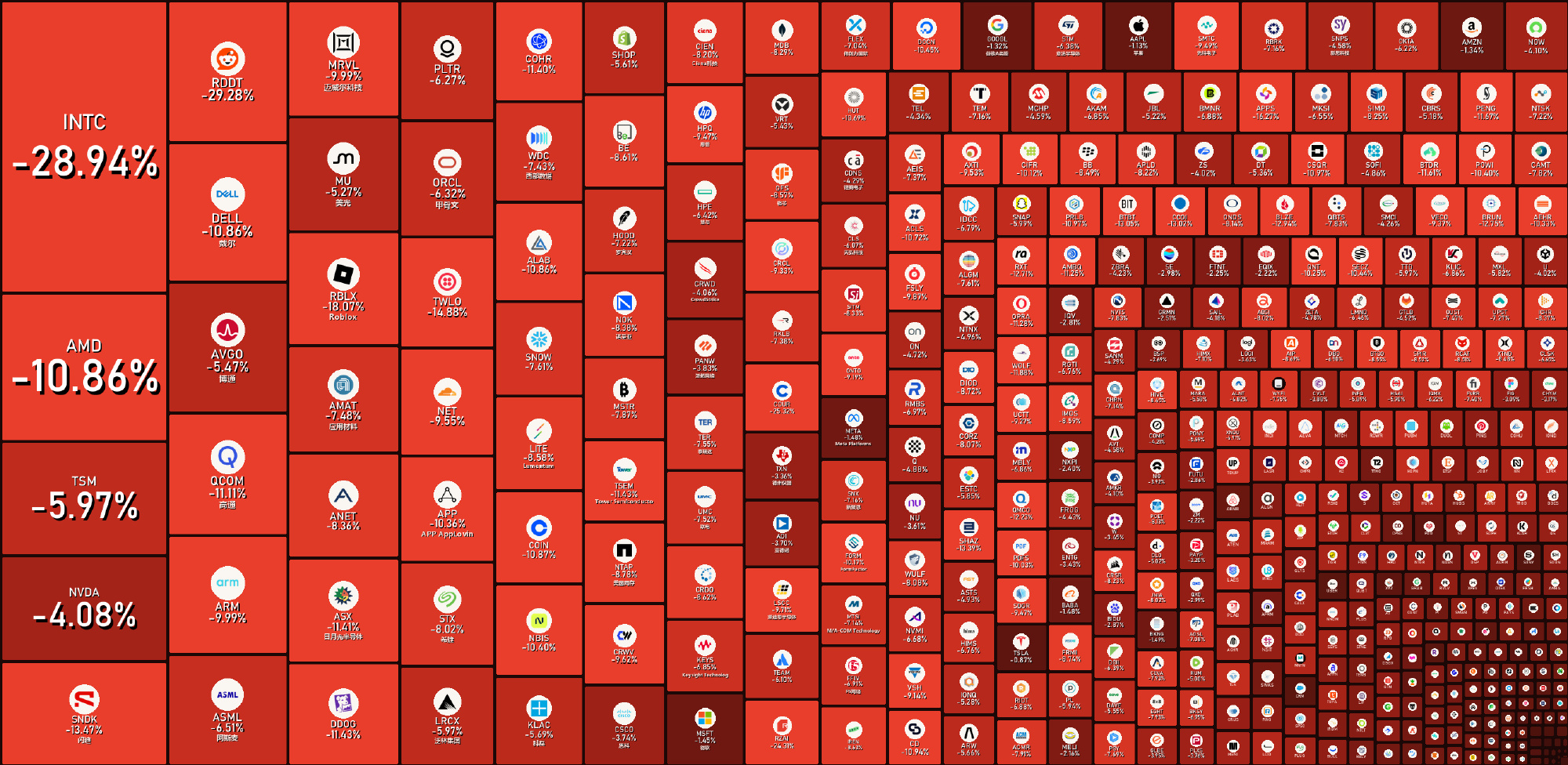
The rout, in one widely shared summary, has wiped close to $1 trillion from American AI-linked stocks in 48 hours: Intel down 32.9 percent at its session low, Alphabet down 14.5 percent after its own earnings disappointed, Amazon down 10 percent. The common thread, the same post argued, is investor doubt that the hundreds of billions big tech is pouring into AI infrastructure can generate enough cash to justify itself.
For Chinese investors, the alarm is not secondhand. On the same day, China's A-share market opened low and sank through the afternoon, with the ChiNext index down more than 4 percent, the STAR 50 down more than 5 percent and more than 4,500 stocks in the red — a slide Baidu's search board attributed directly to US tech weakness and third-quarter earnings disappointments. It caps a brutal month: China's tech boards ended October down more than 23 percent, the worst stretch for the AI trade this year.
This was also the second act of Intel's own drama: the stock had already plunged more than 20 percent two days earlier on the same guidance.
The question both markets are now asking is whether this is a pause or an unwind. A question on Zhihu asking how to read the Intel collapse sits near the top of the site's trending board, alongside another asking what it means that Amazon's free cash flow is "burning through" and Google's profit is falling all at once. The next set of earnings — not the next viral post — will answer it.