Hangzhou Police Say the Viral Elevator Harassment Video Was a Neighbor Dispute
Binjiang police reviewed the full surveillance video and said a woman's viral claim that a neighbor molested and beat her in an elevator 'did not match the facts.' She is now under investigation for spreading false information.
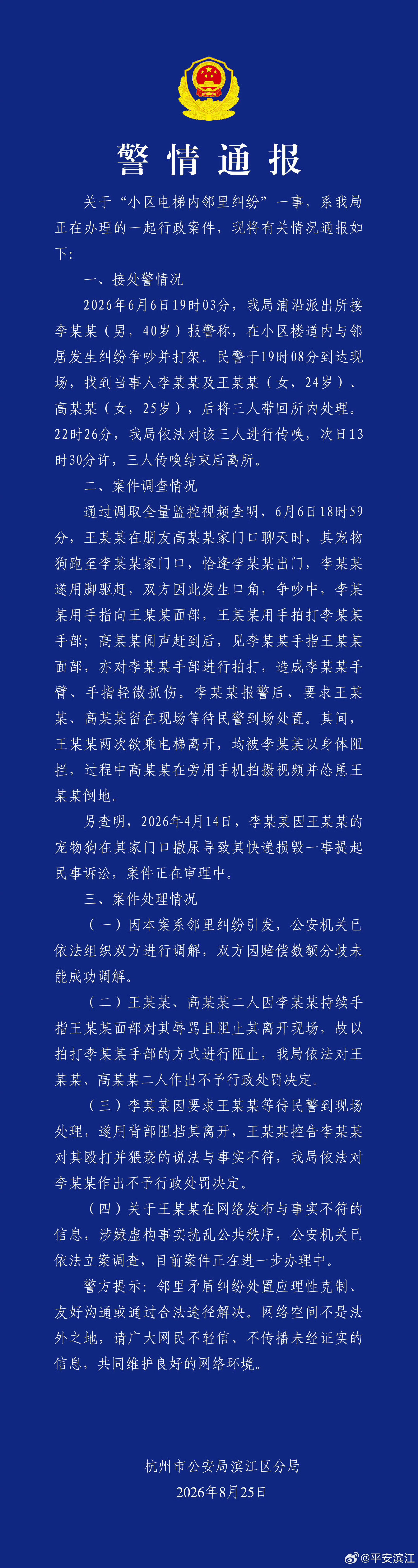
The woman at the center of Hangzhou's viral elevator-harassment video was not groped or beaten in that elevator, according to a police review released August 25. In a one-page statement, the Binjiang district police said the two-minute confrontation was a dispute between neighbors that escalated as each side tried to stop the other from leaving—not the assault the video's account described. The clarification flips a case this site reported on earlier from victim story to misinformation case.
The official account is cramped and specific. On the evening of June 6, a 40-year-old man surnamed Li and two women, 24-year-old Wang and 25-year-old Gao, clashed in a residential hallway. Police arrived and took the three in for questioning overnight. After reviewing "the entire surveillance video," investigators described a loop of provocation and obstruction: Li repeatedly pointed at Wang's face and insulted her while blocking her exit, and the two women pushed and slapped at Li's hand to make him stop. When Li wanted them to wait for the officers, he blocked the doorway with his back. The police statement concluded plainly that, on that evidence, Wang's claim that Li beat and molested her "did not match the facts". Neither side was punished for the scuffle itself, the statement said. Wang is now under investigation for publishing false information—a possible public-order offense.
That was not the story Weibo had been telling. In the earlier, widely shared video, Wang described being harassed in the elevator and then left with the sense that the police had sided against her. The claim drew the scorn of commentators almost immediately, some of whom reconstructed a messier backstory in which an unleashed dog had relieved itself on Li's packages. The police did not confirm that version, but their narrower findings were enough to change the conversation. As one post put it, an elevator is among the most heavily surveilled spaces in any building: if the cameras show no molestation, then the molestation is not there, and people who have been fooled before now want the other side of the story before they join the next rallying cry.
The reversal matters beyond one hallway. It is the latest cycle in a recurring Chinese public debate about xiaozuowen—"little essays," the derisive term for a viral first-person accusation that presents itself as evidence. When such a post is later contradicted by cameras, documents, or other testimony, the platform's sympathy redistributes itself with punitive speed. The woman has gone from survivor to suspect, and the same users who demanded the neighbor be punished are now demanding she be. In Hangzhou, the cameras have spoken; the public case resumes against the person who first addressed them.