Historic Zhijiang Surrender Desk Takes Center Stage in China’s 80th‑Anniversary Commemorations
The modest nine‑drawer desk that now sits behind glass at the Memorial Hall of the Chinese People’s War of Resistance Against Japanese Aggression and Victory tells a story that is both intimate and monumental. On 21 August 1945, in the small Hunan town of Zhijiang, the desk bore silent witness to the formal surrender of Japanese forces that had occupied China for eight brutal years. That single piece of furniture, once a functional work surface in a local yarn factory, has become a rare, tangible link to a moment the nation still marks with reverence.
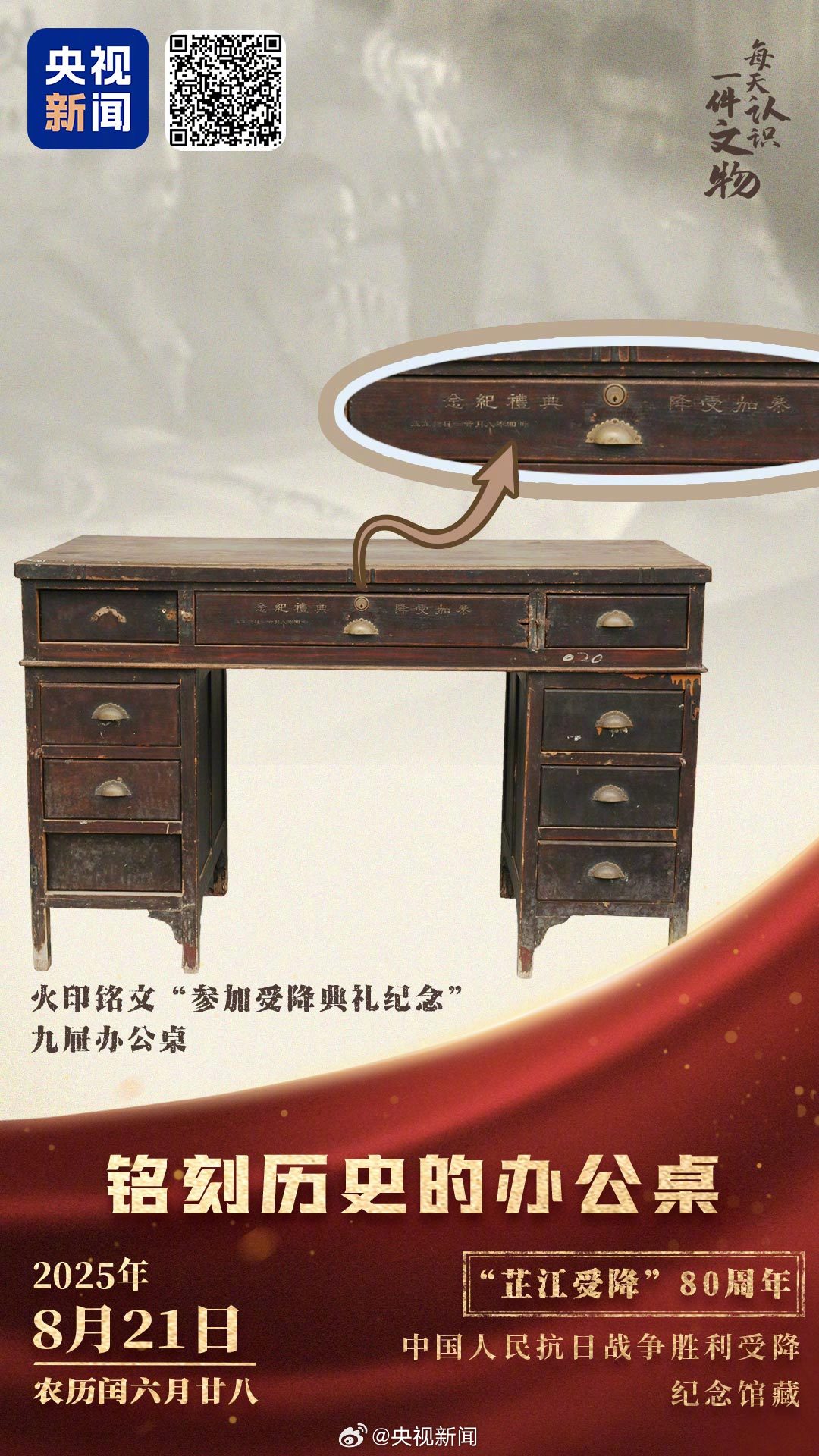
When the Japanese delegation arrived in Zhijiang to sign the surrender order memorandum, Chinese officials had to improvise a setting for the historic ceremony. The nearest suitable venue was the Anjiang Yarn Factory, a modest industrial complex that, on that summer afternoon, opened its doors to the proceedings. Among the items borrowed from the factory was the nine‑drawer desk that would later be christened “the desk of the Zhijiang surrender.” After the ink was dry and the flags lowered, the factory’s owners were asked to retrieve their furniture. In the process, a fire‑engraved mark was added to the desk’s surface, and the owner’s name was recorded alongside an inscription that reads, in Chinese, “参加受降典礼纪念” – “Commemorating participation in the surrender ceremony” – and the date “卅四年八月廿一日于芷江” – “August 21, 1945, in Zhijiang.”
What makes this artifact unique is not merely its age or its association with a pivotal event, but the fact that it is the only surviving piece of furniture from the ceremony that still bears those words. Most of the other tables, chairs and crates that surrounded the signing have long since been repurposed, melted down or lost to the ravages of time. The desk’s preservation was largely accidental: after the war, it was returned to its owner, who kept it in the family’s possession for decades before it entered the museum’s collection. Today, visitors can see the faint burn marks, the faded characters, and the polished grain of a desk that once supported the pens of generals and envoys.
In recent weeks the desk has resurfaced on Chinese social media, especially on Weibo, where official accounts and history enthusiasts alike have shared photographs, short videos and a flurry of hashtags. The post that sparked the most engagement was tagged #抗战胜利80周年, marking the 80th anniversary of the victory over Japan, and #文化中国行文博日历, part of a broader “Cultural China Tour” designed to bring museum treasures into the public eye. The accompanying role as a concrete reminder of the sacrifices made during the war and the importance of “铭记历史” – “remembering history.” The tone is uniformly respectful, educational and patriotic; there is no controversy or debate, only a collective nod to a shared past.
Public reaction has been predictable in its unanimity. Users post reverent comments such as “A piece of our nation’s soul,” “From the factory floor to the pages of history,” and “Every scratch tells a story of resilience.” The emphasis is on the desk’s function as a bridge between ordinary citizens – the workers who built and used it – and the grand sweep of national destiny. By foregrounding the simple object, the posts invite viewers to contemplate how everyday life intertwines with historic events, an angle that resonates with younger audiences who might otherwise feel detached from the distant past.
The desk’s resurgence also underscores a broader trend in China’s cultural policy: the systematic elevation of material culture as a means of reinforcing national identity. By integrating artifacts like this desk into commemorative campaigns, museums and state media are crafting a narrative that blends scholarship with sentiment, ensuring that the victory of the War of Resistance remains vivid in the public imagination. The desk’s inscription, translated variously as “This desk bore witness to the victory of the War of Resistance” or “This desk is a testament to the moment of victory in the War of Resistance,” captures that dual purpose. It is both a factual record and a symbolic promise to future generations that the hardships endured will not be forgotten.
For foreign observers, the desk offers a concrete entry point into a chapter of World War II history that is often eclipsed by the European theater. While the surrender in Tokyo on 2 September 1945 marked the official end of hostilities, the Zhijiang ceremony preceded it by weeks and reflected the unique dynamics of China’s long, drawn‑out struggle against Japanese invasion. The fact that a piece of factory furniture was elevated to the center of a diplomatic act illustrates how resourceful Chinese commanders had to be in the war’s closing months, and how the everyday was inextricably bound up with the.
As the desk continues to draw curious travelers in Wuhan, where the Memorial Hall is located, scholars are planning a more detailed study of its provenance, the fire‑engraving technique used to mark the surrender, and the broader network of objects that accompanied the Zhijiang ceremony. Such research could shed light on the logistics of wartime surrender protocols, the interaction between military and civilian sectors, and the ways in which material culture preserves memory. Until then, the desk remains a silent, sturdy witness—its drawers still empty, its surface still scarred, its story still being retold.
In an age where digital archives and virtual reality reconstructions dominate historical storytelling, the physical presence of this nine‑drawer desk reminds us that history can be held, touched, and examined in the flesh. It stands as a modest yet powerful testament to a nation's endurance, a reminder that even the most unassuming objects can become emblematic of triumph over oppression. The desk does not merely commemorate a date; it embodies a moment when a war‑torn country reclaimed its agency, and it invites every visitor to remember, reflect, and, perhaps, to feel a fraction of that resolve themselves.