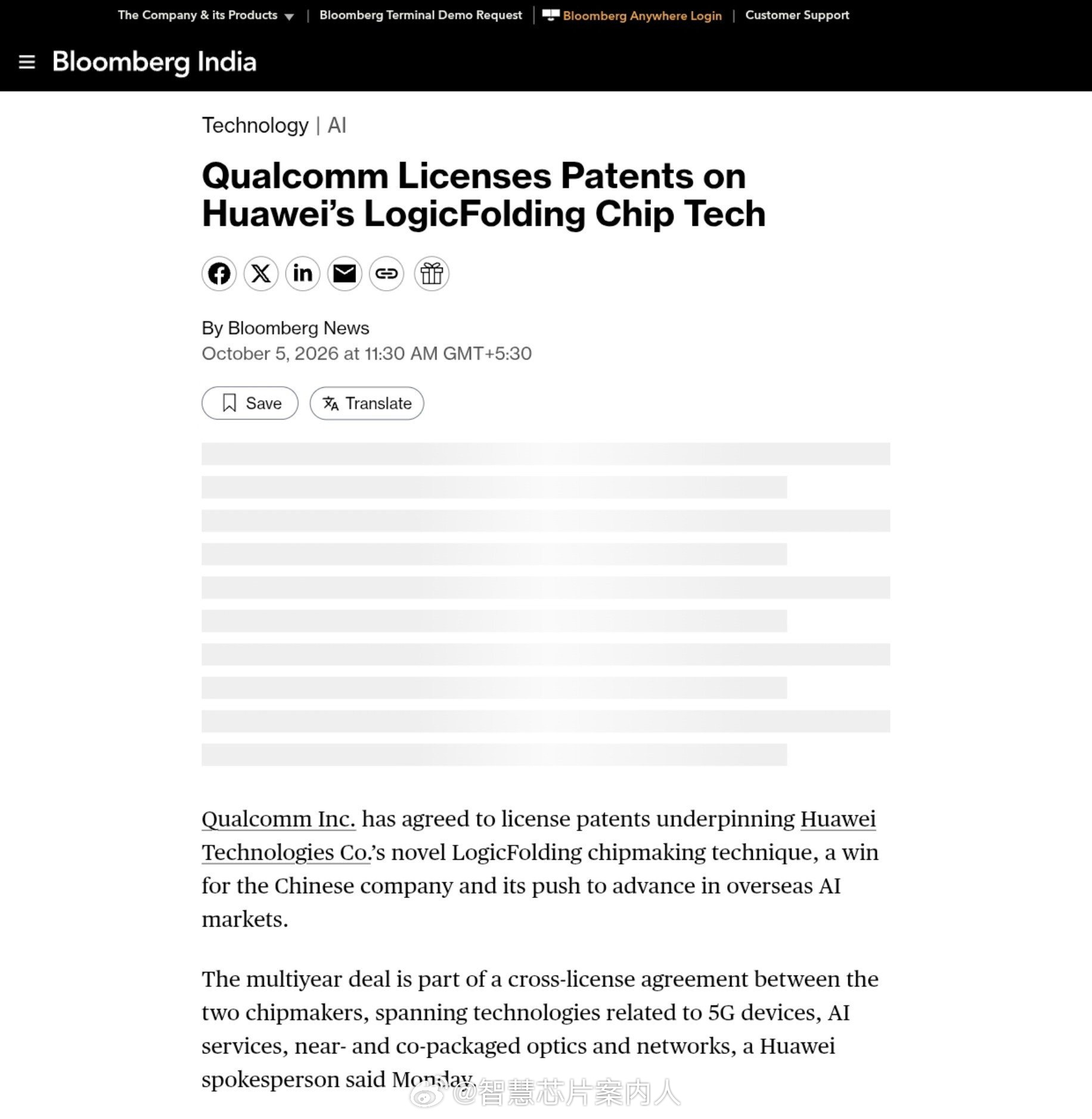
Qualcomm Pays Huawei for the First Time in a Broad Patent Cross-License
The two companies announced a multi-year cross-license over 5G, computing and AI patents on Monday, with Qualcomm buying a package of Huawei's US patents. The deal restores no chip sales, but it marks a shift in who pays whom.
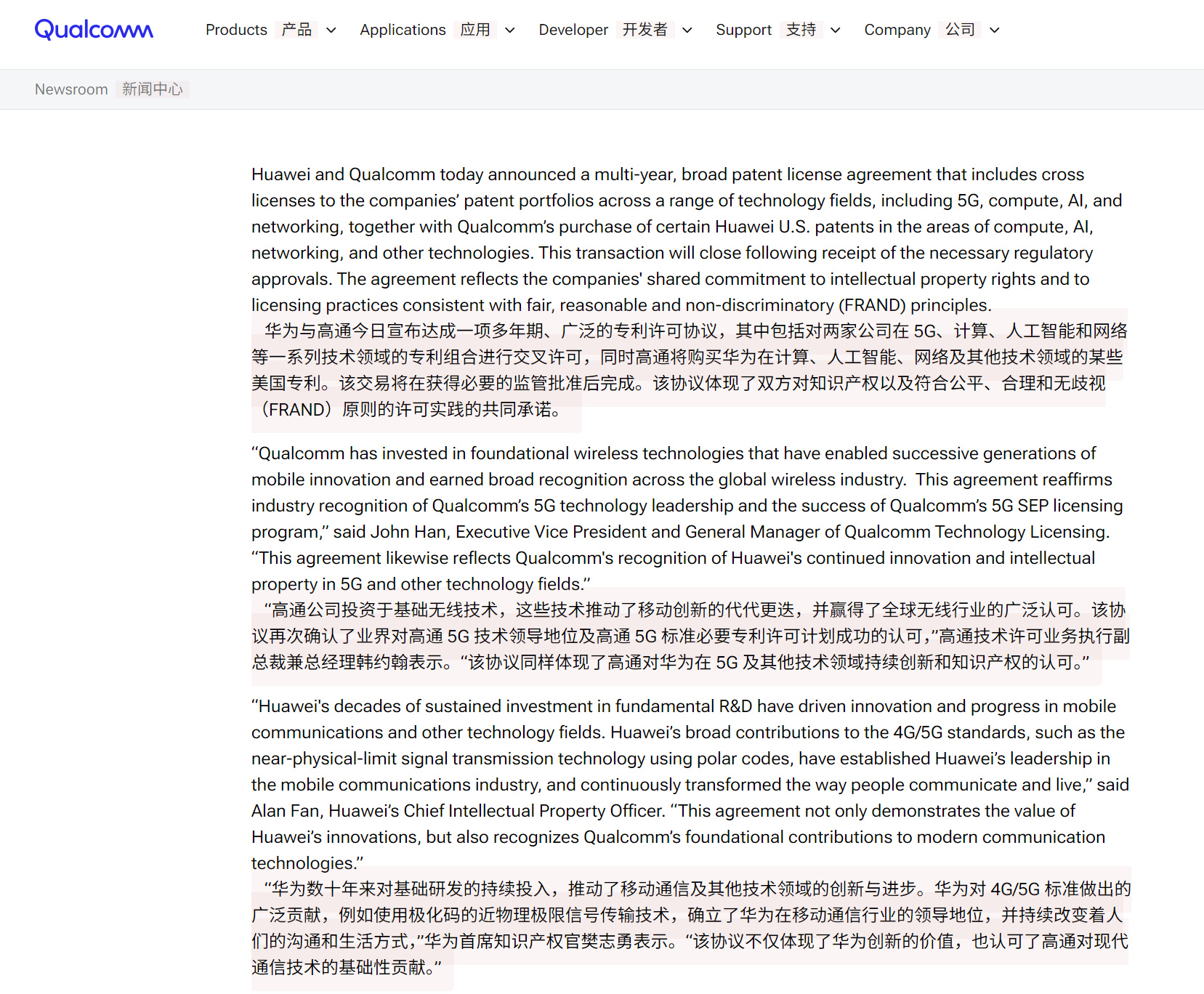
The announcement went up on both companies' official accounts within minutes of each other on Monday: Huawei and Qualcomm have signed a multi-year, wide-ranging patent cross-license covering their portfolios in 5G, computing, artificial intelligence and networking, and including Qualcomm's purchase of a package of Huawei's United States patents. The deal still needs regulatory approval before it takes effect.
Its most striking feature, Chinese tech commentators noted within the hour, is the direction of the money. US export controls have barred Qualcomm from selling chips to Huawei since 2020, and Huawei answered by designing its own processors around domestic fabrication, an arrangement that looked like the end of the two companies' commercial entanglement. Patent licensing, it turns out, runs on a separate track from chip supply, and Huawei's portfolio has grown valuable enough that a summary circulating on Weibo put the news in one line: Qualcomm is paying Huawei for the first time, and buying patents rather than selling them.
What exactly Huawei is being paid for matters as much as the payment. Bloomberg reported that the license extends to Huawei's "logic-folding" technology, the chip-stacking approach at the heart of the company's silicon strategy: a way to keep compounding performance by folding and stacking logic die when the leading edge of lithography is out of reach. "If this license really does cover the logic-folding technology, as Bloomberg says, it has a chance to become a mainstream global semiconductor path," wrote a chip-industry commentator who tracks the sector, "developing in parallel with ever-finer manufacturing, with more vendors joining in."
Qualcomm's own statement, posted bilingually on its newsroom, framed the deal as recognition. The agreement, it said, reflects Qualcomm's recognition of Huawei's continued innovation and intellectual-property investment in 5G and other technology areas; Huawei's chief intellectual-property officer, Alan Fan, credited "decades of sustained investment in fundamental R&D."
The timing lands mid-holiday and mid-launch cycle. Huawei spent the National Day week selling its Mate 90 flagship hours after unveiling it, as HarmonyOS passed 90 million devices, and the license announcement climbed Baidu's search board and ran through the financial newswires the same evening.
What the deal does not do is restore chip sales. Qualcomm's processors remain barred from Huawei phones, which now run on domestic silicon, and the cross-license awaits regulatory sign-off. For now, the two companies' patent offices are talking again; their chip businesses remain apart.