A Web-Novel Site Just Showed China How Much a Story Is Worth
At Jinjiang's annual author conference, China's biggest online-novel platform put staggering copyright numbers on display — with some adaptations like 'Zhu Yu' and 'Till the End of the Moon' reportedly fetching eight-figure sums, and writers, once anonymous fan favorites, finally showing their faces.
The gold rush, in writing
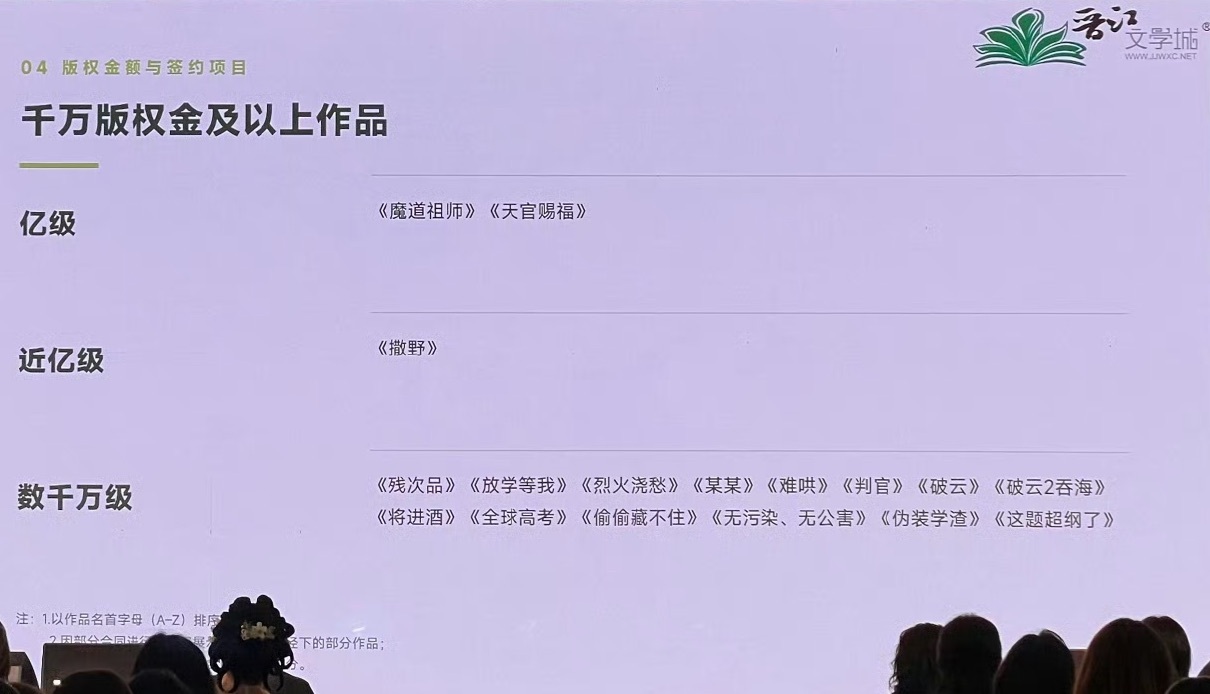
This week the Jinjiang Literature City author conference (晋江作者大会) turned mainland China's web-novel economy — already the world's largest pipeline from page to screen — into a trending-topic collective freakout. The catalyst: a slide showing that big adaptations now carry copyright fees in the tens of millions of yuan.
A viral post by @季风号苏打, with 7,083 likes, 424 comments and 2,640 reposts, said it plainly:
"我靠。。。。晋江热门作品版权费好贵啊!!好多钱!!!" — "Damn… Jinjiang's hit works have such expensive copyright fees! So much money!!!"
The photo-packed thread became the day's evidence board: breakout dramas like Zhu Yu (逐玉) and Till the End of the Moon (长月烬明) anchoring eight-figure deals.
Why this matters outside China
Jinjiang is one of the two pillars — with Qidian — of China's serialized web-fiction industry. Its specialty is women-oriented storytelling: romance, palace intrigue, and increasingly the danmei (BL) and xianxia fantasy genres that have become global exports. When a Jinjiang novel becomes a hit, it doesn't just sell books; it feeds film, TV, dubbing studios, mobile games, audio dramas and merchandise. The conference is the industry's annual public price tag.
Fans translated the numbers into receipts. One commenter credited a hit drama with lifting an author's status:
"长月烬明爆到要在原著后面特别标出来…罗云熙演技硬扛啊" — "Till the End of the Moon blew up to the point where the original novel had to be specially flagged. Luo Yunxi's acting carried it."
And Zhu Yu fans came armed with stats — claiming its male lead helped the show become the first title ever to hit 10,000 heat on both Tencent and iQiyi for a joint broadcast, and the first Chinese mainland drama to top Netflix's official weekly chart for four straight weeks.
The stars are writers
If the numbers drew gasps, the face reveals drew shrieks. Author Wu Zhe (巫哲), beloved for her coming-of-age school stories and known by her long-time pen name 狗蛋儿 ("Doggy Egg") — a deliberate inside-joke nickname she gave herself years ago — appeared on camera looking, in fans' words, nothing like a "Doggy Egg."
"巫哲作者大会露脸,完全女强人精英来着的!巫哲顶着这张脸叫狗蛋儿" — "Wu Zhe showed her face at the author conference, total boss-lady energy. Wu Zhe is calling herself Doggy Egg with that face."
"不敢想狗蛋回到家一看手机,然后发出一声'啧'" — "Can't imagine Doggy Egg getting home, checking her phone, and letting out a 'tsk'."
The post on Wu Zhe's reveal gathered 302 likes and 14 reposts in its corner of the fandom — small next to the copyright thread, but it tells the bigger story: China's web-novel authors, long hidden behind pseudonyms and shameless self-mockery, are becoming celebrities in their own right. That is a new chapter for an industry built on anonymity.
The unsaid part
Also trending as a bare keyword was 墨香铜臭·亿级版权 — author Mo Xiang Tong Xiu tied to "hundred-million-level" copyright. Her Mo Dao Zu Shi (Grandmaster of Demonic Cultivation) already underpinned the global The Untamed phenomenon, making her perhaps the single most internationally recognizable Chinese web-novel author. For an audience that met these worlds through Netflix and fan translations, the Jinjiang conference is a glimpse of the machinery behind the stories they love — and of the authors quietly becoming extraordinarily rich.