Language Barriers and Hospital Tier System: Why Taiwan's Da S Didn't Receive Timely Treatment in Japan
Japan's medical system has faced criticism following the passing of Taiwanese star, Da S, with many pointing to the country's hospital tier system and doctors' language abilities as key reasons for the delayed treatment she received. According to doctors working in Japan, two major factors contributed to Da S's inability to receive timely hospitalization. Firstly, Japan's hospital tier system is distinctly different from that of Taiwan, with hospitals in rural areas like Hakone and Hokkaido strictly divided into tiers, and some small hospitals lacking emergency departments, on-duty doctors, or even intensive care units (ICUs).
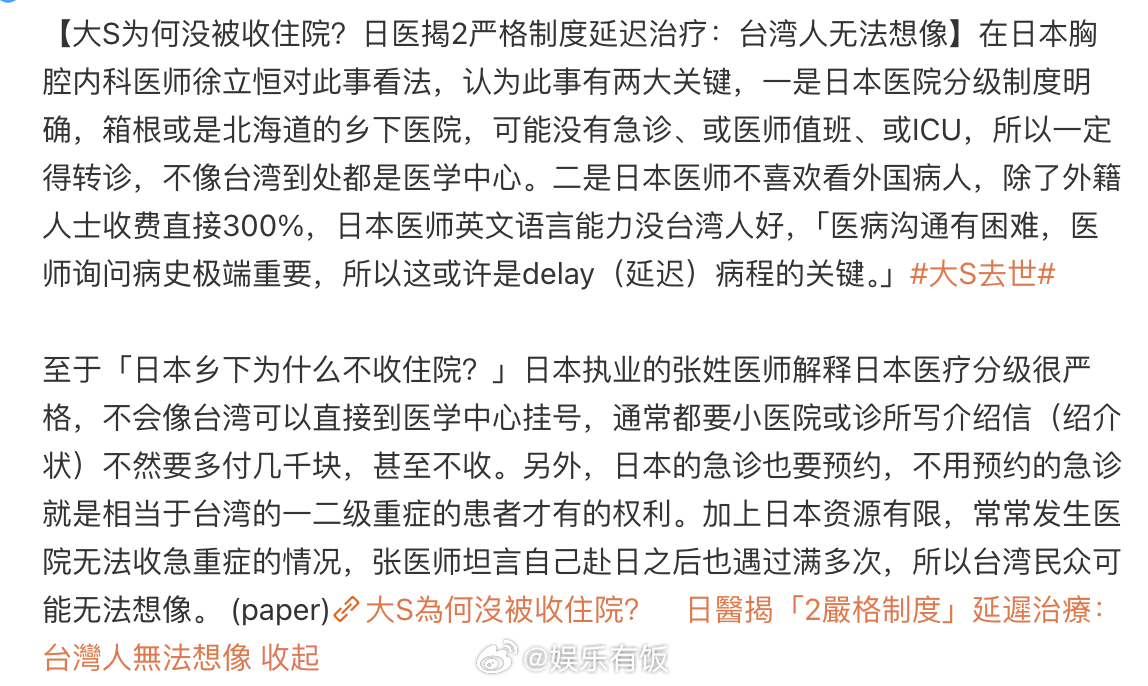
This tier system poses significant limitations for foreign patients in emergency situations, as patients often need to be transferred to higher-tier hospitals for proper care, a situation unlike in Taiwan where multiple large medical centers are available to provide immediate services for urgent cases. Da S required urgent medical attention, but the local hospital might not have been equipped to provide the necessary emergency medical services, complicating her transfer and hospitalization, and thus delaying her treatment. Moreover, the attitude and capability of Japanese doctors towards foreign patients also played a crucial role. Japanese medical professionals often face greater pressure and challenges when treating foreign patients, with the medical fee for foreign patients being significantly higher, up to 300% more than for local residents, which can deter many from seeking medical help.
Additionally, Japanese doctors generally have lower English proficiency compared to their Taiwanese counterparts, creating a significant communication barrier that can lead to delays in treatment. Taipei chest specialist Dr. Su Yifeng expressed his views on the passing of Da S, stating that the main cause of her death was not the flu, but rather the difficulty of receiving medical treatment in Japan, which led to a delay in her hospitalization. Dr. Su believes that if Da S had received medical treatment in Taiwan, the outcome might have been different. He pointed out that Japan's medical system is highly hierarchical, and that patients often need to be referred by a smaller hospital or clinic before they can receive treatment at a larger hospital, which can lead to delays in treatment, critical in emergency situations.
The language barrier between Japanese doctors and foreign patients is another significant challenge, with Japanese doctors' English proficiency being generally lower than that of their Taiwanese counterparts, leading to difficulties in communicating with patients and understanding their medical history. This can result in delayed diagnosis and treatment, which can have serious consequences for patients. In Da S's case, her family reported that she visited the hospital multiple times before her condition worsened, but she was not admitted for treatment, possibly due to the language barrier and the hospital's refusal to accept her without a referral. The incident has sparked a wider discussion about the need for greater awareness and understanding of the medical systems in different countries, and the importance of ensuring that patients receive proper treatment in a timely manner.
Japan's medical system limitations, including its hierarchical structure, language barriers, and strict referral requirements, can create significant challenges for patients, particularly foreign patients, in accessing timely medical care. These limitations may have contributed to the delays in Da S's treatment and highlight the need for greater awareness and understanding of the Japanese medical system among foreign patients and medical professionals. Ultimately, Da S's case not only brings attention to individual health issues but also reflects broader medical phenomena, urging us to think about how to minimize barriers caused by cultural and systemic differences when seeking medical care in different countries.
The hope is for future medical services to be more humane, providing every patient with the care and support they deserve. The incident also serves as a reminder of the importance of health insurance, as Japan's high medical fees can be a significant burden for patients. By learning from Da S's experience, we can work towards creating a more inclusive and accessible medical system for all patients, regardless of their nationality or language proficiency. Furthermore, the recent flu outbreak in Japan has highlighted the country's struggle to cope with a large number of patients, with many hospitals facing a shortage of medical supplies and staff. The incident has led to a renewed focus on the importance of flu prevention and treatment, with experts emphasizing the need for individuals to take precautions to prevent the spread of the disease.
In recent years, Japan has experienced a significant increase in flu cases, with the number of reported cases surpassing 9.5 million in the 2024-2025 winter season. The country's medical system has been put under immense pressure, with many hospitals struggling to cope with the large number of patients. The shortage of medical supplies, including flu medication, has been a major concern, with many patients being turned away from hospitals due to a lack of available treatment options. The incident has sparked a wider discussion about the need for Japan to improve its medical infrastructure and preparedness for large-scale outbreaks.
The flu outbreak in Japan has also highlighted the importance of international cooperation and awareness in preventing the spread of diseases. With the increasing globalization of travel and trade, the risk of disease transmission across borders has become a significant concern. The incident has emphasized the need for countries to work together to share knowledge, expertise, and resources in preventing and responding to public health crises. By learning from the experiences of other countries and working together to address common challenges, we can create a more robust and resilient global health system that is better equipped to respond to emerging threats.
In the wake of Da S's passing, many have reflected on the importance of prioritizing health and seeking medical attention when needed. The incident has serves as a reminder that even seemingly minor illnesses, such as the flu, can have serious consequences if left untreated. It is crucial for individuals to be aware of the risks and take proactive steps to protect their health, including getting vaccinated, practicing good hygiene, and seeking medical attention if symptoms persist or worsen. By taking these precautions, we can reduce the risk of serious health complications and ensure that we receive the medical care we need in a timely and effective manner.
Da S's family, including her sister, Xu Xidi, and her former husband, Wang Xiaofi, have been dealing with the aftermath of her passing. Xu Xidi has canceled her schedule to focus on her family and has received an outpouring of support from fans and fellow celebrities. The incident has also sparked a wider discussion about the importance of family support and care in times of crisis. The need for loved ones to be supportive and understanding during difficult times has been emphasized, and many have reflected on the importance of prioritizing family and relationships in our lives.
In conclusion, Da S's passing has brought attention to the importance of medical awareness, international cooperation, and family support. The incident has highlighted the need for individuals to prioritize their health and seek medical attention when needed, and for countries to work together to address common health challenges. By learning from Da S's experience and working together to create a more inclusive and accessible medical system, we can reduce the risk of serious health complications and ensure that all individuals receive the care and support they deserve.