A Supermarket Persimmon Sprouted Mushrooms, and China Called It 'Good Persimmon, Many Mushrooms'
A woman in Shijiazhuang bought a persimmon that turned out to be sprouting a ring of white mushrooms from its stem, and her photos have made it one of China's favorite small mysteries of the week. Researchers at the Kunming Institute of Botany asked her to send it in, turning a supermarket oddity into a citizen-science sample.
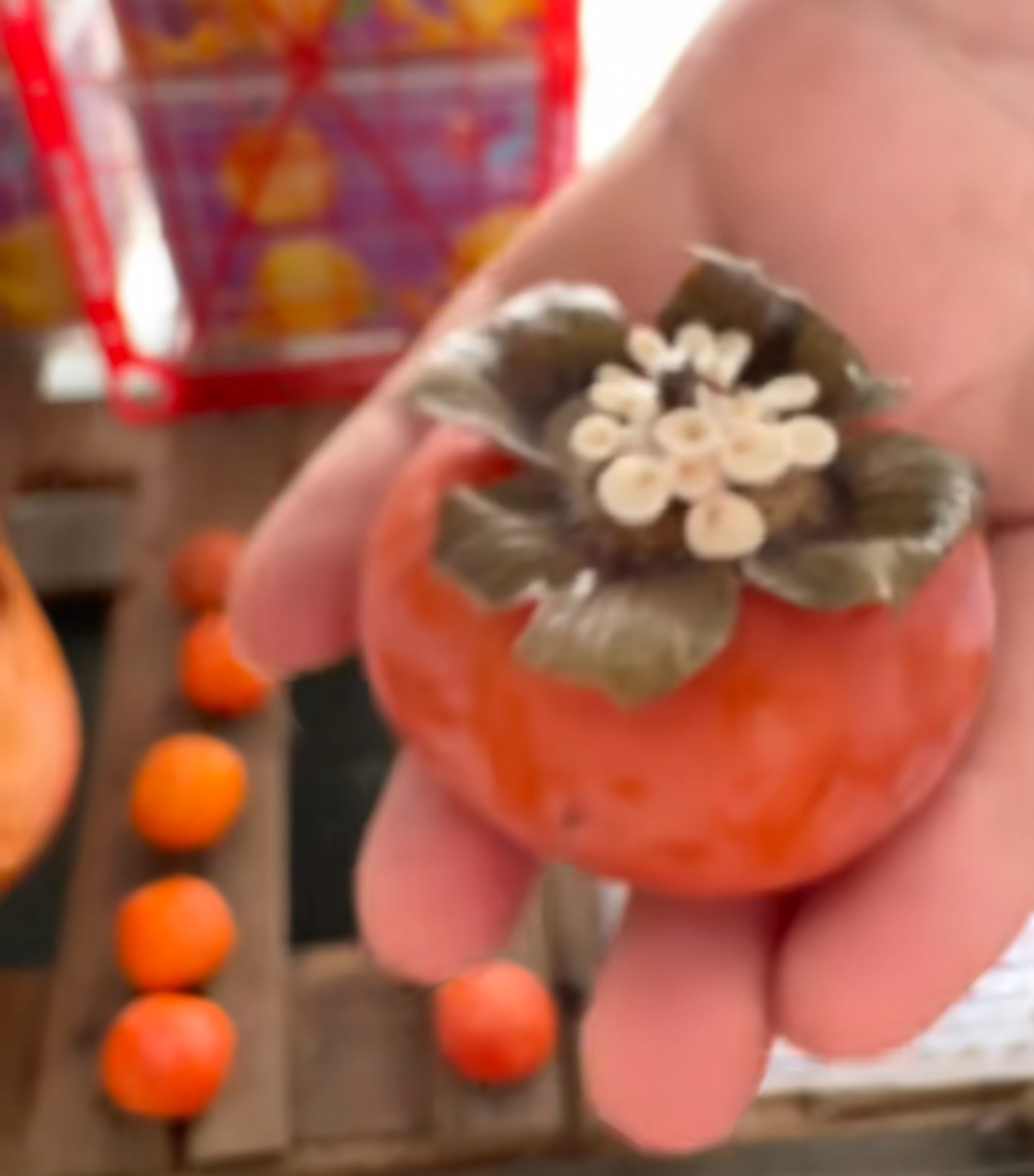
A woman in Shijiazhuang was choosing persimmons at a fruit shop when one of them felt different from the others. She turned it over and found the answer growing on the stem: a neat ring of small white mushrooms, shaped like tiny trumpets and arranged as if the fruit had put on a tiny crown.
Her photos moved fast on Weibo, and the internet did what it does with a perfect, impossible-not-to-share image — it gave the thing a name. Users are calling it 好柿多蘑 (hǎo shì duō mé), a pun on the idiom 好事多磨, "good things come with setbacks," with the middle characters swapped for "persimmon" and "mushroom." In English it lands somewhere close to "good persimmon, many mushrooms," which is to say that the joke is doing real work in both languages.
The scientific side caught up quickly. The fungus has been tentatively identified as Schizophyllum commune, usually called the split gill mushroom. It is common enough on decaying wood, but finding it fruiting naturally from a persimmon's calyx is rare, which is exactly the kind of detail that turns a grocery-store surprise into something a mycologist will happily take off your hands. Researchers from the Kunming Institute of Botany, part of the Chinese Academy of Sciences, reached out to the buyer, and she packed up the fruit and mailed it in. As one account summed it up, most people buy a persimmon for the sweetness; she bought one that may end up in a research note.
There is a small but useful public-service lesson folded into the delight. Several posts made the same point: pretty as it looks, a fruit that has begun hosting fungus is almost certainly contaminated inside, and the caption on the trending clip advises no one to eat it. The woman's good fortune is observational, not culinary.
The story belongs to a genre Chinese social media handles especially well: the small natural-world anomaly that briefly becomes a shared national inside joke. The pun works because almost everyone knows the four-character idiom it echoes, and the image works because it needs no translation. A persimmon wearing mushrooms is legible in any language, which may be why a fruit-shopping trip from Hebei has outlasted most of the day's more consequential news. For the researchers in Kunming, though, the payoff is only beginning: a rare specimen delivered by a stranger, and a reminder that the next scientific sample might be sitting in someone's shopping bag.