Is it Necessary to Rake Through Eight Tons of Trash for a Lost Timepiece?
A recent incident in Shanxi, China, has sparked a heated debate about the nuances of urban governance. Two sanitation workers manually sifted through eight tons of garbage to help a tourist find her child's lost watch, a task that took over four hours to complete in sweltering heat. The incident, which was initially hailed as a "heartwarming story" by local media, has raised questions about the necessity of expending significant public resources to find a lost item valued at only a few hundred dollars. The tourist, Lu, had mistakenly thrown the watch away in a garbage bag on a high-speed train, and after contacting the city's municipal services hotline, the sanitation workers were dispatched to search for it.
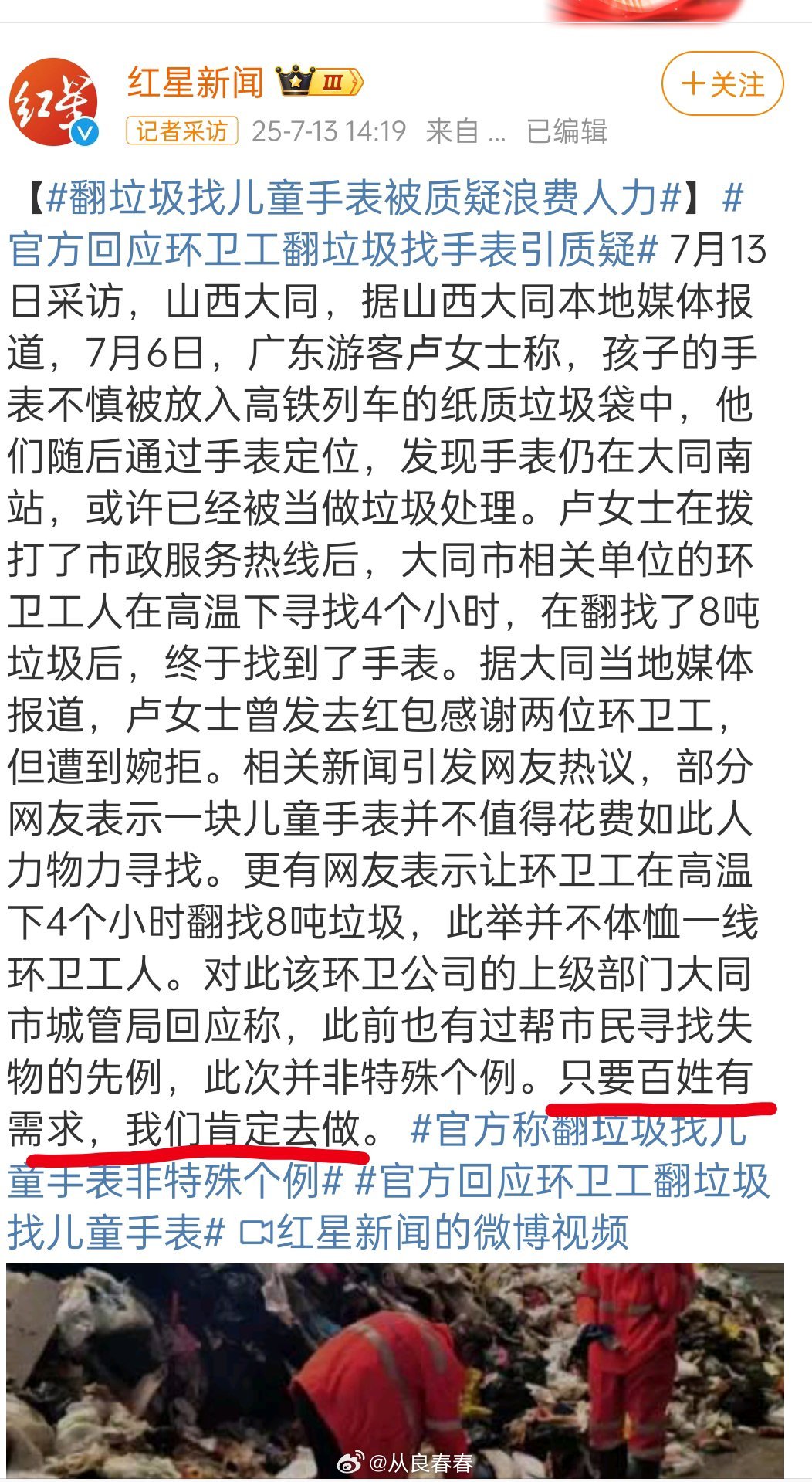
While some argue that the incident embodies the value of humanized service and the enhancement of a city's soft power, others question the rationale behind having sanitation workers manually search through garbage for an extended period. Critics point out that this approach lacks empathy and consideration for the welfare of grassroots laborers, highlighting the need for more pragmatic and compassionate approaches to similar situations in the future. In response to the public's doubts, a government official stated that as long as citizens have a demand, the authorities will take action to help. However, the concerns raised by netizens, such as the high labor cost and garbage disposal fees, are valid and deserving of consideration.
The debate surrounding this incident has sparked a broader discussion about the values and priorities of society. Many have taken to social media to express their outrage, with some arguing that the effort and resources expended to find the watch were disproportionate to its value. Others have pointed out that the real issue is not the watch itself, but the fact that sanitation workers were made to work in harsh conditions for an extended period, potentially putting their health at risk. The incident has underscored the complexities of balancing community service with resource allocation and the welfare of public servants.
Some have also raised questions about the motivations behind the tourist's actions, with some suggesting that she should have taken responsibility for her own mistake rather than relying on public resources to resolve the issue. Others have pointed out that the watch, which was reportedly a child's smartwatch, was not a vital or essential item, and that the effort to recover it was therefore not justified. The incident has also sparked a wider discussion about the need for a more scientific and responsive service mechanism, one that takes into account the needs of citizens while also safeguarding the fundamental rights of workers.
Ultimately, the question of whether it is necessary to have sanitation workers sift through eight tons of garbage to find a lost watch is not just about the watch itself, but about the values and priorities of our society. It is a call to reflection on how we can create a more equitable, more compassionate, and more sustainable model of urban governance, one that honors the dignity of all individuals, regardless of their occupation or social status. As one netizen pointed out, a truly civilized society should not come at the cost of sacrificing the basic rights and dignity of its laborers, but rather establish a more scientific and responsive service mechanism that addresses the urgent needs of citizens while safeguarding the fundamental rights of every worker.