Obedient but Untalented: A Writer's Viral Essay Reopens China's Argument Over the Marriage Bargain
A writer's anecdote about a 1970s marriage — a capable wife, a compliant husband from a comfortable family — has become one of Weibo's most-argued posts of the week, with commenters reading it as a eulogy for an economic bargain that no longer exists.
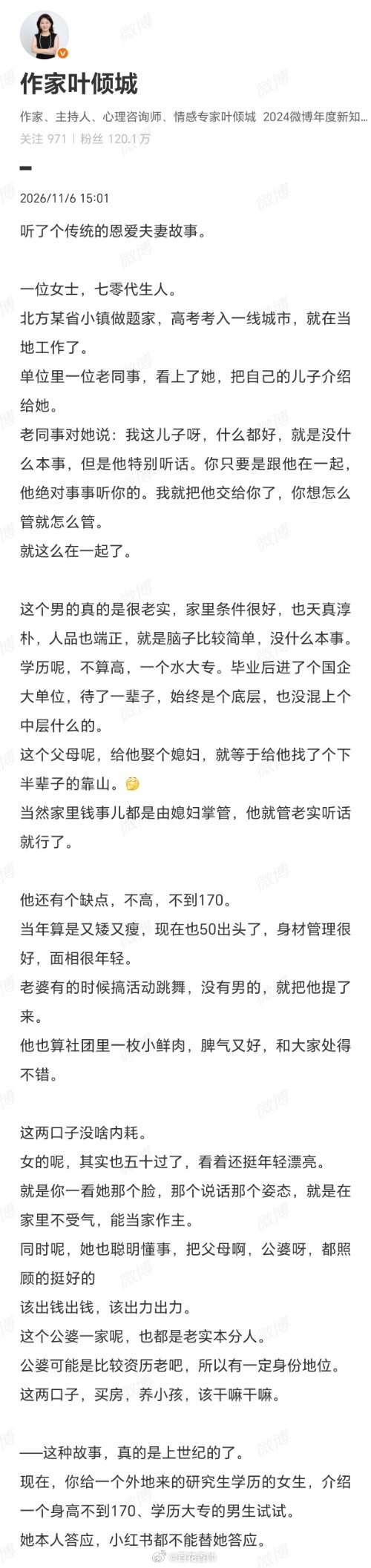
The story writer Ye Qingcheng told her followers this week was, by her own account, someone else's: a woman born in the 1970s in a small northern town, carried into a first-tier city by her college entrance exam score, then set up by a senior colleague at work with his son. The father's sales pitch is the sentence now circulating across Chinese social media: “My son is good in every way — he just doesn't have much ability, but he's especially obedient”(我这儿子呀,什么都好,就是没什么本事,但是他特别听话). The young man was honest, from a well-off family, kind and simple-minded, with a modest vocational-college diploma and a lifetime spent at the bottom of a state-owned enterprise. His parents' plan, she wrote, was straightforward: their marrying him off amounted to securing him “a backstop for the rest of his life.” The wife ran the money and the household, cared for the in-laws, and the couple, in the hashtag's vocabulary, had no 内耗 — no internal friction.
Then came the line that made the post a talking point, in a post liked more than 3,000 times: “This kind of story really belongs to the last century. Now try introducing a man under 170 centimetres with a vocational diploma to a graduate-educated woman just off the train from another province — even if she said yes herself, Xiaohongshu wouldn't say yes for her.”
The hashtag it powered — 没本事但听话的婚姻没内耗, roughly "a marriage of no ability but obedience has no internal friction" — split quickly into two camps. One read the essay as nostalgia. "What really stings isn't 'no ability but obedient,'" one commenter argued, "it's the line about his parents marrying him off to find him a lifelong backstop. For a marriage like that to run without friction, four things had to line up at once: in-laws who gave money and a house and stayed out of the way, a good-tempered husband who didn't fight for control, a wife who was capable and fair, and the cushion of the previous generation's savings. It can't be replicated today — not because women got snobbish, but because that safety net is gone."
The other camp heard a warning. Obedience is not low friction, another replied; it is deferred cost. "Talking less isn't the same as living better. One person decides and the other nods, and what you save on communication today you pay back later in lost judgment and abandoned responsibility. What actually exhausts people isn't disagreement — it's when something goes wrong and nobody steps up, while silence gets praised as being sensible."
The argument has landed in a country where the marriage arithmetic is visibly shifting. Registrations rose about 10 percent in 2025, ending a decade of decline, and cash-strapped local governments have started paying couples to wed. Against that backdrop, the essay's odd couple reads two ways at once: to some, a model of a marriage that pooled risk across generations; to others, a reminder that "obedient" was only ever affordable when someone else was paying the bills. Ye called it a traditional story of a loving couple. Most of her commenters read it as an obituary for an arrangement whose economics no longer exist.