China's First River-to-Sea Canal Since 1949 Opens, Cutting 560 Kilometres Off the Southwest's Route to the Sea
The 134.2-kilometre Pinglu Canal opened to shipping on Wednesday, the first river-to-sea canal China has built with national coordination since 1949. Built in four years at a cost of 72.7 billion yuan, it cuts the journey from Nanning to the sea from 827 kilometres to 204 — and turns a landlocked provincial capital into a port city facing Southeast Asia.

The first cargo ships entered the Pinglu Canal in China's southern region of Guangxi on Wednesday morning, opening a 134.2-kilometre waterway that is the first river-to-sea canal China has built with national-level coordination since the People's Republic was founded in 1949. The project began only in August 2022; four years and a reported 72.7 billion yuan later — roughly ten billion US dollars — ships can now sail from the outskirts of Nanning, the regional capital, straight down to the Beibu Gulf on the Vietnamese border.
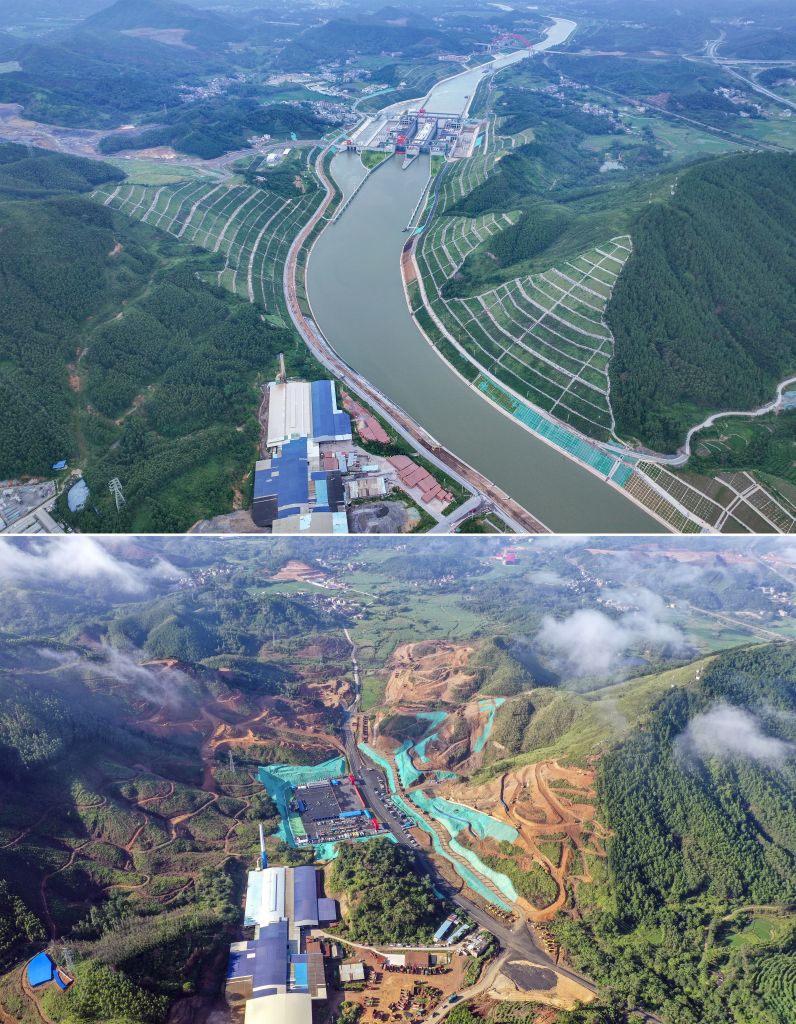
For an outsider, a canal can sound like heritage rather than news. In Guangxi, it solves a geographic frustration that has shaped the region for decades. Guangxi is the only province-level region in western China with a coastline, but its rivers flow the wrong way: the Xijiang carries Nanning's freight several hundred kilometres east to the Pearl River delta before it reaches the ocean. Under the old route, a barge leaving the Nanning port area travelled 827 kilometres and spent nearly 69 hours on the water to get to the sea; the canal turns that journey south into a 204-kilometre, 17-hour run, a saving of 623 kilometres, according to a graphic published by The Paper. Baidu's trending board put the wider effect in round numbers — inland shipping distances to the sea cut by more than 560 kilometres — and declared that Nanning, "never far from the sea, yet never able to reach it," has become a genuinely coastal city.

The engineering behind that shortcut is what dominated the morning's coverage. The canal is built to China's highest inland navigation grade, certified for 5,000-tonne vessels, and drops toward the gulf through three cascading lock complexes at Madao, Qishi and Qingnian. State media listed four world records claimed along the way: the strongest navigation capacity of any canal in its class, the fastest lock transits, and water-saving locks of the highest drop and largest scale in the world, which recapture much of the water each passage would otherwise expend. An aerial photograph carried by The Paper shows a covered cargo barge passing under a banner that reads "the century project Pinglu Canal sets sail from here."
The canal's politics are as legible as its engineering. Its terminus faces Southeast Asia, and the opening was framed almost entirely as an ASEAN story: Guangxi Daily coordinated a "global livestream" of the first ships with what it described as mainstream media from eleven ASEAN countries, and at a press briefing on Wednesday the Taiwan Affairs Office spokesperson Zhu Fenglian invited Taiwanese manufacturers to use the new route, arguing that river-sea transshipment through Guangxi would lower export costs toward ASEAN markets. The canal sits inside a decades-long push, billed as the Western Land-Sea New Corridor, to pull trade from China's congested eastern ports toward its less-developed southwest.
That tension is also why the story has traction beyond the ceremony. By mid-morning the top question on Zhihu asked both how the canal was built and whether it can, in the site's phrasing, "lift" the southwest — a region that has watched coastal China pull away for forty years. The question's framing notes that the canal was imagined for nearly a century before anyone broke ground; Guangxi, after all, built the Ling Canal more than two thousand years ago. Whether this one does more than move ships past Nanning is the part that will be measured in cargo tonnage, not ceremonies.