What 10,000 Yuan Actually Buys: China's Viral Money Reckoning
A video blogger's line that 'the power of 10,000 yuan is badly underestimated' opened one of the week's biggest conversations about money, as Chinese social media converted abstract figures back into rice, hospital bills and half-years of farm labor.
The post that started it ran barely a sentence long. A video blogger known as Ke Daibiao Xiaozouzou declared that 'the power of 10,000 yuan is badly underestimated' (一万块的威力被严重低估了), and the phrase became a national hashtag — the original post was liked almost 4,000 times. Under it, people have been doing something increasingly unusual with money in a country of QR-code payments: counting it out slowly, by hand, to feel its weight again.
The arithmetic that resonated most came from a user named Xingguang-Tang, who began with the asymmetry everyone recognizes: carrying 10,000 yuan feels like nothing — owing 10,000 feels like the sky has fallen. Electronic payment, she wrote, has quietly sanded away money's physical thickness. Cash in hand gets spent a bill at a time and can last months; the same sum inside a phone can drain in two weeks. And nowhere does it evaporate faster than a hospital, where 10,000 yuan 'runs through like water.'
Then she retold the lesson her father gave her when she once bought a 20,000-yuan handbag without thinking. Rice costs two yuan a jin — half a kilogram — so 20,000 yuan is ten thousand jin of rice, five tonnes. A family of three who eat one and a half jin a day would take nearly eighteen years to finish it. Ten mu of paddies — most of a football field's worth of land, farmed for half a year — sell for about 9,000 yuan. 'In that moment I suddenly understood,' she wrote: every yuan is someone's day after day of labor, pressed flat.
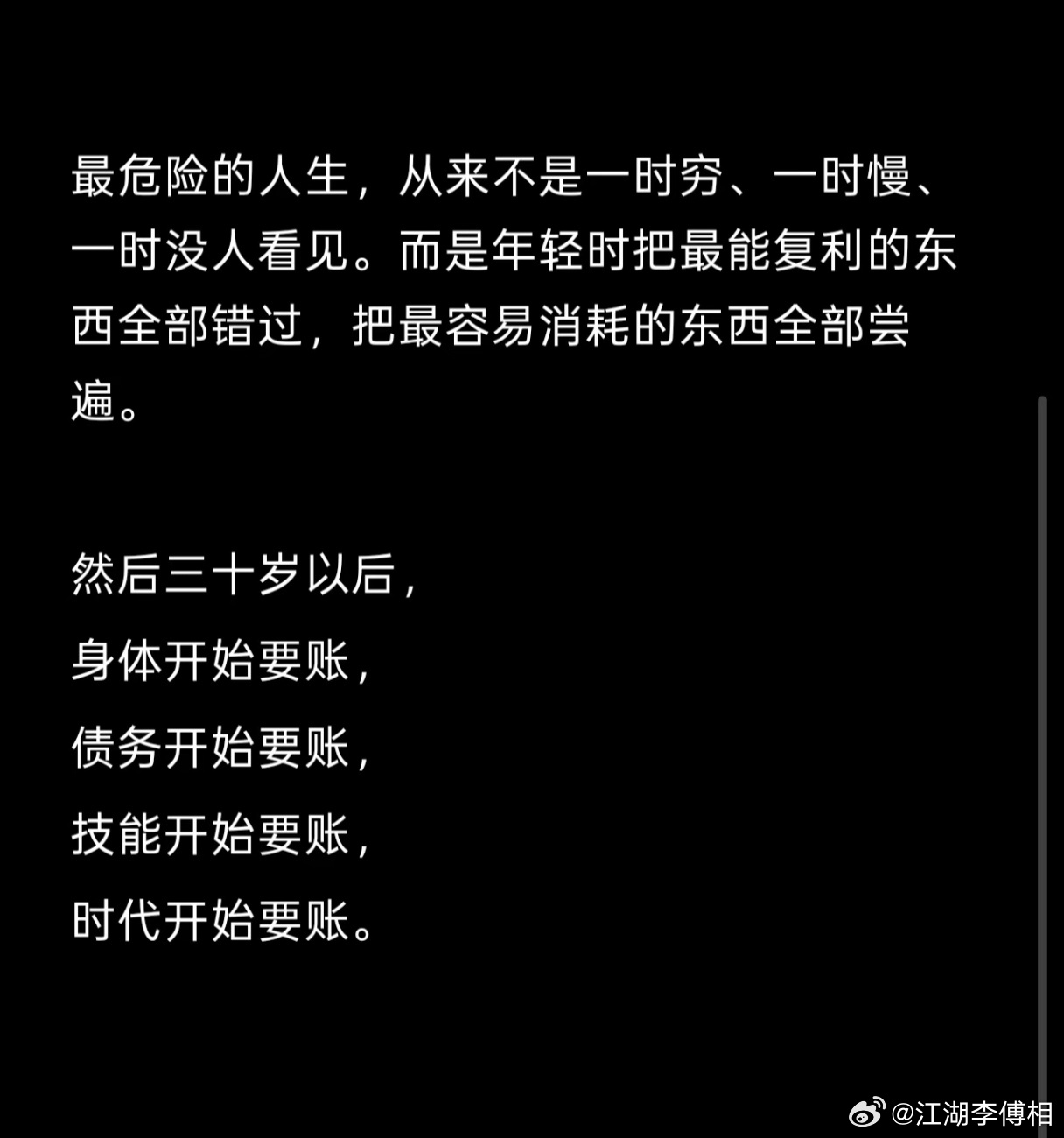
A companion trend made the same argument about time instead of money. 'The most dangerous thing is to miss compounding when you're young' (最危险的是年轻时错过复利) trended off a black-screen graphic by the writer Jianghu Li Fuxiang, who framed a good life as an accumulation problem: miss everything that compounds — health, skills, savings — and taste everything that burns out fast, and by thirty 'the body starts collecting its debts, the loans start collecting, the skills start collecting, the era starts collecting.' The replies turned it into a five-year test: before you do anything, ask what it will have done for the you of five years from now — so study the language, and skip the game account.
The mood is of a piece with what the site has been tracking all season: a lawyer's viral essay telling young Chinese to hoard cash as AI reprices office work struck the same nerve — security recalculated from the bottom up, in units small enough to feel. The rice calculation is the genre's master form: the bag bought on a whim cost more than half a year's harvest from ten mu of paddy, and ten thousand yuan, counted out bill by bill, is nine years of a family's rice.