Pregnant Engineer's Salary Slashed: Chinese Court Rules Against Discriminatory Pay Cut
A recent case in China has sparked widespread social concern, highlighting the issue of unfair treatment of women in the workplace. A female engineer, surnamed Zhao, saw her monthly salary plummet from 17,000 yuan to 3,000 yuan after she became pregnant. According to her labor contract, Zhao's monthly salary consisted of a basic salary of 3,000 yuan and a project-based allowance of 14,000 yuan. However, after she informed her company of her pregnancy, they unilaterally announced her exit from the project team without her consent, and subsequently reduced her salary to the basic rate.
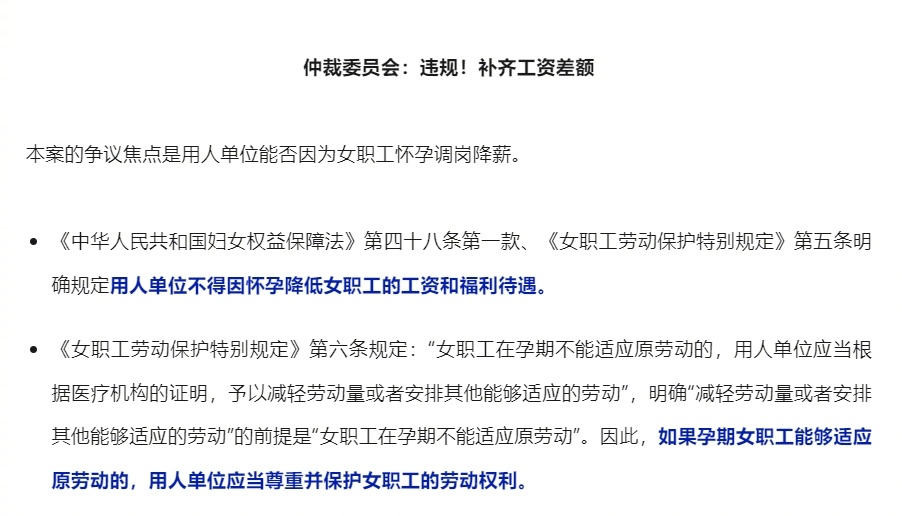
The company claimed that Zhao was no longer participating in the project, but the arbitration committee ruled that this decision was unlawful and ordered the company to pay Zhao the difference in salary based on her original monthly rate of 17,000 yuan. This case has raised questions about the treatment of pregnant women in the workplace and the protection of their labor rights. The dispute centers on whether an employer has the right to demote or reduce the salary of a female employee simply because she is pregnant.
According to the "People's Republic of China Law on the Protection of Women's Rights and Interests" and the "Special Provisions on Labor Protection for Female Employees," employers are strictly prohibited from lowering the wages or benefits of female employees due to pregnancy. These laws emphasize the protection of women's rights and interests in the workplace, ensuring that pregnancy does not become a pretext for unfair treatment. In Zhao's case, the company's decision to remove her from the project and significantly reduce her salary, without evidence that her pregnancy rendered her incapable of performing her original duties, constitutes a violation of these protections.
The arbitration committee, in accordance with the laws and regulations aimed at protecting the rights and interests of female employees, ruled in favor of Zhao, ordering the company to pay her the difference in salary based on her original wage of 17,000 yuan per month. This ruling underscores the importance of upholding the legal rights of pregnant employees and serves as a reminder to employers of their obligations to provide fair treatment and protection to all employees, regardless of pregnancy or gender.
The verdict is significant as it addresses the pervasive issue of pregnancy discrimination in the workplace, where women often face reduced pay, demoted roles, or even termination upon disclosing their pregnancy. By upholding the engineer's rights and ordering the company to rectify the pay disparity, the legal system sends a strong message about the importance of protecting women's economic and social well-being during pregnancy. The implications of this verdict extend beyond the individual case, setting a precedent for the protection of pregnant women's rights in the workplace. It emphasizes the importance of a fair and inclusive work environment, where employees can expect to continue their careers without facing discrimination due to pregnancy.
The incident has sparked intense social response, with many people expressing outrage and disappointment on social media platforms, arguing that the company's actions are discriminatory and illegal. They believe that female employees should be entitled to equal employment opportunities and treatment, regardless of their pregnancy status. The case has also sparked a broader discussion about the challenges faced by women in the workplace, particularly in male-dominated industries such as engineering. Many have argued that such discriminatory practices can have a chilling effect on women's career aspirations and hinder their ability to balance work and family responsibilities.
The reduction in salary is seen as a blatant example of discrimination against female employees, who are entitled to equal employment opportunities and treatment under the law. As such, the incident has highlighted the need for stronger enforcement of labor laws and greater protections for women's rights in the workplace. The legal system's commitment to safeguarding the labor rights of women serves as a deterrent to companies that engage in discriminatory practices against pregnant employees, promoting a fair and inclusive work environment for all.