China's 60-Centimetre Egg Tarts Are Already Being Pulled From Menus
Three weeks after the 60-centimetre 'super-long egg tart' became China's must-queue snack — one brand sold more than 700,000 in eight days — bakeries are quietly retiring it, and the pull-out is being announced store by store.
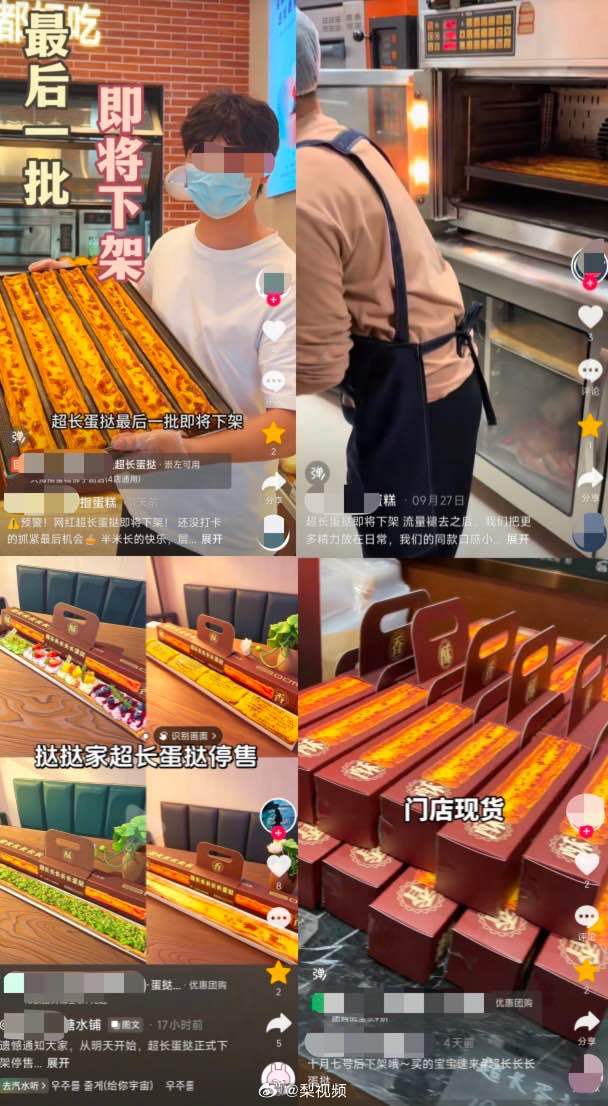
The super-long egg tart's reign lasted about a month, and everyone involved seems fine with that. In September the 60-centimetre pastry — a an elongated, bicycle-sized cousin of the Cantonese classic — was China's most-queued snack, with one brand moving more than 700,000 of them in eight days and a Wuhan store reported to be baking over 600 a day, its other lines cut back to make oven room. On Friday, Pear Video confirmed that shops have begun taking it off the menu: one bakery said its first batch sold out within a week and it has switched back to ordinary tarts because "we can't get stock now, so we've stopped making them." Another gave its 19.8-yuan tarts two or three more days. "Once the last batch is sold, we're done."
The retreat is the natural end of a very specific kind of Chinese product — one built to be photographed rather than eaten. As one widely shared Weibo commentary put it, people queued for hours and paid scalpers triple for one thing: "a half-metre-long egg tart to photograph and post to their feed" (拿着半米长的蛋挞拍张照发朋友圈). Once the photo was taken, the incentive to return was thin. Customers described a pastry that tasted like an ordinary tart at best — thicker crust, uneven custard, several comparing the experience to chewing a youtiao. A Beijing News column criticized the format as cutting corners for visual marketing, and Bao Shi Fu, the chain whose version drew the earliest complaints, was already taking flak a fortnight ago for a tart that was, in the popular verdict, all crust and no custard.
There were practical objections too. Regulators flagged that a tart this size cools slowly at its centre, a food-safety risk for delivery orders — one buyer reported finding an insect — and noted that a single 60-centimetre tart runs to roughly 1,000 calories, six to eight ordinary tarts' worth, which made "share with a group, eat fresh in store" the officially recommended approach. Meanwhile the manufacturing reality did the rest: the product requires nothing but a long mould and a standard pre-made pastry supply chain, so every bakery in the country could stock it within days — and saturation killed the scarcity that made it worth queueing for.
Merchants are strikingly unsentimental about the whole cycle. "Internet-famous products don't sell forever," one shop owner told Pear Video, estimating sales had halved over the National Day holiday and predicting the tart would survive, at most, as a niche item — the same trajectory as the "dirty bun" craze before it. That is the pattern worth watching for an outside reader: China's pre-made food supply chains are now so fast that a novelty can go from a single store's experiment to a national sensation in a week, and from national sensation to discontinued in another three. The same machinery that makes instant trends also guarantees their expiry.
For now, the last batches are selling out on schedule. Several chains told the outlet they expect to pull the product within a week, once remaining stock is gone — at which point the super-long tart joins the queue of photographed, tasted and retired Chinese snack phenomena, its job as a camera prop formally complete.