A Famous Chinese Maths Tutor Wants English Demoted as a Core School Subject
Tang Jiafeng, one of China's best-known exam-prep tutors, has publicly called for English to lose its status as a core school subject, calling decades of compulsory English a waste of most students' time. The argument landed at the top of two platforms at once — and reopened an old fight over what Chinese children owe the world's language.
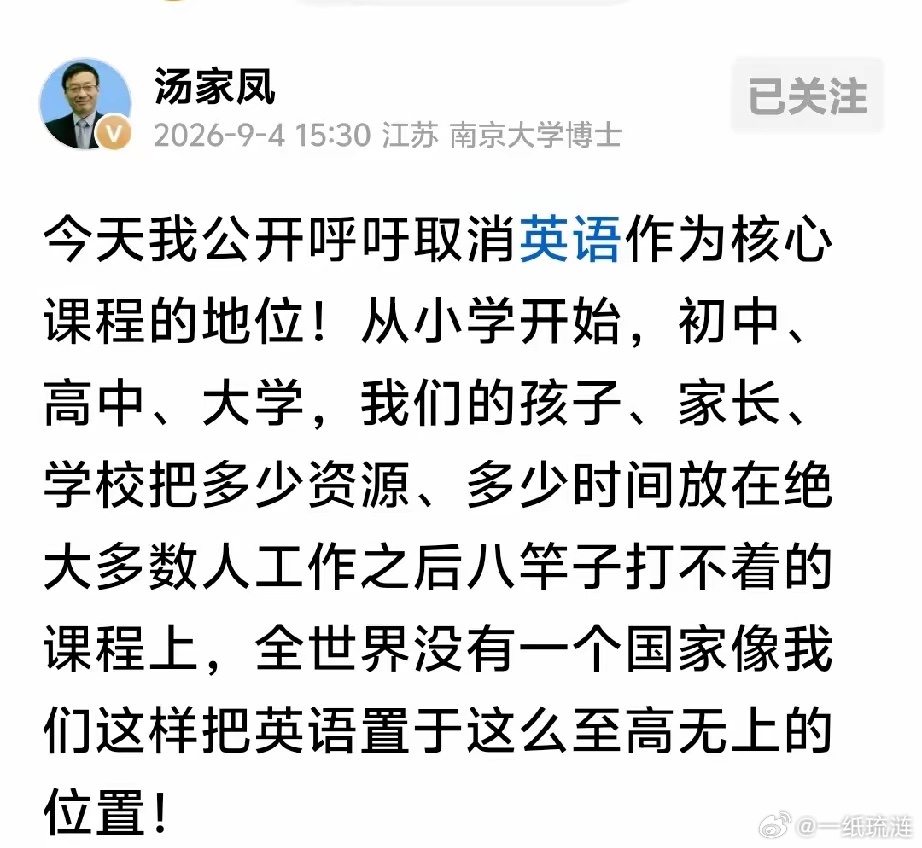
Tang Jiafeng is a maths teacher, but for two days the argument China was having was about English. The postgraduate-entrance-exam coach, whose mock-lecture clips have made him a celebrity among China's exam-takers, published an open call on September 4 to strip English of its status as a core subject from primary school through university. "Today I publicly call for cancelling English's place as a core course," he wrote. "No country in the world elevates English to such a supreme position as we do."
His case, laid out across three short bursts, was one part money and two parts nationalism. Families, he argued, pour years of resources into a subject most people will never need once they finish school — "English is just a tool; knowing how to use it is enough" (英语只是一个工具,会用就可以了). Then he reached for the line that carried the post across the internet: "The history of Chinese people fawning over things foreign should end" (中国人崇洋媚外的历史该结束了).
The post spread fastest through other people's mouths. A widely shared recap noting that Tang had "said out loud what many have swallowed for a long time" drew more than 37,000 likes, and the topic reached No. 3 on Baidu's trending board the same day, with a Zhihu question asking whether readers agreed drawing hundreds of answers. For an international reader, the shape of the debate is instructive: nobody was defending rote grammar drills. The fight was over what the requirement signals.
The most-liked rebuttal came from a fellow teacher — of maths. If usefulness after graduation is the test, he asked, why stop at English? Calculus and analytic geometry face the same charge, and few suggest demoting them. That rejoinder points at what critics hear beneath Tang's argument: not a syllabus proposal but a claim about what counts as legitimate knowledge, with a foreign language on the losing side. Others made the fairness case the other way — English, drilled into pupils through fees and family resources, is precisely the subject that lets a child from a small town out-qualify a city rival; make it optional and the advantage compounds for those who can buy it privately. The site's own coverage of the exam grind — one man's ninth failed attempt at the CET-6 college English test becoming a generation's shared memory — shows how much of adult working life in China still runs through these exams.
There is also the irony his questioners did not miss: Tang is one of the biggest beneficiaries of China's exam industry, and his call to demote English came in the same week the graduate-exam season opened.
No education-ministry directive followed — none was needed for the debate to run its course on two platforms. What changed is the mood around the question — a debate that used to live in policy proposals now arrives by influencer, packaged with a grievance, and finds its audience before any official has to answer it.