Tencent Puts a 28-Year-Old OpenAI Veteran in Charge of Its AI Push
Broadcast footage of Guangdong leaders touring Tencent shows founder Ma Huateng seated beside Yao Shunyu, the 28-year-old OpenAI-trained scientist who now runs the company's AI divisions — a glimpse of how China's biggest tech firms are reorganizing around the AI race.
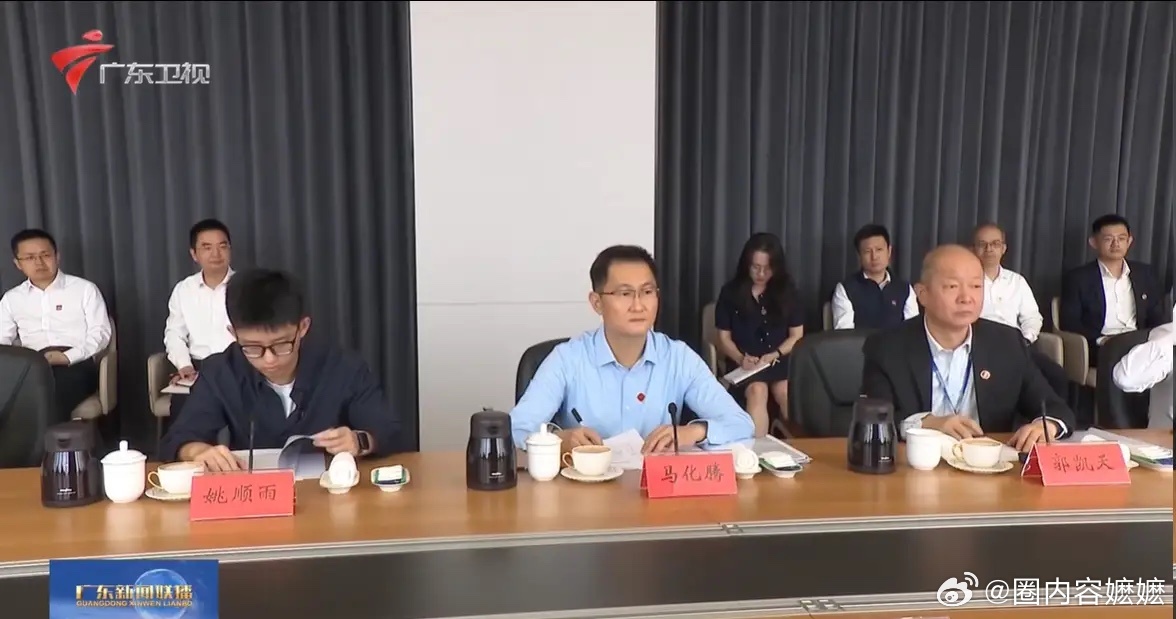
Guangdong Satellite TV's evening news on October 8 carried the kind of scene China's tech watchers rarely get: a provincial leadership delegation filing through Tencent's Shenzhen headquarters, past AI demonstrations in the exhibition hall, and then a conference table where the nameplates read Yao Shunyu (姚顺雨), Ma Huateng (马化腾) and Guo Kaitian. The founder of China's largest social-and-games company seated next to a 28-year-old most of the country had never heard of was itself the story by Thursday, running under a trending topic that translates as "Ma Huateng, 54, makes a rare appearance" (54岁马化腾罕见露面).
Baidu's search board recorded the occasion — provincial party secretary Huang Kunming's delegation in Shenzhen to examine the company's artificial-intelligence work — but the commentary fastened on the seating. Within a day, tech accounts had assembled Yao Shunyu's biography with the thoroughness usually reserved for founders: born in Hefei, Anhui, in 1998; 704 out of 750 on the 2015 gaokao, enough for Tsinghua's Yao Class, the university's elite computer-science programme; a Princeton doctorate; then OpenAI in 2024, where he worked on the Operator agent and the Deep Research tool.
In April 2025 he published "The Second Half," an essay arguing that AI's frontier is shifting from solving problems to defining them — that evaluation, not training, will decide who wins next. It circulated widely through China's engineering circles, and in December Tencent hired him as chief AI scientist, reporting directly to president Martin Lau, with the three divisions behind the company's Hunyuan models — base models, AI infrastructure and AI data — under his remit. One widely shared post put it plainly: this may be the most powerful young executive in Tencent's history.
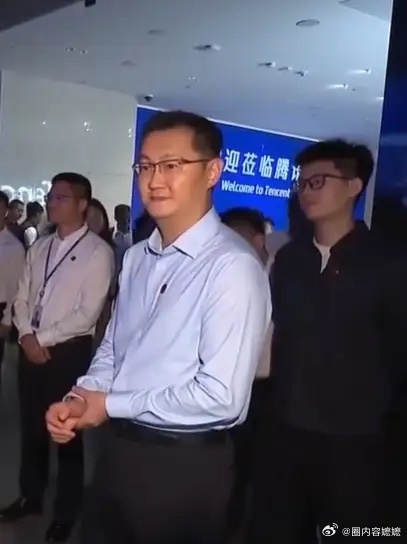
Ma's own mood frames it. He is famously publicity-shy — the trending phrase "rare appearance" is doing precise work — and his last extended public moment came in May at the shareholders' meeting: "A year ago we thought we had boarded the ship. Then we found the ship was taking on water" (原来一年前,我们以为上了船,后来发现那个船漏水了). Since then, the financing tallies circulating with the broadcast describe a company that has swung from AI-cautious to aggressive: a recently issued 4.7-billion-dollar bond, a five-billion-dollar offshore issue said to be in the works, and a five-year lease on Oracle data-centre capacity in Southeast Asia to feed the computing appetite.
The visit also fits a week of state signalling. On Friday the Central Committee and the State Council published an opinion on developing "new quality productive forces," and financial media flagged the "AI+" action plan moving into full implementation across the economy (Yicai's evening brief). A provincial delegation touring a private company's AI exhibits, broadcast on the provincial channel, is the local footnote to that document.
The seating chart, in the end, is the industry diagram. China's internet champions are hiring back the people who built the frontier tools — and giving them the whole stack before their 29th birthday, with the founder keeping the chair beside them.