A Typhoon Named Purplewood Is Doing Something No Typhoon Does: Parking Over Beibu Gulf
Typhoon Purplewood stalled over the Beibu Gulf and has barely moved for two days, dumping record rain on Guangxi. Forecasters warn it could set a record as the first typhoon to form, loop, and make landfall there.
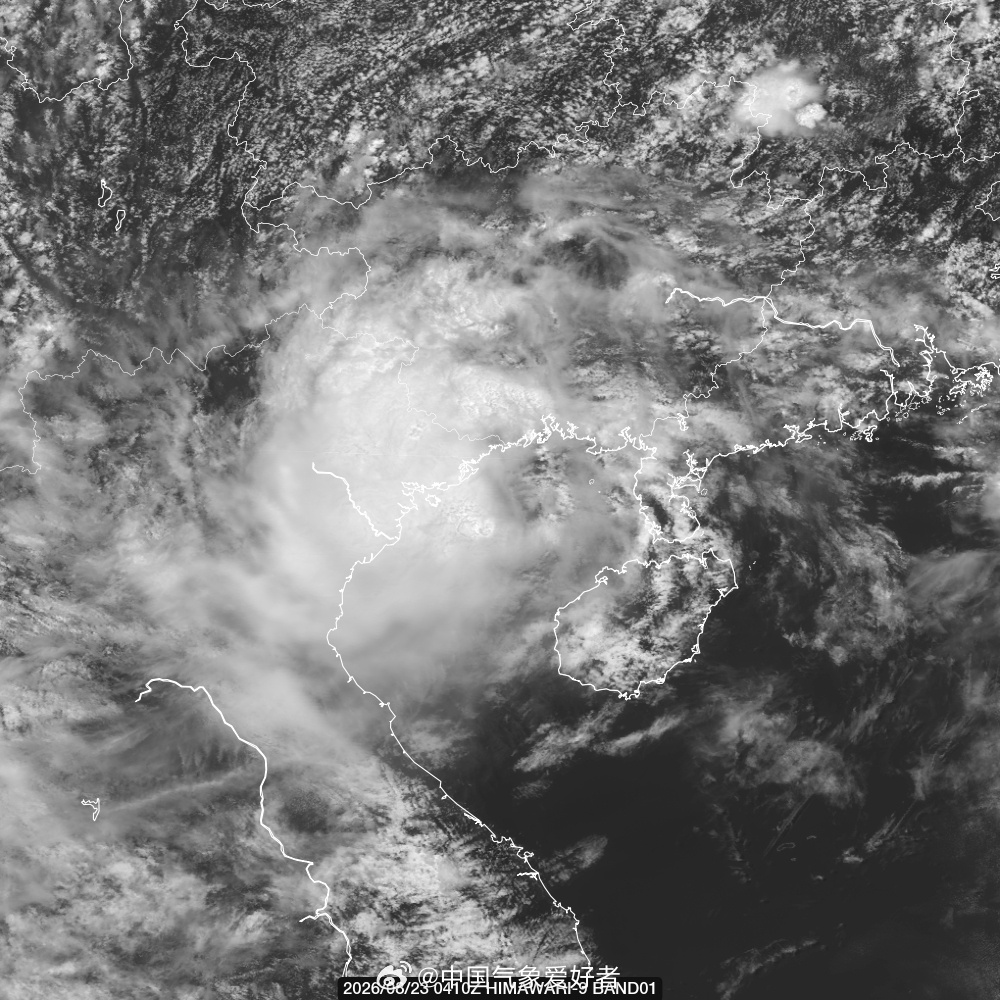
For nearly two days, Typhoon Purplewood has sat almost still over the Beibu Gulf, the body of water between Guangxi and Vietnam. Its center has moved less than 50 kilometers in 48 hours. Meteorologists on Weibo are calling it the strangest track of the year, and it is testing a region that rarely has to face a storm this patient.
The weather-enthusiast account that has been the most-cited source puts it in unusually vivid terms: Purplewood, the 19th named storm of the season, is trapped between two ridges of high pressure and a neighboring typhoon, and is spinning in place. Conditions have not changed, so it will keep spinning for three more days — long enough, the forecasters say, to produce something unprecedented: a homegrown, category-12 typhoon making direct landfall in Guangxi, a province that normally catches the edges of storms headed elsewhere.
The rain has already arrived. In Ningming, Pingxiang and Tiandeng, single-day August rainfall records fell over the weekend. Somewhere in Chongzuo, totals have passed 500 millimeters. Xinhua reported that 13 rivers have 19 monitoring stations above flood stage, with the Mingjiang River and its tributaries reaching six meters over the warning line. The provincial authorities raised a red flood warning — the highest level — for the first time in this storm.
The framing helps explain why this particular typhoon has grabbed attention. Typhoon season in the western Pacific is described this year as a golden age: every disturbance that forms a seed seems to earn a name. A satellite view posted by the same forecasters shows five cyclones in one frame, four in the western Pacific and one far to the east — what the forecasters call a "four pillars" pattern, a crowded sky.
For Guangxi, the warning is straightforward and delivered by the regional traffic radio station: the Mingjiang is entirely above its banks, the Zuojiang and Yujiang are still rising, and communities along the rivers should leave low-lying areas and watch for landslides and urban flooding. Yunnan, Guangdong and Hainan have all activated flood-defense responses.
The unusual thing about Purplewood is not that it is strong. It is that it is stuck. Typhoons usually trade in momentum — they arrive, they leave. A storm that lingers over warm water and feeds itself for a week is a different kind of threat, and Guangxi is about to demonstrate precisely how different.