Universities in China: From Elite Institutions to Factory-Like Environments
In recent days, a series of tweets have been circulating on Chinese social media platforms, specifically about a statement made by Tsinghua University professor Gan Yang. In an interview with Sanlian Life Weekly, Gan Yang highlighted the increasingly industrialized nature of universities, likening them to factories with departments functioning as production lines.
He described elite students at institutions such as Tsinghua, Peking, and other top universities in the country as exhausted and anxious, prone to burnout. The professor's comments have ignited a widespread debate, with many netizens expressing their agreement and frustration over the state of higher education in China. The tweets reveal that Gan Yang used eight words to describe modern students:
"fatigued, anxious, prematurely aged." He further elaborated on the correlation between the evaluation system in universities and the prevalent phenomenon of intense competition, stating that these two factors are interconnected and heavily burden students, who often become discouraged and disillusioned.
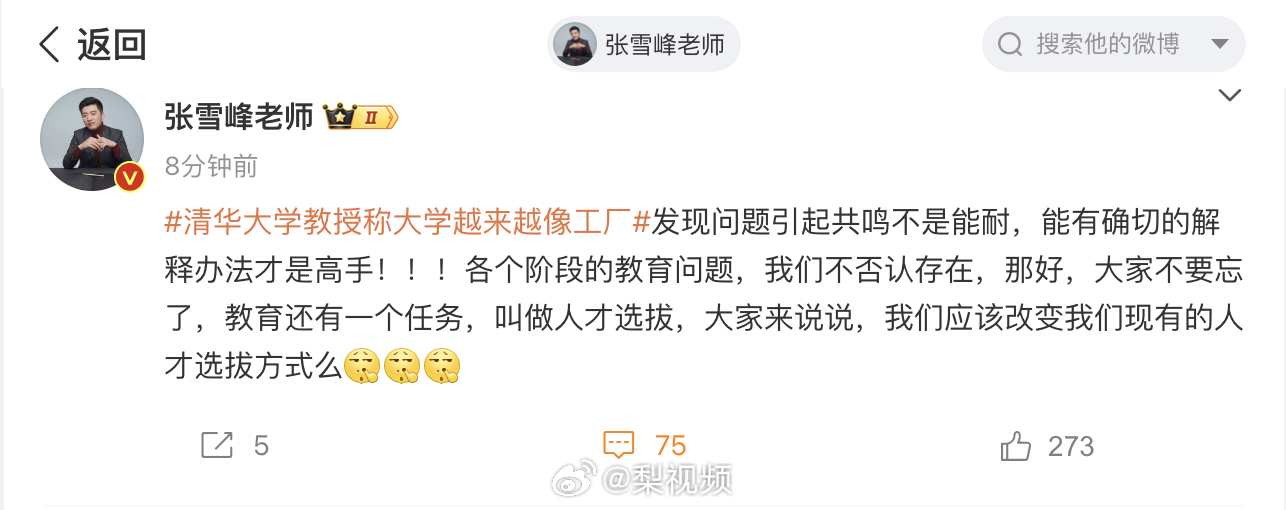
The conversation reached fever pitch when Dr. Zhang Xuefeng published an article, using the popular hashtag "#Tsinghua University Professor Says Universities Are Like Factories." In his response, Zhang echoed Gan Yang's sentiments, asserting that discovering problems isn't a sign of weakness, but a valuable opportunity to find concrete solutions.
He emphasized that the various stages of education should not be dismissed, and that society must not forget the primary goal of education: to identify and cultivate talents. Zhang's article resonated deeply with many netizens, who expressed their own frustrations with the current education system in China.
Referencing the assembly line-like nature of education, one user mused, "Students are taught the same subjects with the same grading standards. But isn't that what mass education is all about?" Another netizen, responding to Zhang's statement about selecting talents, questioned the current system:
"Should we change our way of identifying talent? It seems to me that we are more focused on competition and grading rather than nurturing students' potential." The tweets also featured discussions around the idea of university students being "like factory workers." Some argued that universities, like factories, do not produce unique products tailored to individual needs but rather churn out students who conform to society's expectations. Meanwhile, others pointed out the disparities between the work ethic of university students and that of the average factory worker.
While factory workers might earn a modest income, they would never consider staying up all night playing video games or going to bars without any concern for their studies. This observation has led some to question whether the high expectations placed on university students are entirely reasonable or fair.
Some netizens expressed support for Gan Yang's statement, looking forward to seeing his suggestions for improving the university system. Others, however, criticized the professor's assessment of students, arguing that responsibility for their well-being lies not only with the students themselves but also with their teachers and the institutions they attend.
A widely shared image in the discussion thread depicts a cartoon cow, seemingly making a satirical reference to the research conducted at some Chinese universities. The caption reads, "Research at some universities has become ridiculous." This highlights the broader concern that the relentless focus on producing successful students has resulted in a skewed education system, one that prioritizes grades and competition over creativity and critical thinking. Despite the criticisms leveled against universities and the education system, there is also a sense of hope among some netizens. They believe that by highlighting the problems, they are contributing to the larger conversation about how to improve education in China and create a system that better serves the needs of students and society as a whole. In conclusion, the debate surrounding Gan Yang's comments about universities highlight a growing concern in China about the state of higher education. While some view universities as increasingly industrialized, others argue that the focus on competition and grading has led to a system that prioritizes conformity over creativity. Ultimately, the hope is that this conversation will lead to meaningful changes in the way education is approached in China, with a renewed focus on nurturing talents and fostering an environment that encourages critical thinking and intellectual curiosity.
The Twitter conversation surrounding these issues has been thought-provoking and emotive, with many contributing their own experiences and perspectives. As the debate continues to evolve, it remains to be seen how the education system in China will adapt to address these concerns and create a more equitable and effective learning environment for its students.