Why a Rant About Having to Shout for Breakfast Struck a Nerve in China
A post about breakfast stalls where the loudest customer gets served first became one of Weibo's most-liked rants of the week, and the argument underneath it — about disorder, civility and who has to perform aggression to get their due — is a very Chinese one.
"I really hate things you have to scramble for," the post began, and then gave the example every Chinese reader instantly recognizes: the breakfast stall. "At the breakfast place, it's exactly like this — you only get served first if you shout loud enough." The post, signed by a Weibo user with a taste for the ordinary grievance, drew more than 7,800 likes and pulled the phrase "how I hate things that have to be fought over" (好讨厌需要靠争抢来的东西) onto the trending list, where it stayed for days. No celebrity, no scandal, no policy: just the morning congee queue, and the fact that the meek wait while the loud eat.
The comment threads beneath it turned into a confessional. People recalled shouting to place an order, wedging bodies onto buses, grandparents elbowing for discounted eggs at the supermarket — and, more revealingly, how long they had resented it. "I've hated, since childhood, this feeling of having to compete hard just to buy something," one top reply admitted. Another wrote of the anxiety learned at breakfast counters that never quite unlearns itself in adulthood. The screenshots circulating with the post are, fittingly, pictures of the comment section itself: the argument is the event.
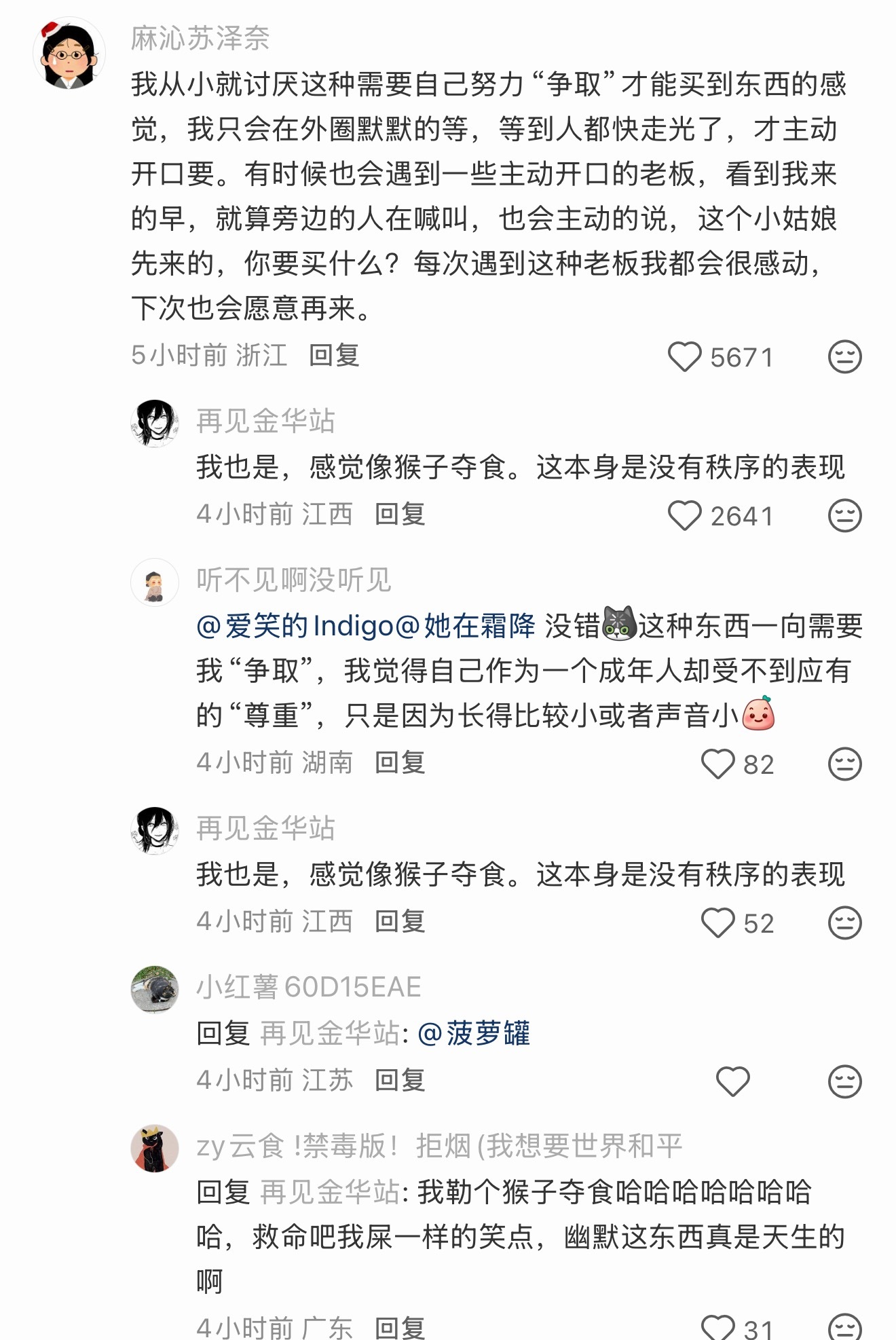
The most-quoted response tried to say why such a small thing stings so much. People do not actually resent competition, the reply argued — they resent "the tearing feeling of being forced to play the barbarian in disorder." Shouting over a vendor, shoving at a bus stop, violates the social reflexes most people are raised with; the mild-mannered must raise their voices and harden their faces simply to hold their place, and it is that forced self-distortion, not the scarcity itself, that humiliates. "When rules fail and the law of the jungle takes over, people can only trade aggression for a sense of safety" — and everyone leaves the transaction diminished.
That reading is why the topic traveled beyond breakfast. China has spent two decades, and considerable official effort, on campaigns for queuing, courtesy and "civic order," and in airports and subway stations the training shows. What the rant describes is the gap between the scrubbed public ideal and the ungoverned micro-queue at a steamer basket, where the only enforcement mechanism is volume. It is also, structurally, a trust problem: a queue that a shout can jump is a queue no one protects.
The responses the post collected did not propose fixes; almost all of them proposed exits. Filter out, the most popular essay-reply concluded, the relationships and resources that can only be won by scrambling, and spend yourself instead on what cannot be taken from you — clarity of thought, steadiness of mood, a professional moat. It is a strikingly individual answer to a collective failure, and a familiar one: when the queue cannot be trusted, the ambitions withdraw from it. The congee, meanwhile, still goes to whoever yells.