Weibo Banter Between Hu Xianxu and Wang Anyu Fuels New Travel Show, Signaling a Shift in Chinese Celebrity Promotion
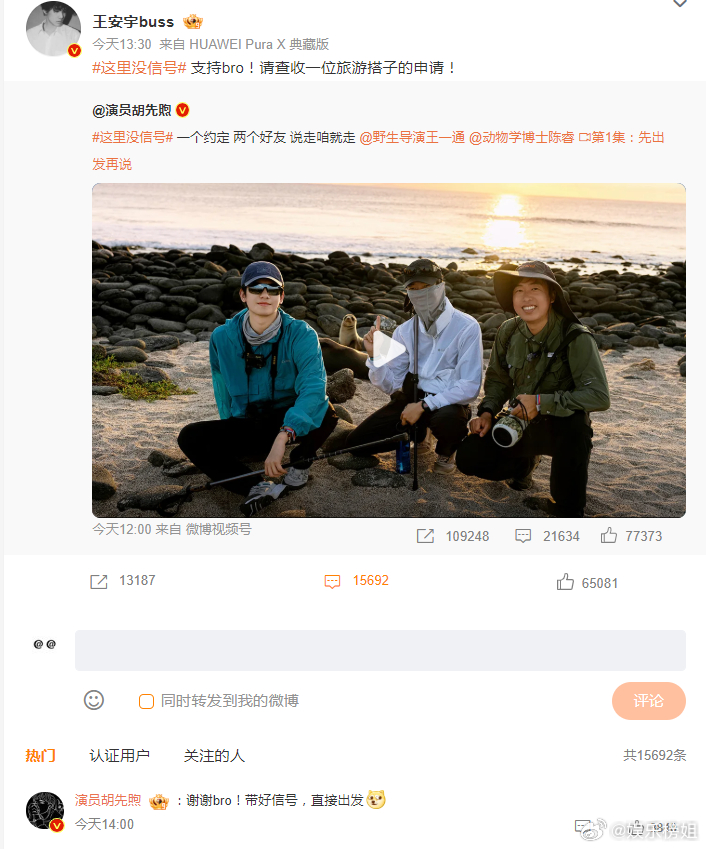
The Chinese entertainment world has been buzzing over a recent, seemingly simple exchange on Weibo between two of its most likable young stars: actor‑producer Hu Xianxu and his longtime “flower and youth” co‑star Wang Anyu. While the interaction itself—Wang reposting a supportive comment for Hu’s brand‑new travel variety series, “这里没信号” (literally “No Signal Here”), and Hu replying with a grateful “Thanks, bro! Bring good signal, let’s go directly!”—might appear modest, it has ignited a wave of nostalgic fan enthusiasm and highlighted a broader narrative of friendship, professionalism and savvy cross‑promotion.
The roots of the current hype stretch back to late 2023, when both men appeared together on the reality‑travel program “花儿与少年” (Flower and Youth). A seven‑minute, thirty‑seven‑second segment that aired on November 25, 2023, captured a minor disagreement about a travel itinerary. Hu gently rebuked Wang for not communicating his plans, prompting an initially apologetic response from the younger star. The tension was quickly diffused as Hu shifted his tone, offering reassurance and praising Wang’s effort. Netizens lauded the exchange as a textbook example of emotional‑intelligence communication within the high‑pressure environment of reality TV, drawing parallels to other notable interactions on the show and praising the respectful dynamic between the two.
The clip lingered in public memory. Throughout February 2024, fans revisited the footage, commenting on the pair’s ability to “listen and speak directly” and contrasting it with the more dramatic moments involving other cast members. Some online threads even playfully labeled Wang the “hard‑working brother” and Hu the “talk‑but‑do veteran,” a testament to the affectionate nickname culture that has grown around the duo. By October 2024, the conversation resurfaced yet again as a benchmark for effective conflict resolution among the “Flower and Youth” alumni.
Fast forward to August 2025. Hu has taken the reins of his own self‑produced travel series, “这里没信号,” a show that promises off‑the‑grid adventures and a focus on authentic, unfiltered experiences. With the series debuting this month, Wang used his sizable social‑media following to boost the launch, posting a supportive comment that read, “Support bro! Please check an application from a travel partner!” Hu’s quick reply—“Thank you bro! Bring good signal, let’s go directly!”—was promptly shared across fan groups, sparking a cascade of hashtags such as #胡先煦回应王安宇 and #HuXianxuConnections.
The response on Weibo has been overwhelmingly positive. Fans, many of whom have followed the pair since their “Flower and Youth” days, have praised the “bro” language as a refreshing display of camaraderie in an industry often dominated by rivalry. The phrase “花少售后🈶” (literally “Flower and Youth after‑sales available”) has trended, framing the duo’s continued interaction as a beloved extension of the show that originally brought them together. Commentators note that the exchange does more than celebrate personal friendship; it serves as an effective cross‑promotion, funneling attention from Wang’s extensive fan base directly to Hu’s nascent series.
Industry observers also see the episode as illustrative of a shifting promotional model in Chinese entertainment. Rather than relying solely on traditional advertising, stars increasingly leverage their personal relationships to generate organic buzz. In this case, Wang’s endorsement functions as a seal of approval that resonates with younger viewers who value authenticity and peer recommendation over polished PR campaigns.
As “No Signal Here” rolls out, early viewership numbers suggest the strategy is paying off. Episodes have trended on streaming platforms, and discussions on forums frequently reference the supportive banter between Hu and Wang. The friendly back‑and‑forth has not only reinforced the actors’ individual brand images—Hu as an earnest explorer and Wang as a loyal teammate—but also underscored a broader fan desire for genuine, unscripted connections among celebrities.
In short, a brief Weibo exchange has become a microcosm of modern Chinese pop culture: a blend of nostalgia, genuine friendship, and strategic self‑promotion. For fans, it reaffirms the warmth of the “Flower and Youth” family; for the industry, it offers a template for how personal rapport can translate into measurable audience engagement. As the two continue to collaborate—whether on travel expeditions, variety programs, or social‑media shout‑outs—their bond remains a bright spot in a rapidly evolving media landscape.