Calm, Not Showy: The Chinese Debate Over What 'Living Well' Actually Looks Like
A trending Weibo question asks what the clearest sign of a person who is truly doing well looks like, and the most-liked answers are not money or travel but emotional calm, neat hands, good skin and an absence of performance. The discussion is a window into how Chinese social media now reads class and contentment through the body.
The question trending on Weibo this week sounds like small talk, but it has pulled in thousands of replies. What, Chinese users are asking, is the clearest sign that someone is truly doing well?
The top answers are not wealth, vacations or imported cars. They are bodily: smooth hair, clean teeth, neat hands, straight posture. Equally praised are temperamental clues — a person who is 情绪稳定 (qíngxù wěndìng, emotionally stable), unhurried, and free of 戾气 (lìqì, aggressive bile). One widely shared post collected the replies into a set of cards, and the common denominator is a person who does not need to prove anything.
Take the physical details. Commenters point to “hands that look tender,” “clothes that are always tidy,” teeth that are even and skin that is smooth. The logic is close to the old Chinese concept of 养尊处优 — being well cared for over time — but reframed for a consumer age. These are things money helps with, yet the signal is not the brand. One reply put it plainly: good skin, a good figure and good hair are “indicators of long-term pampering.”
Then comes the counterargument. Some users push back on the idea that the truly happy are always serene. One comment argues that genuinely content women are often outgoing and direct rather than merely quiet and stable, and points to Wang Xifeng, the flamboyant, sharp-tongued matriarch's niece from Dream of the Red Chamber, as the model of a woman who is unmistakably alive. The exchange captures the underlying dispute: whether calm is proof of a good life, or sometimes the residue of one that has learned to keep its head down.
Around the edges is a second, more cynical observation. A separate post in the trend argues that people who truly live well tend to keep quiet, while those who post constantly about their lives may be filling a void — performing the contentment they do not feel. It is a very Chinese-internet twist: even the act of joining the discussion can be read as evidence about which side you are on.
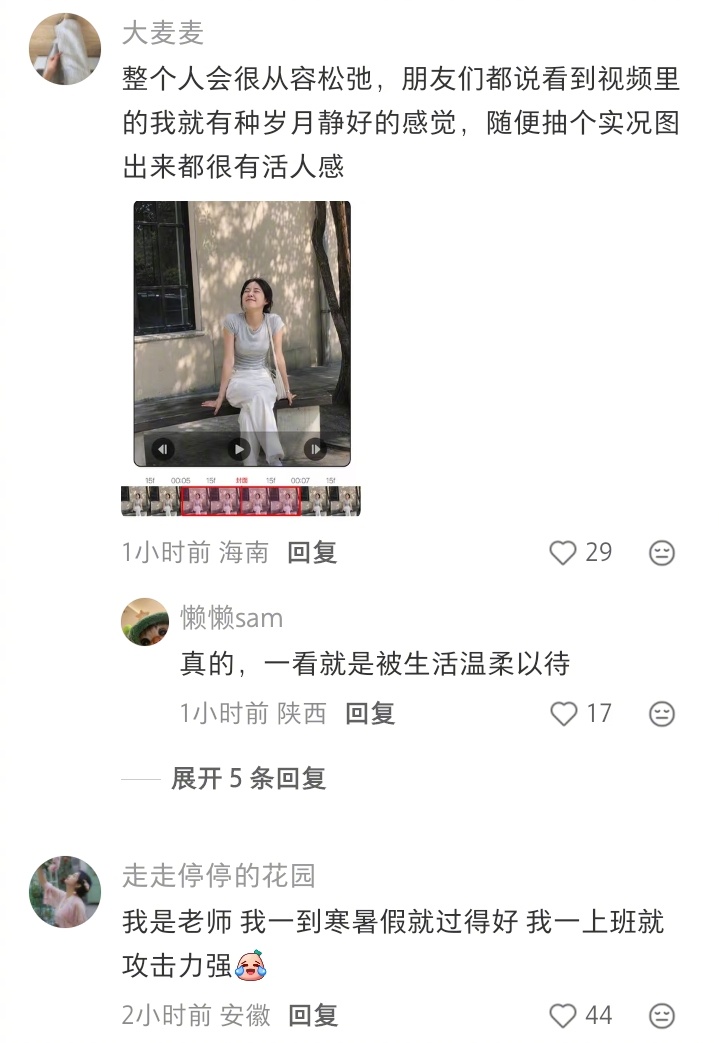
The whole episode is best understood through two words that have become aspirational shorthand in recent years. One is 松弛感 (sōngchí gǎn), an almost untranslatable quality of looseness and ease under pressure. The other is 情绪稳定, emotional stability — now a near-mandatory trait in dating profiles and job interviews. Together they describe a generation that has grown tired of hustle and is starting to treat unruffled calm as the real luxury.
What is striking is that none of the answers describe what the person actually does. Living well, in this formulation, is something you can see before anyone tells you — in a face that doesn't frown, hands that don't look worn, and a feed that doesn't try too hard.