World Marks 80th Anniversary of Japan’s WWII Surrender as Historic Footage Goes Viral】
On September 2, 1945, at 9:18 a.m. Tokyo Bay, the world witnessed a scene that would come to symbolize the end of the deadliest conflict in human history. A delegation of Japanese officials signed the Instrument of Surrender aboard the U.S. battleship USS Missouri, sealing the formal conclusion of World War II and, for China, the culmination of a fourteen‑year struggle known as the War of Resistance Against Japanese Aggression. The footage of that moment—often described in Chinese as “日本签署投降书画面” or “scenes of Japan signing the instrument of surrender”—has resurfaced on social media this week as the 80th anniversary is observed, prompting a fresh wave of remembrance, reflection, and discussion across the globe.
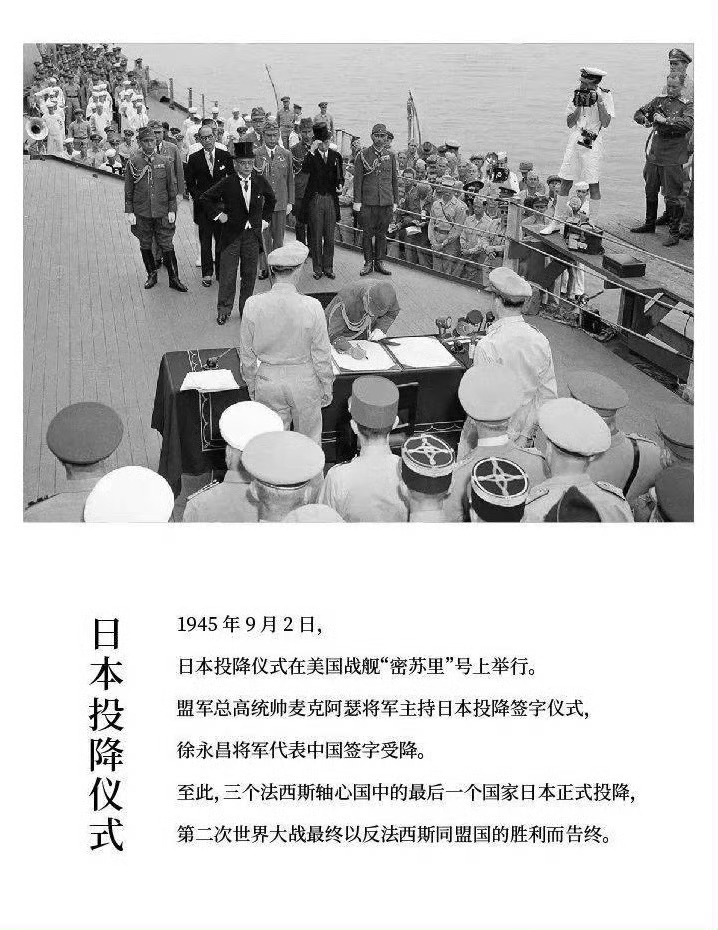
The Japanese delegation was led by Foreign Minister Shigemitsu Mamoru, who signed on behalf of Emperor Hirohito and the Japanese government, and by General Umezu Yoshijiro, chief of the Imperial Japanese Army General Staff, representing the Imperial General Headquarters. Standing alongside them were the representatives of the Allied powers: Fleet Admiral Chester W. Nimitz, commander‑in‑chief of the U.S. Pacific Fleet, signed for the United States; General Richard Sutherland, an American army officer, bore witness; and General Xu Yongchang, head of China’s Military Affairs Department, signed for the Republic of China, one of the victorious Allies. The ceremony was a tightly choreographed act of diplomatic theatre, designed to underscore the total defeat of the Japanese war machine and the emergence of a new, cooperative world order.
The political reverberations of that day were immediate and lasting. The surrender paved the way for the creation of a United Nations‑centered international system, replacing the imperialist and militarist hierarchies that had dominated the interwar years. In Japan, the capitulation marked the definitive end of militarism and set the stage for a radical transformation: under Allied occupation, the nation embarked on a comprehensive democratization and demilitarization programme that rewrote its constitution, redefined civil liberties, and reshaped its political institutions. Across Asia, the collapse of Japanese colonial rule unleashed a cascade of independence movements. Former occupied territories—from Korea to Indonesia, from Vietnam to the Philippines—found the political space to assert sovereignty, reshaping the continent’s geopolitical map even as the emerging Cold War sowed new tensions.
For China, the surrender held a particular resonance. The formal signature by General Xu Yongchang was a powerful affirmation of China’s contribution to the Allied victory and a symbolic vindication of the sacrifices endured during the protracted conflict that claimed millions of Chinese lives. Contemporary Chinese netizens, especially on platforms such as Weibo, are using the anniversary to honor those sacrifices, recount the long, arduous struggle, and emphasize a narrative of national resilience. The visual record of the signing—augmented by rare color footage that brings the historic tableau into vivid relief—has become a focal point for patriotic commemoration, underscoring how a single image can encapsulate collective memory.
Beyond politics, the surrender’s social impact reverberated through post‑war societies. The images of defeated Japanese officials kneeling before Allied representatives have become ingrained in the collective memories of nations that suffered under occupation, fueling a potent mix of nationalist pride and lingering historical grievances. In Japan, the same footage has spurred ongoing debates about historical responsibility and revisionism, reflecting a society still wrestling with how to reconcile its wartime legacy with its post‑war identity. Internationally, the aftermath of the war accelerated the development of human‑rights norms and the global consensus that atrocities must be prosecuted, an ethos that continues to inform contemporary international law.
Economically, the surrender signaled the dissolution of Japan’s pre‑war colonial economic network, opening the door for a new, export‑driven industrial model. Though Japan’s factories lay in ruins, American aid, combined with Japanese ingenuity, a highly skilled workforce, and a relentless focus on technology and quality, propelled the nation into a period of “economic miracle” that would, within a few decades, elevate it to the world’s second‑largest economy. This rapid reconstruction not only altered Japan’s domestic landscape but also reshaped the global industrial order, contributing to a more diversified and interlinked world economy.
As the 80th anniversary unfolds, the circulation of the historic footage on social media serves a dual purpose: it reminds the world of the profound human cost of war and it underscores the fragile peace that has endured for eight decades. While some commentators note the lingering diplomatic sensitivities—particularly regarding how Japan acknowledges its wartime actions—the broader sentiment is one of reverence for the moment when, in a solemn ceremony on the deck of a battleship, the guns fell silent and a new chapter began. The images of that day continue to inspire reflection on how nations can move from conflict to cooperation, a lesson as vital today as it was in 1945.