Yang Mi’s Touching Reply to Xing Fei Sparks Nationwide Praise for the “Sheng Wanwu” Finale】
In the feverish wake of the finale of the Chinese drama *Sheng Wanwu*—literally “All Living Things”—social media commentators and fans alike have turned their attention to a single, resonant phrase that has lit up Weibo: “杨幂回复邢菲” (Yang Mi replies to Xing Fei). The expression, which began as a simple reference to a supportive comment posted by veteran star Yang Mi, has blossomed into a virtual rallying cry for the emotional depth and luminous performances that defined the series’ closing chapters.
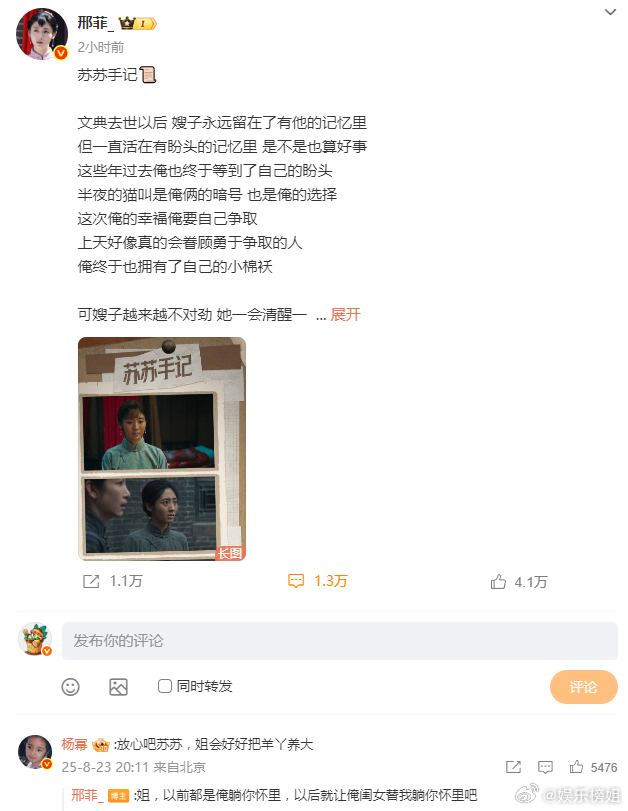
Sheng Wanwu aired its final episode in early August, and the concluding scenes have sparked an outpouring of tears, nostalgia and admiration that is striking in its intensity. At the heart of the drama’s emotional climax is the bond between Ning Xiuxiu, played by Yang Mi, and her younger “sister” Su Su, portrayed by rising actress Xing Fei. In a poignant exchange, Xiuxiu promises, “放心吧苏苏,姐会好好把羊丫养大” (“Don’t worry, Su Su—your older sister will raise the little sheep well”), a line that has been quoted and retweeted countless times. The promise underscores the narrative’s central theme of sisterhood and mutual support, and it resonated deeply with viewers who described the moment as both heartrending and heroic.
The most talked‑about segment is the so‑called “runaway horse lantern” (走马灯) sequence, in which Xiuxiu’s life flashes before her eyes in an eight‑minute uninterrupted shot. The montage, coupled with an elaborate “elderly makeup” transformation, showcases Yang Mi’s capacity to embody a character across decades, navigating love, loss and the inexorable march of time. On Weibo, users have lauded the scene as a “封神 ending” (a legendary finish) and declared that it “made them cry,” with comments ranging from the straightforward “看完哭了” (“I cried after watching”) to the more emphatic “俺哭爽了” (“I cried my heart out”). Even the most critical observers have softened, noting that the drama’s conclusion, though occasionally described as “烂尾” (a poor ending), was overwhelmingly redeemed by the performances.
Yang Mi’s portrayal of Xiuxiu has been described in the local press as a “满分的答卷” (a perfect answer sheet). Critics point to her nuanced delivery, especially in the older‑age scenes where the weight of years is conveyed through subtle gestures and a meticulous makeup design. The actress’s ability to navigate the emotional breadth of the character, from youthful optimism to stoic acceptance, has been highlighted as a masterclass in range.
Xing Fei, meanwhile, has been praised for her sincere and compelling embodiment of Su Su, a character who endures profound hardship while retaining a fierce spirit of resilience. Her performance has been described as “too good at acting,” prompting a chorus of fan pleas for a second collaboration with the veteran Mi: “求杨幂邢菲二搭,俩人太会演了” (“Please give Yang Mi and Xing Fei another pairing; they are both amazing”). The chemistry between the two actresses, both on‑screen and, it appears, off‑screen, has become a centerpiece of the online discourse.
Beyond the fictional universe, the phrase “杨幂回复邢菲” has taken on an additional layer of meaning. A recent interview saw Xing Fei publicly acknowledging that Yang Mi had helped her navigate a difficult “native family dilemma” (原生家庭困境). While the exact nature of that mentorship remains private, the revelation has further humanized the bond, blending the actresses’ real‑life camaraderie with their on‑screen sisterhood. Fans have interpreted the exchange as a symbol of female mutual aid—a warm, if not idealized, illustration of how established stars can lift emerging talent.
The flood of reactions also highlights how Chinese social media can elevate a single line of dialogue into a cultural moment. Users have commemorated the series’ most memorable moments, from the eight‑minute long shot in the old house to the final heartbreaking vows, using the hashtag #杨幂回复邢菲. The collective sentiment is unmistakable: viewers are emotionally invested, deeply appreciative of the craft, and eager for future projects that reunite the pair.
In the broader context of Chinese television, Sheng Wanwu stands out as a drama that combined high production values, literary storytelling and powerful performances to create a cultural touchstone. The wave of praise shaping around Yang Mi’s reply to Xing Fei underscores how a well‑executed narrative can transcend the screen, spawning goodwill, fan activism, and even a narrative of personal support that blurs the line between fiction and reality. As the entertainment industry watches, one thing is clear—both actresses have solidified their places at the forefront of contemporary Chinese drama, and audiences will be waiting with bated breath for the next chapter of their on‑screen partnership.