The ¥100 Seafood Hotpot That Brought Fujian's Zhu Fugui a 500-Million-Yuan Year
A Fuzhou hotpot brand has become China's quiet restaurant phenomenon by slashing the price of a seafood feast from around 300 yuan to barely 100, using scale, short supply chains, and a one-pot-per-diner format. The line outside its 208-table flagship is now the business story visitors post most.
The queue outside Zhu Fugui, a seafood hotpot chain that started in Fuzhou, has become its own kind of travel recommendation. "208 tables and still a daily line," reads one writer's account. A diner in Xiamen put it more viscerally: "My friends kept saying I had to try it. I finally went, and the line was a hundred tables deep — though, honestly, it moved fast."
What the chain has done is straightforward on paper and difficult in practice. The seafood hotpot experience in China's coastal south traditionally runs about 300 yuan a head — a real restaurant meal, not a casual lunch. Zhu Fugui cut that to roughly 100 yuan, kept the seafood fresh, and built a model that lets diners each have their own small pot rather than sharing one communal broth. The result is a chain that reported five hundred million yuan in revenue in 2025 and expects eight hundred million in 2026, according to its own projections.
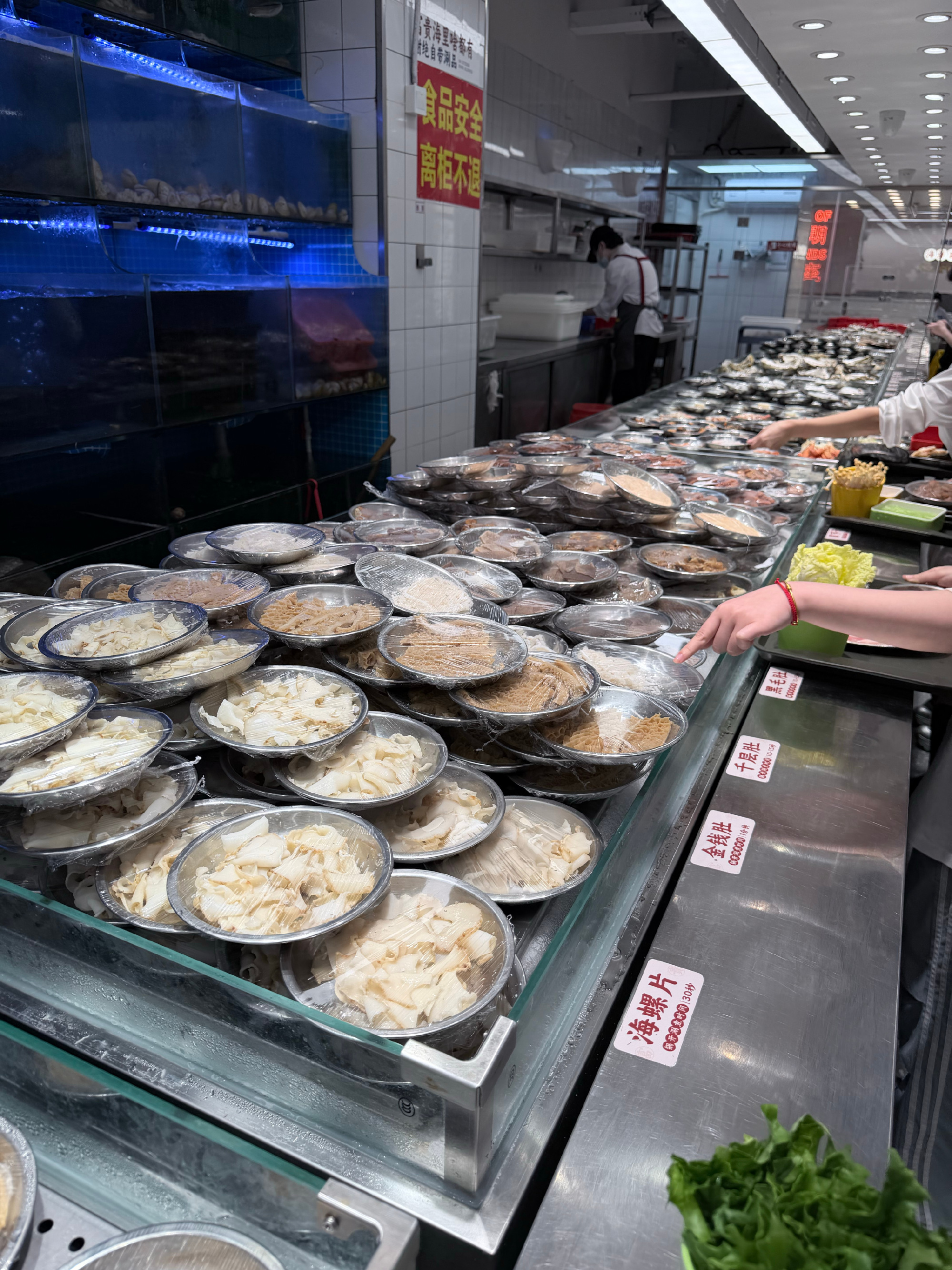
The food tells the story better than the numbers. In the buffet-counter photos diners post, rows of metal bowls hold conch slices priced at 68 yuan per half kilogram, beef tripe, thousand-layer tripe, and original-cut fatty beef — the quotidian grammar of a Chinese all-you-can-take seafood bar. One photo shows a counter spread of sliced meats, seafood, and greens around a pot of orange broth, the kind of table the phrase "seafood freedom" attaches to online.
A word of caution that probably interests no one but is everywhere in the photos: the wall signs stress food safety and warn that marine and freshwater products may contain parasites and must be fully cooked. That is standard Chinese restaurant signage, but it reflects the reason the format works — the ingredients are raw, the diner cooks, and freshness is the entire product.
How it works at this price is the part of the story mainland consumers argue about. The chain's scale lets it buy seafood directly and in volume — it claims a short, self-controlled supply chain with minimal markup between dock and counter. The single-serving pot cuts waste and sharing friction, which speeds turnover on those 208 tables. And the brand concentrated on Fuzhou first, saturating one market before spreading across Fujian and beyond.
There is a cultural echo for anyone who has watched China's restaurant business treat hometown food as intellectual property. Hotpot is a Sichuan invention; seafood wants to be Cantonese; and Fujian's own cuisine, Min Dynasty cooking, is famous for being precise but has no single outgoing blockbuster dish. Zhu Fugui's trick is to take a format the country already loves and apply it to the thing Fujian does best — cheap, honest seafood — without pretending to be anyone else's cuisine. The queue outside the Fuzhou flagship is the proof that scale, more than a viral gimmick, can be a flavor."