Anita Mui's Mother Dies at 102, Ending the 23-Year Battle Over the Singer's Estate
Tam Mei-kam, mother of Cantopop legend Anita Mui, died on Sunday at 102, closing the 23-year legal war over Mui's estate. The trust Mui signed from her deathbed in 2003 — a monthly allowance for her mother, the remainder to a Buddhist society — held to the end.
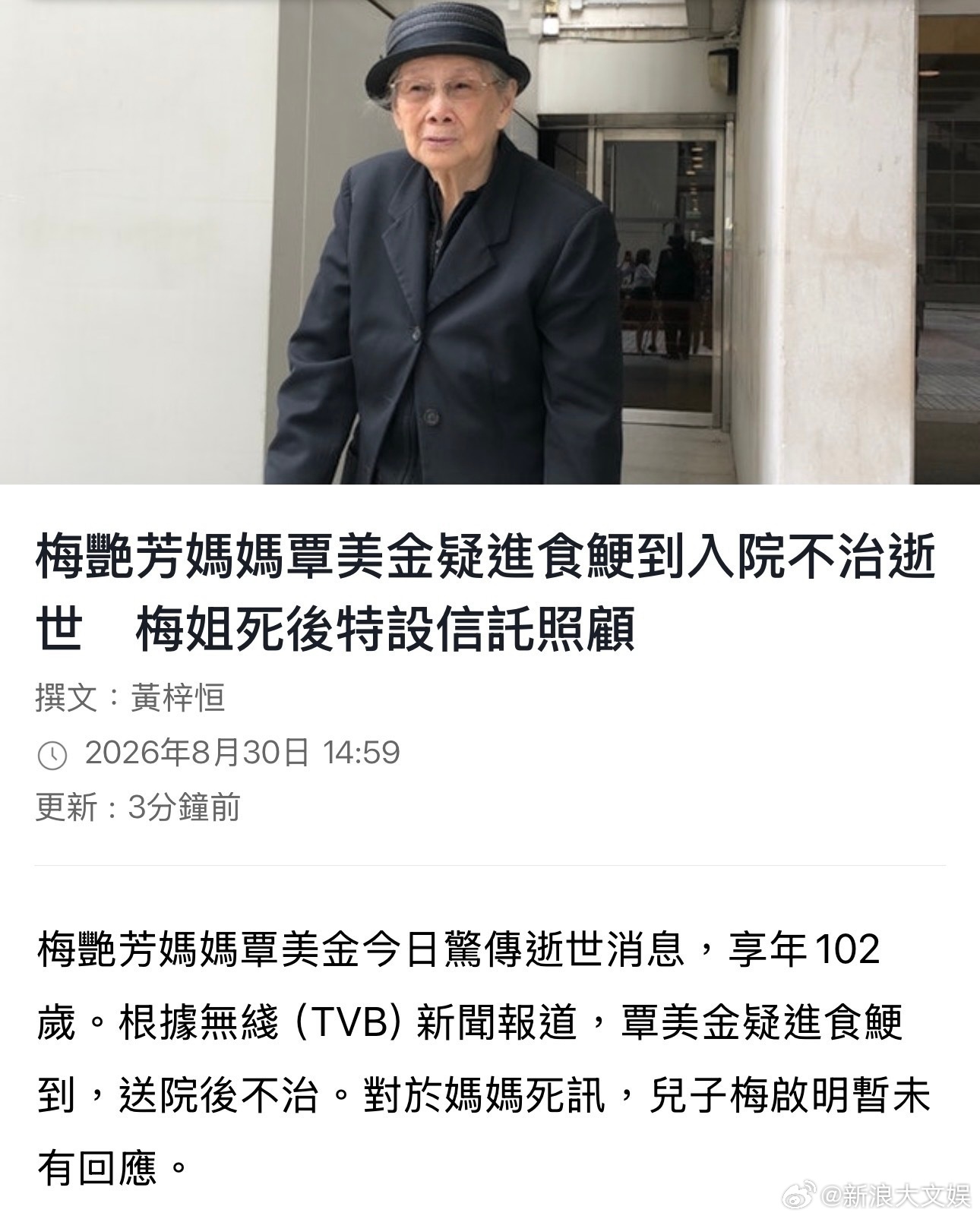
Tam Mei-kam, the mother of the Cantopop star Anita Mui, died in Hong Kong on Sunday at the age of 102, reportedly after choking during a meal and dying in hospital despite emergency treatment. Her death closes, at last, one of the longest-running inheritance sagas in Chinese-speaking popular culture: a 23-year fight between Mui's mother and the trust fund Mui set up from her deathbed to protect both of them.
Anita Mui Yim-fong, who rose from child performer on Hong Kong's Temple Street to become the "daughter of Hong Kong" and one of the biggest pop stars in Asia, died of cervical cancer in December 2003 at 40, having also lost an older sister to the same disease. She left an estate of close to HK$100 million — and no immediate family she trusted to manage it. Her mother was, by the account of those writing about the family this weekend, a gambler who spent freely and managed money badly. So Mui signed her will while receiving treatment and put roughly HK$30–35 million into a trust administered by HSBC.
The terms, as recapped by Weibo users poring over the saga after her death was announced, were precise. Her mother would receive a monthly allowance — HK$70,000 at first, later raised to HK$250,000 — plus a driver and a domestic helper. Nieces and nephews would share a HK$1.7 million education fund. Two properties would go to Liu Peiji, the designer who was her closest friend. And when Tam died, whatever remained would pass to the Miaojing Buddhist Society (妙境佛学会).
What followed was two decades of litigation. Tam sued the trustees again and again, unwilling to accept a monthly allowance when she wanted her daughter's entire estate, and the courtroom battles — covered by Hong Kong's tabloids each time — turned the estate into a parable about filial duty, money and a daughter's foresight. Commenters this weekend were blunt: one post that recapped the trust's terms argued that Mui, by locking the fortune into monthly payments, had chosen "a deeper kind of protection" for a mother she could not trust with the principal — support that could not be gambled away, whatever else happened.
The story broke out of Hong Kong's own bubble on Sunday, taking three separate spots on Baidu's news board at once: Tam's death, the end of the 23-year case, and the response of Mui's only surviving sibling, her brother Mui Kai-ming.
With Tam gone, the trust's remaining assets should now flow to the Buddhist society, exactly as instructed in 2003. The succession is unlikely to be simple — the estate has been contested in one courtroom or another for 23 years — but the core arrangement has already outlasted every challenge to it. The monthly allowance, the item the family fought over for two decades, lapsed this weekend; what remains of the estate goes where Mui pointed it more than twenty years ago.