Apple's Weather App Told Half of China It Would Hit Minus 32. The Meteorologists Pushed Back.
When iPhone Weather began showing lows of -32°C for Beijing, Shanghai and Hangzhou on the same November day, China's forecasters had to publicly reassure the country — and one city weather account's plea for users to check its own app instead became the story's funniest footnote.
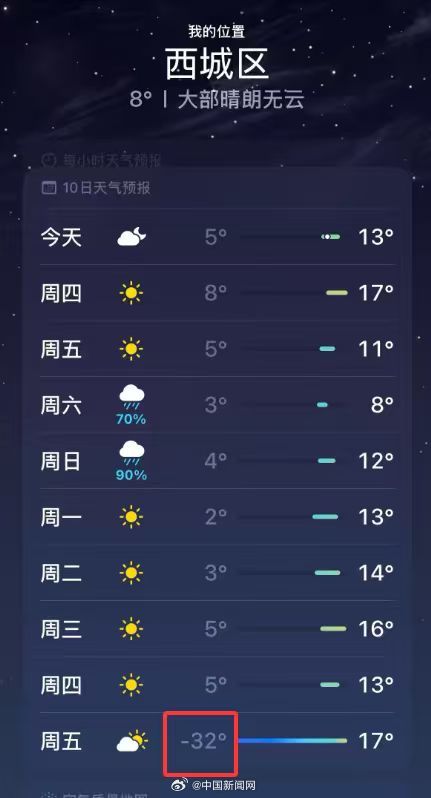
For a few hours on November 4, iPhone owners across China compared forecasts and got the same improbable answer: next Friday, November 13, the temperature would plunge to around minus 32 degrees Celsius. Beijing, Shanghai, Hangzhou, Hefei, Suzhou, Qingdao — cities hundreds of kilometers apart, in some cases a 50-degree swing within a single day — all showed the same deep-freeze. Screenshots piled up, and "Apple Weather suddenly shows -32" was trending on Weibo by early morning.
The numbers were nonsense, and everyone whose job it is to know that said so quickly. The China Meteorological Administration told reporters it had issued no such forecast and would certainly announce any genuinely extreme weather in advance; the official China Weather account dismissed the viral screenshots with a breezy "nothing to see here" — noting, almost in passing, that even with El Niño now the strongest on monitoring record, it would not get that cold that fast. Within hours Apple acknowledged a data anomaly, said its technical team had fixed it, and the November 13 forecast returned to normal.
What turned a routine app bug into a national conversation was a mix of timing and folklore. China is deep in a cold-snap season — the country's meteorologists are warning of the strongest El Niño ever measured, with more frequent cold waves than usual this winter — so a -32°C reading, however absurd, did not arrive in a vacuum; it arrived plausible enough to be screenshot-able. And Apple's weather service in China has a long tail of trust issues, from years of data-sourcing complaints to the running joke that its icons lag reality. A glitch that once would have been an IT footnote now lands on an app tens of millions of Chinese check first every morning.
The best moment belonged to the professionals. Guangzhou Weather, the city's official forecast account, posted a plea that reads like an employee at the end of a very long shift: "iPhone, I'm trapped by my own walls — please, everyone, just check the Guangzhou Weather app, or management is going to make me issue a response. Save the children." It attached four screenshots of its own, entirely sensible, forecast.
Underneath the humor sits a real shift. For two decades, Apple's built-in apps defined the baseline experience of a smartphone in China; now, homegrown alternatives — from Amap's weather channels to government-run city accounts with personalities — are the ones users turn to when something looks off. A foreign device hiccuping through a cold wave is no longer just an inconvenience; it is an occasion for the local forecasters to remind everyone who actually watches the sky.