China's Most Famous Robot Was Carried Down Mount Tai on a Stretcher
Unitree's star competitor overheated mid-race at the first robot Mount Tai climbing contest, and the viral image of workers stretcher-carrying it downhill has become China's most candid snapshot yet of the gap between humanoid hype and reality.
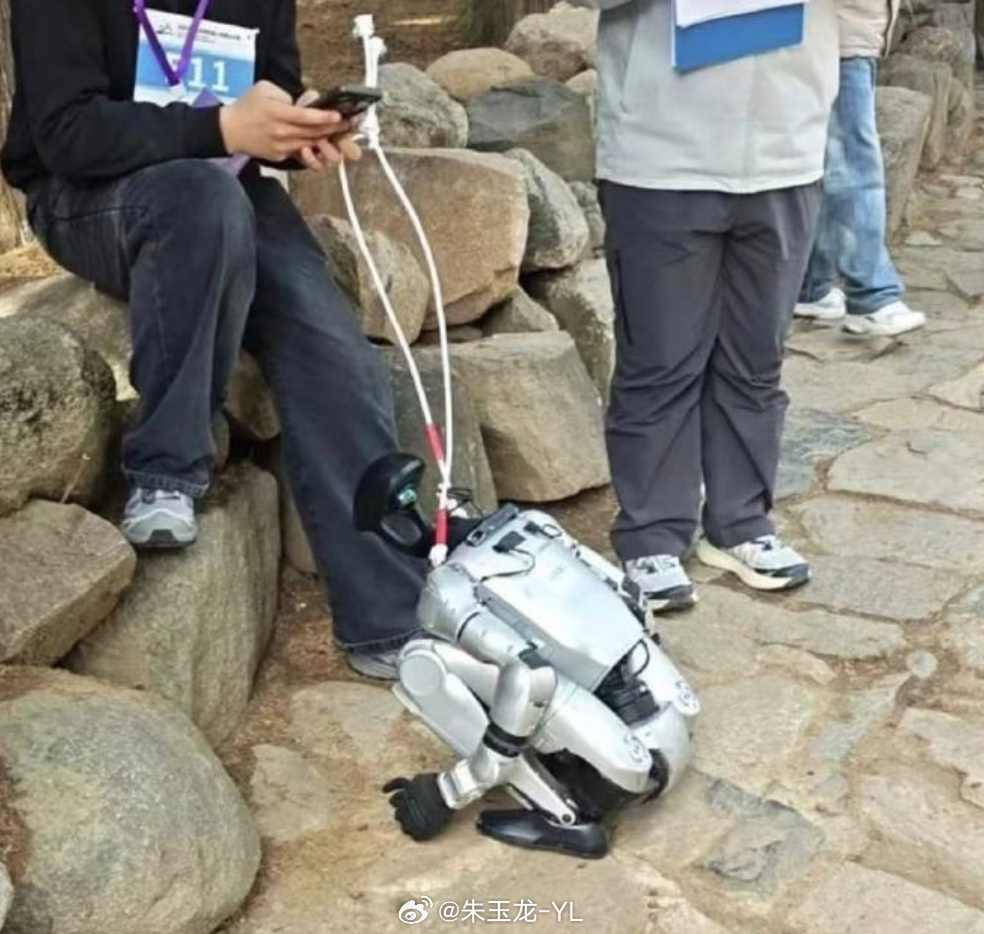
At China's first robot Mount Tai climbing contest, the star of the show was carried back down on a stretcher.
The inaugural CMG World Robot Mount Tai Competition, held in Tai'an, Shandong, on November 2, sent humanoid machines up a 3.9-kilometer mountain course with more than 3,100 uneven stone steps. Among the entrants was a Unitree G1 — the same model that danced on the Spring Festival Gala — fielded by a team called Yongda Zhicheng. It never finished. Around halfway up, the operator judged the machine was overheating from the sustained, high-torque climbing and withdrew it for safety. Staff strapped the robot to a blue stretcher and workers in orange vests carried it down the mountain like an injured hiker.
The image did more than any marketing campaign could have. It spread across Weibo and Douyin, and on Zhihu — where the question "how should we view the Unitree robot being carried down Mount Tai on a stretcher?" drew 2.16 million heat — precisely because it punctures the reigning picture of Chinese humanoid robots. The videos that built Unitree's reputation show machines doing kung fu and lifting cars in clean, controlled settings. A damp mountain staircase is a different physics problem: irregular steps, low friction, and an energy demand that turns heat management from a footnote into the failure mode. One engineer watching the race put it plainly: some competitors wobbled "one step forward, three steps back," and one was walked up the hill by a rope around its neck — no shame in that, he wrote, but complex terrain is exactly where these machines still need work.
That candor is itself the story. The race was co-organized by state broadcaster CMG, and the coverage made no effort to hide the stretcher, the stumbles or the struggling batteries. A public failure by a national-champion robot maker would once have been edited out; here it became the image of the day. The honest framing mirrors how Chinese robot companies now talk about themselves — Unitree's flashy demos come with escalating disclaimers, and engineers openly list terrain adaptability and thermal limits as open problems.
The rest of the field told the same story. The first robot to complete the full climb wobbled visibly through the final staircase, and most finishers needed at least some human handling. Organizers built the event deliberately as a stress test rather than a showcase — a way to surface failure modes in public, on camera, before these machines face their intended jobs: elderly care, delivery, patrol work in the hilly, rural China where stairs outnumber ramps.
Unitree, for its part, lost a race and gained something like affection. The most-shared reaction to the stretcher photo was less mockery than sympathy — a machine that tried, overheated, and got the same treatment as a tired climber. That is a long way from where the humanoid hype started.