BRICS Gathers in New Delhi as Xi Pays His First India Visit in Seven Years
Xi Jinping arrived in New Delhi on Saturday for the 18th BRICS summit — his first trip to India in seven years — and met Narendra Modi the same day, as Putin mocked the G7's shrinking share of world GDP and Beijing prepared to take over the bloc's chairmanship in 2027.
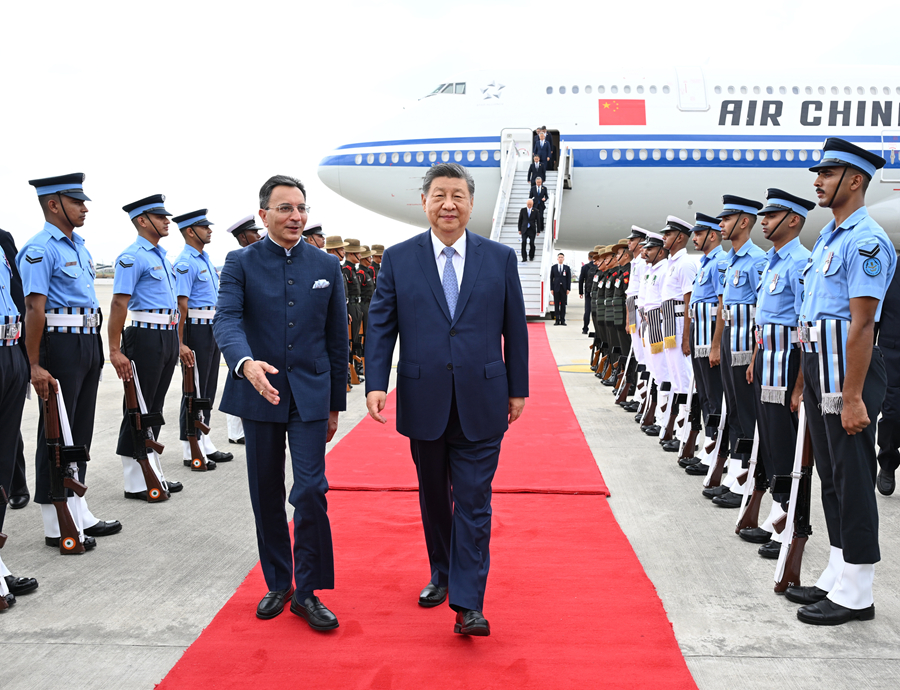
Xi Jinping's plane touched down at New Delhi's Palam air force base shortly after midday on Saturday, the first time China's president has set foot on Indian soil since 2019. An honor guard and a red carpet were waiting, and so was Narendra Modi: the two leaders met the same afternoon, their third meeting in as many years after Kazan in 2024 and Tianjin in 2025 — a rhythm that would have been hard to predict when border clashes killed soldiers on both sides of the Himalayan frontier in 2020.
The summit owned Chinese social media all day. Xi's arrival held the top slot on Weibo's trending list into the evening, Baidu's search board filled with summit items, and CCTV, The Paper and Yicai all carried the Modi meeting within minutes of it ending. As our preview noted, the meeting sits against a deliberate thaw — resumed direct flights, eased visa rules and pilgrim travel — even though the 2020 border standoff remains unresolved.
Speaking in the summit's opening session, Xi marked two decades since BRICS began as a grouping of emerging economies and told fellow leaders the bloc must "stand firmly on the right side of history." 疾风知劲草,烈火见真金, he said — the strong wind reveals the sturdy grass; raging fire proves true gold. He announced that China will take over the bloc's rotating chairmanship in 2027 and host the nineteenth summit, and turned to the war in the Gulf, calling it against "the shared interests of the international community" and offering a four-point Chinese proposal aimed at a "permanent and comprehensive ceasefire."
Vladimir Putin supplied the clip that traveled furthest on Chinese feeds. At the BRICS Business Forum he noted that BRICS economies now account for more than 40 percent of global GDP against the G7's 29 percent, and said he could not understand why the group still calls itself "great powers." "Why 'seven'? Where is the bigness? Wherever you look, it is hard to even see them on a map," he said, in a passage carried by Hong Kong's Wen Wei Po and flagged by China News Service, which also noted that Putin named Huawei among Chinese firms whose global reach proved the point. He went on to accuse Western rivals of competing "in an unseemly form" — citing strikes on industrial and logistics facilities, hijacked ships and the threat of secondary sanctions.
Not everyone reads the summit as momentum. Deutsche Welle's Chinese service, also trending on Saturday, argued the gathering may achieve little: the border question is unresolved and the enlarged eleven-member bloc remains divided on fundamentals. The official readout of the Xi–Modi meeting was long on atmospherics and short on announced agreements.
Beijing, for its part, spent the day emphasizing delivery over drama. State media pushed the story of a "smart and secure" China–South Africa shipping lane, launched last year, that moves Chinese cargo through Durban into inland Africa — the kind of plumbing that official commentary presents as the real business of "Greater BRICS cooperation." The bloc's direction will soon be China's to set: the chairmanship, and the nineteenth summit, arrive in 2027.