China's August Credit Data Was Weak Across the Board — and the Money Piled Into Stocks Instead
New bank loans collapsed to 60 billion yuan in August as Chinese households kept paying down mortgages. For the first time on record, companies raised more money selling shares than banks lent in a month — the latest sign that China's savers are choosing stocks over property.
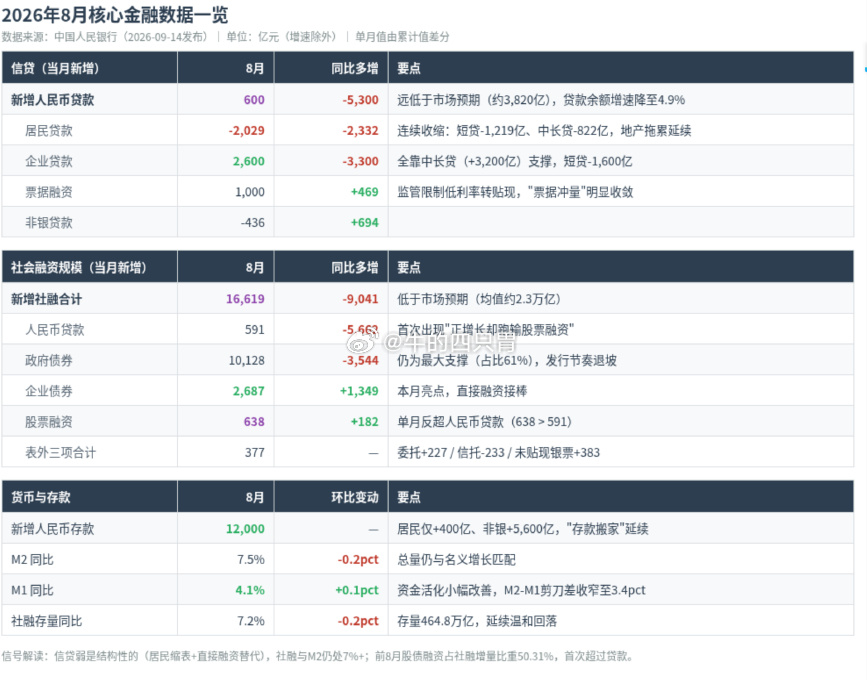
The People's Bank of China published August's credit figures on Monday, and they were weak in almost every line. New loans to households and companies came in at 60 billion yuan — against expectations near 380 billion, and more than 300 billion below last August. Aggregate social financing, the economy's broadest measure of new credit, was 1.66 trillion yuan against an expected 2.3 trillion. A data-breakdown post circulating on Weibo called it "a whole era's worth of disappointing," and the official release was little cheerier: the central bank's own brief put cumulative social financing for the first eight months at 23.91 trillion yuan, with conditions it described as "continuing to run relatively loose."
The household line is where the story stops being about statistics. Chinese families repaid 202.9 billion yuan more than they borrowed in August — mortgages "still bleeding," in the Weibo post's phrase — and have now spent years doing the same. After a property downturn that erased the main store of household wealth, the instinct to pay down rather than borrow has become the durable fact of China's economy, dragging on consumption no matter how the stock market performs.
Companies barely filled the gap. New corporate loans of about 260 billion yuan leaned on 320 billion in medium- and long-term lending — down from 470 billion a year ago and 490 billion the year before that.
One line in the data did glow, and it is the one analysts flagged hardest. Companies raised 63.8 billion yuan in equity financing in August — more than the 59.1 billion that banks lent. For a month in which credit grew at all, that is a first in Chinese records, and it lands in the middle of a running debate about where Chinese savings go now that flats no longer absorb them. The Weibo breakdown put it starkly: with going abroad constrained, factory profits thin and property subdued, "the falling stock market has become the only sea" for the money leaving deposits. Overnight in New York, Wall Street slipped on AI-related losses, but Chinese markets took the weak credit data in stride.
The poster's closing note was history as warning: similarly dismal figures in September 2024 are remembered as the trigger for Beijing's sweeping stimulus pivot, and two years on, the data has fallen through even that floor. Whether officials answer again, or whether China's savers have genuinely settled on stocks as the next place to park a lifetime's savings, is now the question both the data and the market are waiting on.