DeepSeek's New Architecture Lets AI Start Work Without Being Asked
DeepSeek's Harness team has unveiled a 'super-agent' design — a router-and-worker system that runs continuously, reacts to events like group-chat messages, and fixes bugs in the background — betting that the bottleneck in AI work is no longer the model but human attention.
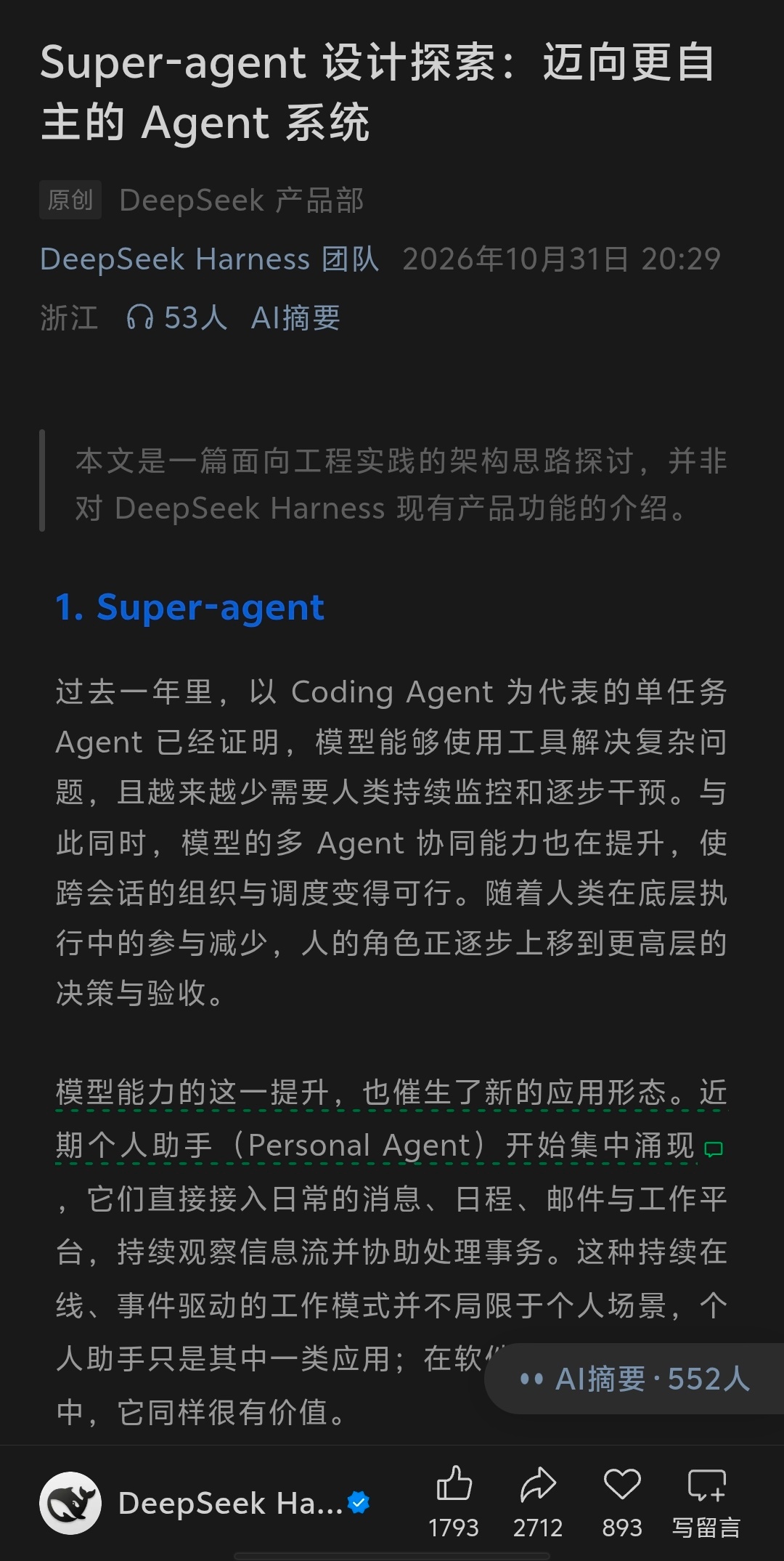
DeepSeek's latest release is not a model but a working arrangement. On Friday night the Hangzhou lab's Harness team published an article, "Super-agent design exploration: Towards a more autonomous agent system," describing an architecture in which a "router" plans and delegates while "worker" agents execute — a system that stays online across tasks, reacts to events without being asked, and, in the team's telling, quietly fixes software bugs in the background.
The premise is stated with unusual candour: as models get better at finishing single tasks without supervision, the bottleneck moves to the human. A person can monitor one conversation attentively; they cannot attentively monitor ten. DeepSeek's answer is to reorganize the stack so the system — not the person — manages sessions, context and coordination, leaving humans "to move up from the details of execution to higher-level decisions and acceptance."
The design leans on four ideas: a two-layer structure separating planning from execution; event-driven operation, meaning the agent responds to outside happenings such as group-chat messages rather than only to direct commands; asynchronous multi-channel interaction, so it can hold several threads at once; and an external "watchdog" that checks its work. An internal instance is already running, the team says, handling bug reproduction, code review and iterations on the tooling itself — even when nobody has mentioned it in the group chat.
Baidu's board ranked the news at No. 5 within a day, and Zhihu's question on the design drew comparisons to the agent frameworks Western labs have spent the year demoing. The competitive frame is real but partial. China's leading labs have mostly competed on model benchmarks; DeepSeek is now competing on scaffolding — the plumbing that turns a good model into a colleague. The lab has form here: its open-source playbook earlier this year, giving away architecture and revenue math alike, is what made it the best-known Chinese AI lab abroad.
The open question is reliability. An agent that acts without being asked can also be wrong without being asked; the paper's own framing puts humans in charge of "acceptance" rather than direction, which presumes the work submitted is worth accepting. DeepSeek says its internal instance earns that trust by iteration. Whether the pattern generalizes — or stays an engineering memo — will be visible in the next model cycle.