Viral Teardown Accuses Apple of Cutting Corners on the Chinese iPhone Duo
A Shenzhen teardown blogger claims China's version of Apple's first foldable ships without components found in the US model — a charge that drew more than 12,000 likes and an equally fast rebuttal pointing out that several of the 'missing' features were never approved for use in China.
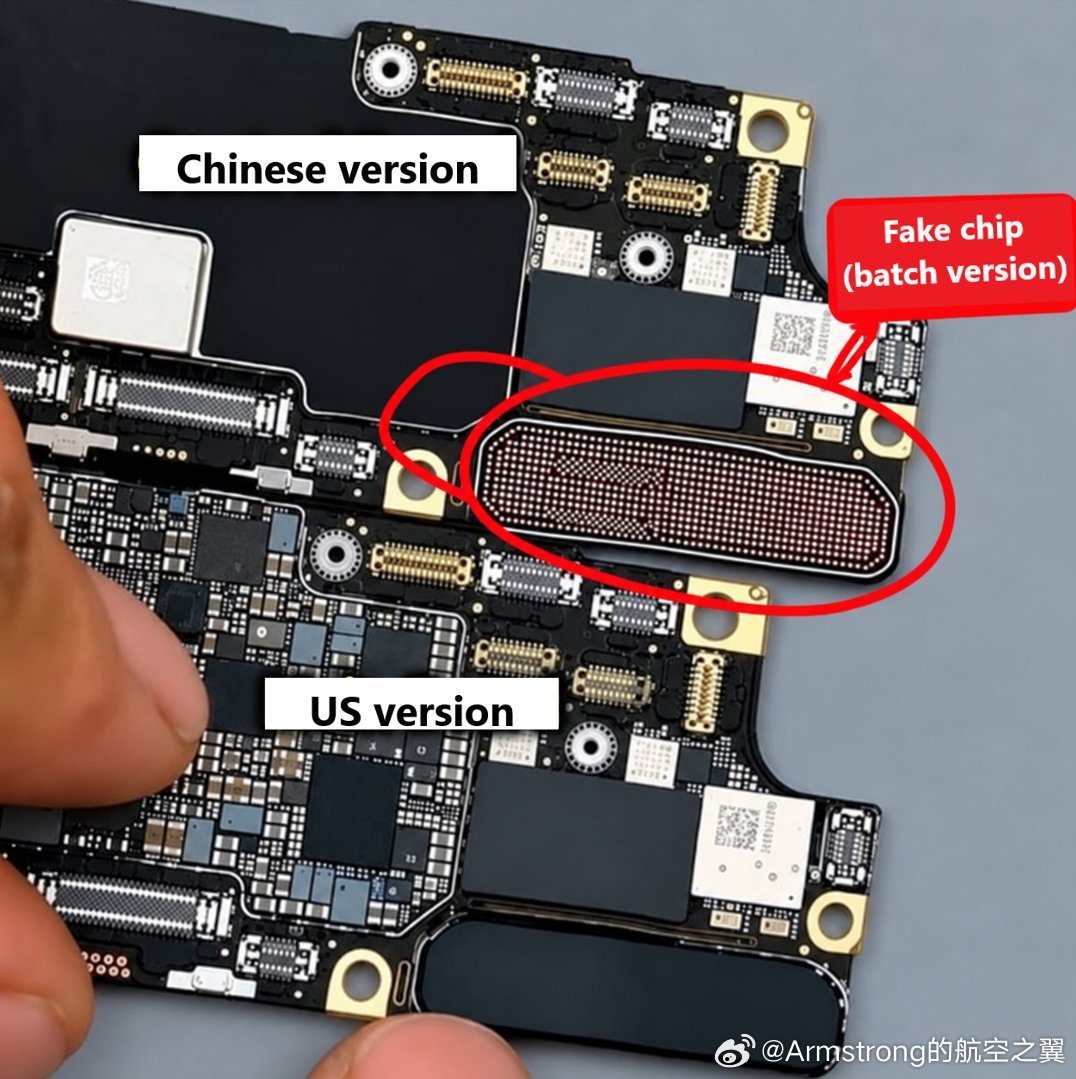
The latest storm around Apple's first foldable began, as so many do, in Shenzhen's Huaqiangbei electronics district. Yang Changshun, a teardown blogger whose dissections of new phones have made him a fixture of China's gadget scene, opened up an iPhone Duo bought in China and compared its insides with the American model. In an annotated teardown video liked more than 12,000 times within a day, he listed what the Chinese version lacks: a satellite-communication module, the antenna and radio-frequency hardware for the 6GHz band, the power circuit for 25-watt fast wireless charging, and the ultra-wideband antenna and chip.
His conclusion was blunt: a phone missing these parts should cost 800 to 1,000 yuan less than the 15,999-yuan price Apple set at launch. By evening the phrase "iPhone Duo China version accused of cutting corners" sat near the top of Weibo's trending list.
The rebuttal came just as fast, and it was technical. One widely shared response pointed out that Apple's own Chinese spec sheet explicitly lists second-generation ultra-wideband support — "if your unit doesn't support the UWB the spec sheet promises, you can demand a refund plus triple compensation," the commenter wrote, invoking a provision of Chinese consumer law that lets buyers claim three times a purchase price for proven misrepresentation. As for the other "missing" features, the same argument went: the Qi2 wireless-charging profile behind the 25-watt speed and the 6GHz Wi-Fi band both rely on spectrum that Chinese regulators have not approved for consumer use in China. Blaming Apple for a frequency band the regulators never handed out, the commenter concluded, was a new low for hit-job reporting.
Both sides are, in a sense, right, and that is exactly why the fight caught fire. Chinese regulators allocate spectrum differently from their American counterparts: the 6GHz band that carries Wi-Fi 6E in the United States has been reserved for cellular networks in China, and satellite-messaging features have never been switched on for Chinese iPhones because the service depends on local approvals Apple has not secured. Where compliance ends and quiet cost-cutting begins is a question each component raises on its own — and teardown bloggers like Yang have built their following on refusing to take a spec sheet's word for it.
The Duo has needed the scrutiny. Since its debut the phone has been cracking along the crease, a Foxconn insider claimed Apple relaxed its quality standards to keep the foldable in supply, and buyers learned that a screen replacement would run 7,998 yuan. Against that backdrop, a claim that the China model is physically different from the US one lands on soil that has been prepared for months.
Apple has not responded to the teardown. Whether the missing components amount to a regional price cut in reverse — same price, less hardware — or to ordinary compliance with Chinese spectrum rules is the question the debate is actually about. For now, the most consequential fact may be the one the rebuttal pointed to: under Chinese consumer law, a spec sheet is a promise, and buyers who catch a gap can make it an expensive one.