Officials Verify the Welfare Cancellation Behind China's Hong Kong Concert Debate
Ganzhou's civil affairs bureau says it is still verifying the case of the vocational student whose Hong Kong concert trip cost her family its dibao benefits, as lawyers set out the rules that make the cancellation legal — and the proportionality question that keeps the argument burning.
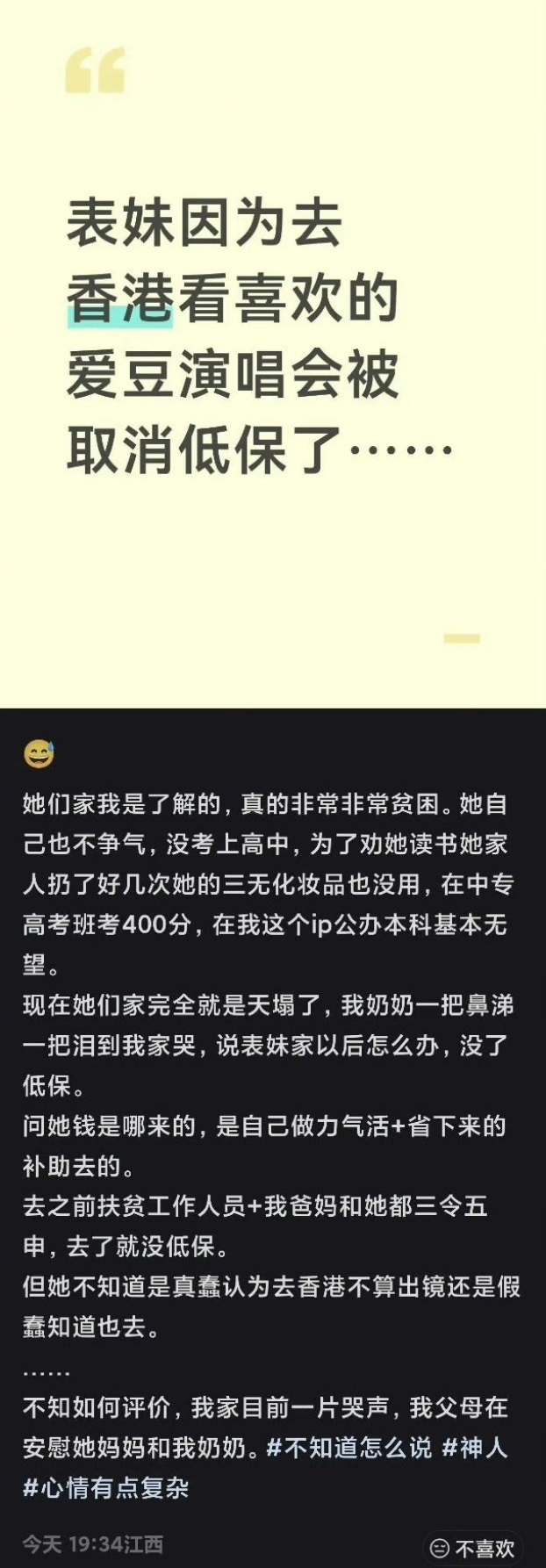
The civil affairs bureau of Ganzhou, in Jiangxi province, is still checking. That is the closest thing to an official verdict in the case that has gripped Chinese social media all week: a vocational student from a family on dibao — the country's means-tested subsistence allowance — travelled to Hong Kong for an idol's concert on savings she earned herself, and when her exit record surfaced in a routine welfare review, the family's benefits were cancelled. Asked on Monday whether the family had in fact lost its eligibility, a duty officer at the bureau said verification was under way across the city and its counties. "It's still not certain," the state-run China News Weekly reported, in a post now liked more than 135,000 times; the original account of the affair had been deleted the day before.
The story was already running when we covered it on Saturday as a raw argument over who deserves help. What has changed since is that the argument has acquired rules, and a legal framework to fight about. Under the regulation that governs social assistance, a dibao household's eligibility is assessed on the family's overall finances and subject to "dynamic review": if a household's actual living standard visibly exceeds the threshold, benefits can be terminated. Jiangxi's own assessment rules go further, listing self-funded outbound travel and entertainment as a high-consumption scenario that must be flagged. A self-paid trip to Hong Kong for a concert, a Shanghai lawyer told Cover News, fits that definition squarely — and since staff had warned the family before she left, cancelling the benefits "has a legal basis." But, she added, the bureau must give written reasons for stopping payment, and the deeper question — whether one entertainment purchase, from the girl's own wages, should end benefits for an entire household — is a genuine question of proportionality. The family can appeal administratively or sue.
Opinion has hardened into two camps. One holds that the system worked as designed: "Staff pleaded with her and couldn't talk her out of it," one commentator wrote. "If she has money to chase idols, she has the ability to earn — cancelling is entirely proper." The other camp reframes the case as something older and more familiar: the question of whether China's poor are permitted small pleasures at all. A post reflecting on exactly that — how reports like this one reopen childhood memories of being poor and shamed for any spending that wasn't survival — drew more than 70,000 likes. "Chasing stars, listening to music, watching a film — it's the same dilemma as whether a poor student can afford a cup of coffee," its author wrote. The retort from the other side was equally blunt: most taxpayers never see a concert in Hong Kong either.
The story is now running on every platform at once: Zhihu's top question asks how eligibility rules for dibao are actually designed, while Baidu's board splits the difference — one regional TV commentary argued the case "should not be handled as a simple one-size-fits-all cut," urging a "buffer zone of humanity" inside the rules. The verification, and whatever written explanation it produces, will say which philosophy wins.