Why the EU Wants China to 'Voluntarily' Limit Its Car Exports
The European Union has floated asking China to 'voluntarily restrict' its car exports, a phrase that turned a trade-policy dispute into one of the day's biggest debates on Chinese social media — because Chinese cars just passed one million sales a year in Europe.
The phrase in quotation marks is what made it travel. A question asking how the EU's reported request that China "voluntarily restrict" its car exports would reshape trade between the two blocs drew 1.54 million heat on Zhihu's hot list on Wednesday — one of the day's biggest business debates, running on question-and-answer boards rather than Weibo's trending page.
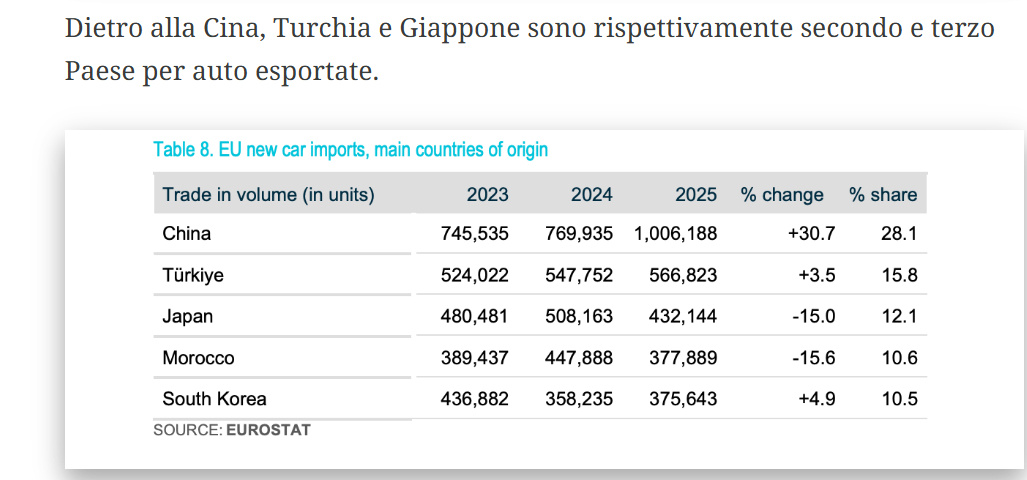
The background number explains why Brussels is reaching past tariffs. A Eurostat table shared widely on Weibo shows the scale: in 2025, Chinese-built cars sold into the EU numbered 1,006,188 — up 30.7 percent on the year, and more than 28 percent of all new cars the EU imported. As one Weibo blogger summed up the table, that is out of roughly 10.82 million EU registrations, and Chinese brands' European footprint widens again if the UK, Russia and Turkey are counted, taking sales past 1.6 million.
China's export machine, meanwhile, is still accelerating. Another widely shared post tallied the first half of 2026: 5.31 million vehicles exported, including 1.03 million in June alone — a single-month record for any country — with the full-year forecast above ten million. The EU's own countermeasure is already in place: anti-subsidy duties on Chinese battery-electric cars, which the post dates to April and puts at up to 35 percent.
"Voluntary" restriction is quota by another name — an import cap framed as a favor rather than a defeat, so that both governments can call it something else. The phrase carries a loaded history: Japan "voluntarily" restrained its car exports to the United States in the 1980s, a deal remembered as protectionism wearing diplomacy's clothes. That lineage is precisely why Chinese readers lit up the Zhihu thread: the word choice signals a negotiation over how, and how far, China's most competitive export industry gets slowed down.
The squeeze runs in both directions, which is what makes the request awkward for Beijing to refuse outright. European car exports to China fell 43 percent in 2025 — the market the EU once counted on is closing — while the same Weibo tally noted that Chinese carmakers' profit margin was just 3.4 percent in the first half of 2026, well below the 6 percent that counts as healthy for manufacturing. Export volume is the pressure valve for an industry whose home market has turned into a price war; cap it, and the pressure looks for another exit.
What happens next is the open question the Zhihu debate turned on: whether Beijing entertains a "voluntary" cap, demands something in return, or lets the tariffs and the quotas accumulate. Either answer redraws the route by which a million-plus Chinese cars a year now reach European driveways.