Xianyu Clears Itself of Underage-Listing Claims and Reports the Case to Police
Two weeks after reports that underage escort services were being funnelled off its marketplace, Alibaba's secondhand app Xianyu says its own sweep found no such listings — the screenshots came from other platforms — and it has reported the case to the police.

The most down-to-earth corner of Chinese e-commerce spent Wednesday morning in lawyerly mode. Xianyu, Alibaba's secondhand marketplace where hundreds of millions of Chinese buy and sell used goods, published the findings of an internal investigation into the most damaging allegation an app can face: that its listings had become a storefront for underage prostitution. The verdict was a full denial — and, the moment it was delivered, a police report.
In a statement carried by Sina Finance, the platform said a sweep of everything publicly visible on Xianyu had found no obscene content of any kind, and nothing involving minors. The chat screenshots behind the media reports — negotiations hidden behind the facade of secondhand air-conditioner listings — came from other platforms entirely, Xianyu said. It has now reported the merchants, the payment QR codes and the screenshots to the public security bureau, and asked the platforms where the messages actually travelled to follow up.
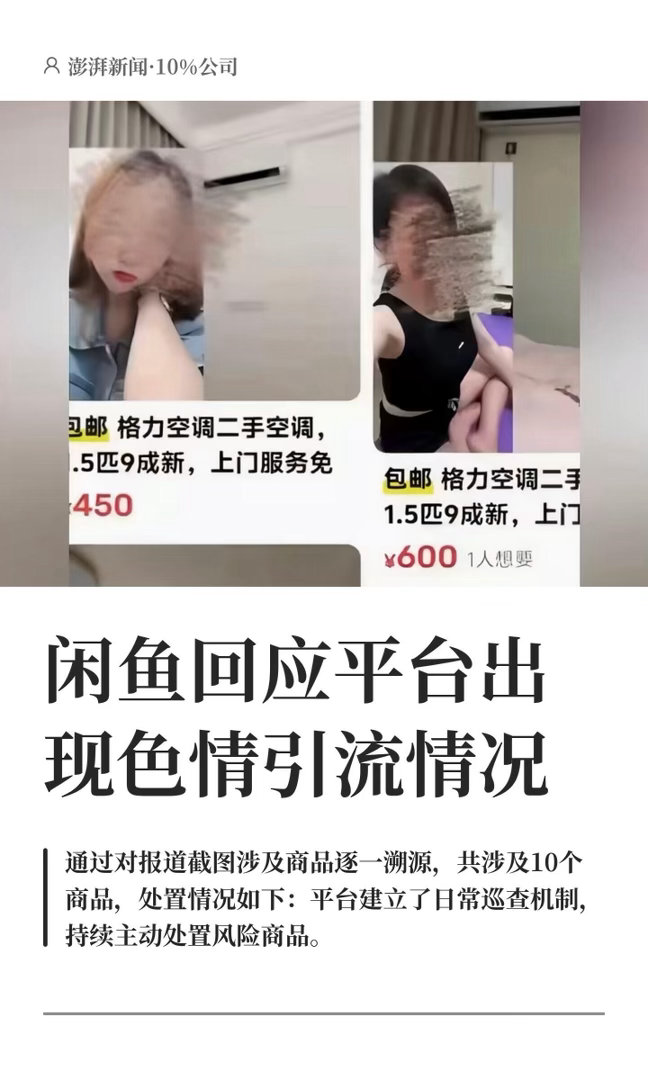
When the reports first surfaced earlier this month, the platform's response was a purge: nearly 100,000 accounts linked to adult-content "funneling" were banned, and the story looked like a platform caught hosting a grey market. Wednesday's statement reframed it. The practice at issue, known in Chinese as yinliu (引流) — "redirecting traffic" — works like this: a seller posts an ordinary-looking item, a buyer's chat drifts toward an off-platform app, and the transaction happens where moderation is thinner. Xianyu's position is that its listings were camouflage, not storefront.
What made the statement travel was the concession folded inside the denial. Although the reported chats and deals happened elsewhere, Xianyu wrote, the platform remains one of the targets criminals use for funneling — and it bears "a governance responsibility that cannot be shirked" (负有不可推卸的治理责任). It promised tighter keyword screening and more human review, and proposed an industry-wide anti-funneling alliance, so that a loophole closed in one app does not simply reopen in another.
The reaction was measured, not relieved. "Back to self-punishing with three toasts again," one user shrugged (依旧自罚三杯) — the drinking-table idiom for ritual, consequence-free self-criticism. On Zhihu, a question climbing Zhihu's hot list asked bluntly whether the day counted as a "reversal," and who should own the screenshots if they were never Xianyu's at all. A summary of the findings posted by Sina Finance drew close to 16,000 likes in a few hours, a measure of how many people were watching the platform measure its own words.
The open question is now the police's, not the platform's. If investigators trace the screenshots to the apps where they originated, the case becomes the first test of the alliance Xianyu is proposing — whether rival platforms that compete for the same users will actually hand each other the evidence that puts a grey market out of business, or each keep quietly denying that the funnel starts on their side.