Why China Puts Its Farmers' Holiday on the Autumn Equinox
The autumn equinox doubles as China's Farmers' Harvest Festival, created in 2018 and marked this year with presidential greetings, a state-television harvest tour — and a reminder that a strengthening El Niño will bend the season ahead.
At 8:05 on Wednesday morning, Beijing time, the sun crossed the equator, and China marked the moment twice over. The autumn equinox — qiufen — is one of the twenty-four solar terms of the traditional calendar, and since 2018 it has also been the fixed date of the country's Farmers' Harvest Festival. This year the two arrived together with the usual state choreography: President Xi sent festival greetings to the nation's farmers, and CCTV live-streamed a day of harvests, from rice paddies in Jilin to kiwifruit in Shandong and, improbably, salmon farms in the river valleys of Xinjiang.
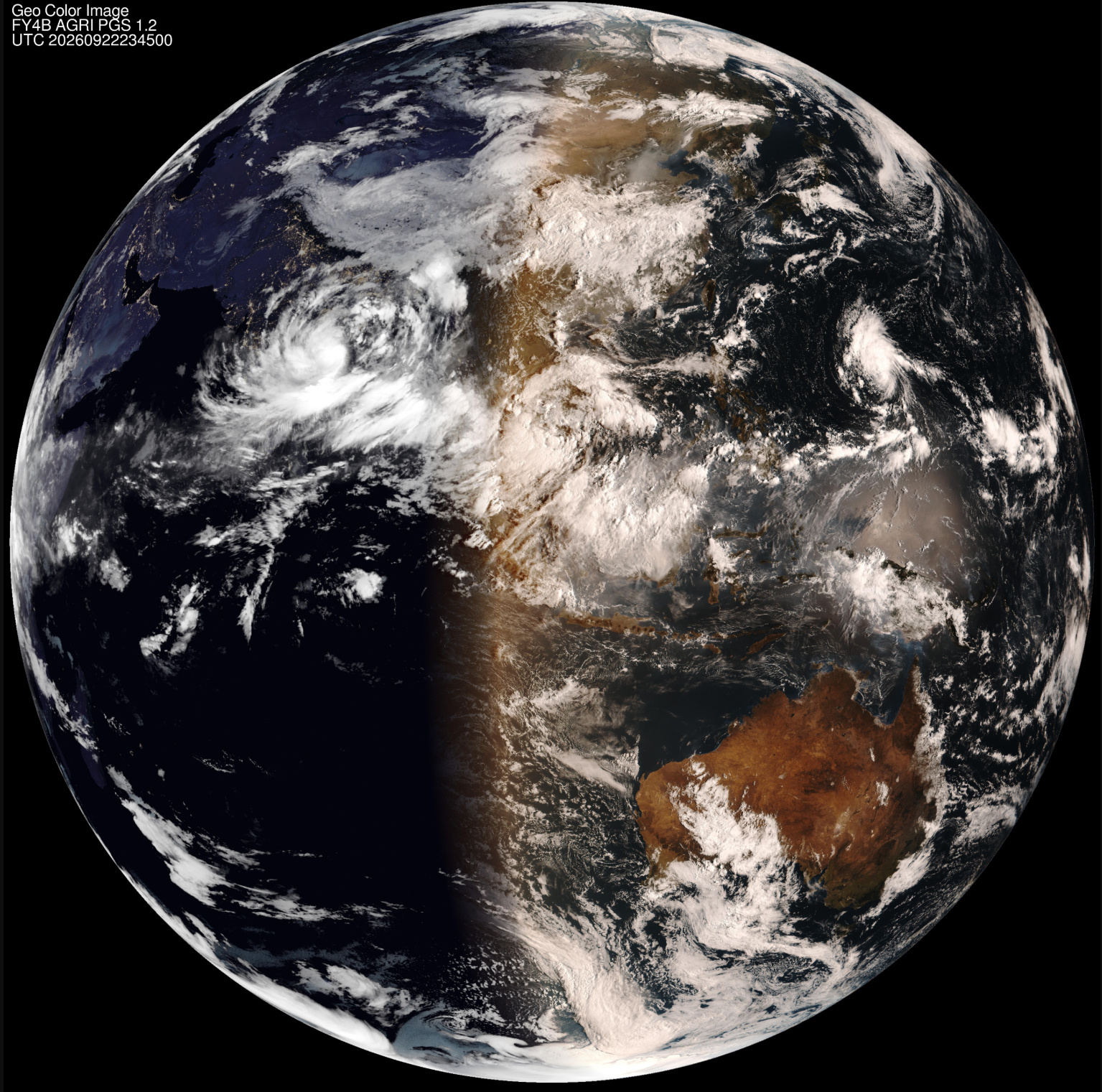
The equinox is the one day the calendar treats everyone equally — "day and night equally divided, cold and heat in balance," as the classical formula runs. A weather blogger marked the exact minute, solar longitude 180°, with a full-disk image from China's FY-4B satellite captured minutes before the moment: Earth centred on Asia, the day and night hemispheres sharing the frame almost evenly. His framing of qiufen as "the most fair day" (最公平的一天) speaks to why the solar terms have long escaped farming into moral vocabulary: a date when light is apportioned with perfect neutrality carries a pull the almanac never intended.
The festival itself is young. Established in 2018, it is the only observance in the Chinese calendar dedicated to a profession, and the state's framing of it is unambiguous: People's Daily's festival commentary Wednesday was titled for "the world weight of Chinese grain" (中国粮的世界分量), a reminder that consecutive bumper harvests are presented as a global fact, not a domestic one. The Paper's commentary posed the sharper question for urban readers — what does a farmers' festival have to do with the big cities? — and answered it with the dinner table: the price and provenance of what urban China eats is the city's side of the harvest.
The harvests state media chose to showcase were a tour of the improbable: high-protein corn in Hubei, sweet potatoes grown in sand in Liaoning, rice and crayfish sharing paddies in Hunan, and salmon from landlocked Xinjiang — the desert-edge aquaculture the site covered when Xinjiang's 'seafood' first went to market, now joined by Global Times reporting on freshwater lobster farmed at the desert's margin. The through-line is deliberate: a picture of agriculture that revises where an outsider assumes China can grow what.
On Weibo, the equinox trended as much as lifestyle guidance as astronomy. A finance blogger turned the solar term into portfolio advice — the year's midpoint as a "risk-control reminder," a prompt to strip useless social engagements and excess anxiety from the balance sheet of a life the way one strips bad debts. State health accounts used the day for their annual turn on autumn: shorter light and cooler air make it, they warned, a season of low moods, especially for the elderly, and prescribed earlier nights.
This year's observance carries a weather rider. The same equinox post noted that a strengthening El Niño is pulling the seasons south faster than usual, pointing to a wetter deep autumn and winter for most of southern China. The astronomical clock that now sets the country's harvest calendar, in other words, arrived this year with a forecast attached.