A 'Rusting' Cancer Drug Reaches First-in-Human Trials in China
Chinese teams have published the world's first human trial of a drug that kills cancer cells by inducing ferroptosis — letting iron 'rust' them from the inside. Eighteen patients, a disease-control rate of 84.2 percent, and a phase II trial with radiotherapy now underway.
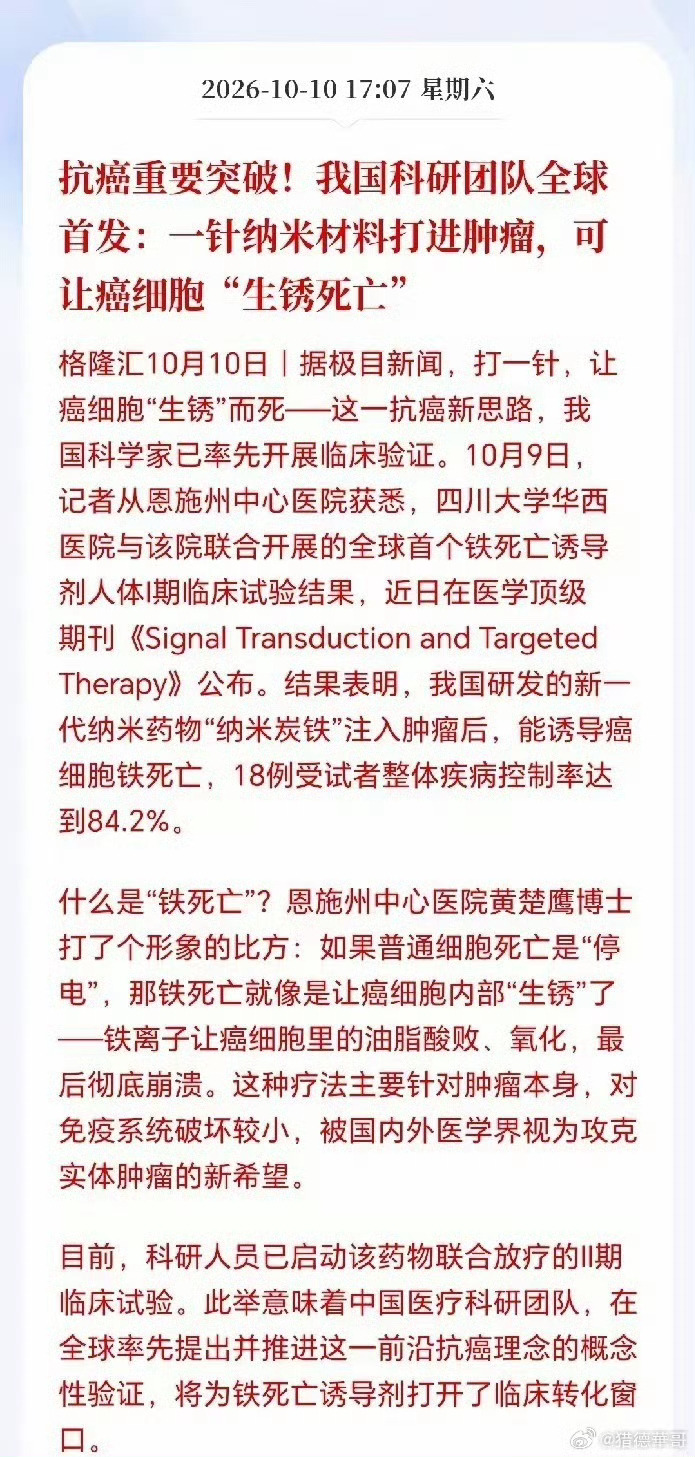
If ordinary cell death is a power cut, ferroptosis is rust: iron gets into a cell, the fats inside oxidize and go rancid, and the cell collapses from within. Chinese scientists have now put that idea — killing a tumor by making its cells rust — into human beings for the first time, and the Phase I result, announced on October 9, became one of Saturday's most-read stories on Weibo.
The trial was run jointly by the oncology center of West China Hospital in Chengdu, one of China's largest, and Enshi Prefecture Central Hospital in the mountains of Hubei. The drug — a carbon-nanoparticle–iron complex the reports call 纳米炭铁, "nano-carbon-iron" (CNSI-Fe) — is injected straight into the tumor, where the iron drives ferroptosis: an iron-dependent form of cell death in which the lipids inside a cell oxidize until the membrane falls apart. Because it is aimed at the tumor it is injected into, researchers describe it as comparatively sparing of the immune system — the shorthand for the collateral damage of conventional cancer treatment.
The result, published in Signal Transduction and Targeted Therapy, which the reports describe as a top medical journal, is being called a global first: the initial human Phase I trial of a ferroptosis-inducing drug. Eighteen evaluable patients — people with hard-to-treat solid tumors including soft-tissue sarcomas, head and neck cancers and non-small-cell lung cancer — received injections, and disease was controlled in 84.2 percent of them; among patients with lymph-node metastases or sarcoma lesions, the control rate was 100 percent. A Phase II trial combining the drug with radiotherapy has already begun.
The caveats are real, and Chinese readers are already voicing them. Phase I trials test safety in a handful of volunteers; eighteen evaluable patients is a proof of concept, not a cure, and "disease control" includes tumors that merely stopped growing. The gap between ferroptosis in the lab and ferroptosis in the clinic is, in fact, the story: over the past two decades researchers have found many compounds that induce the process, but poor solubility, instability and rapid clearance kept every one of them short of human trials until now. One patient's questions under the trending topic captured the mood: "Really? When can this be used at scale? Does it work for every cancer? How much will one shot cost? Could someone who understands explain — I urgently need to know."
For an outside reader, the signal is in how the work got done: the drug was developed and produced by a Sichuan pharmaceutical company, Yingrui Pharmaceutical Technology, trialed by a partnership spanning a megacity cancer center and a prefecture hospital in Hubei's mountains, and published in a journal the reports call a leader in its field. The trending phrase itself — "one injection makes cancer cells rust to death" — is a metaphor doing real work, making a peer-reviewed result legible to everyone. The story crossed platforms within hours, reaching Baidu's hot board and, by evening, investing circles — the fund manager Dan Bin shared it with a one-line hope: "May such progress help humanity conquer cancer soon."
The next checkpoint is the radiotherapy-combination Phase II. Whether the rust metaphor survives contact with larger numbers of patients is what the next few years will answer.