A Funeral Shop Covered Its Sign in Red Carpet for a Neighbor's Wedding
A funeral goods store in Suqian, Jiangsu, covered its black-and-white signboard with red carpet and shut for two days so a neighbour's wedding could be staged next door — a small accommodation that Chinese outlets read as a lesson in getting along.
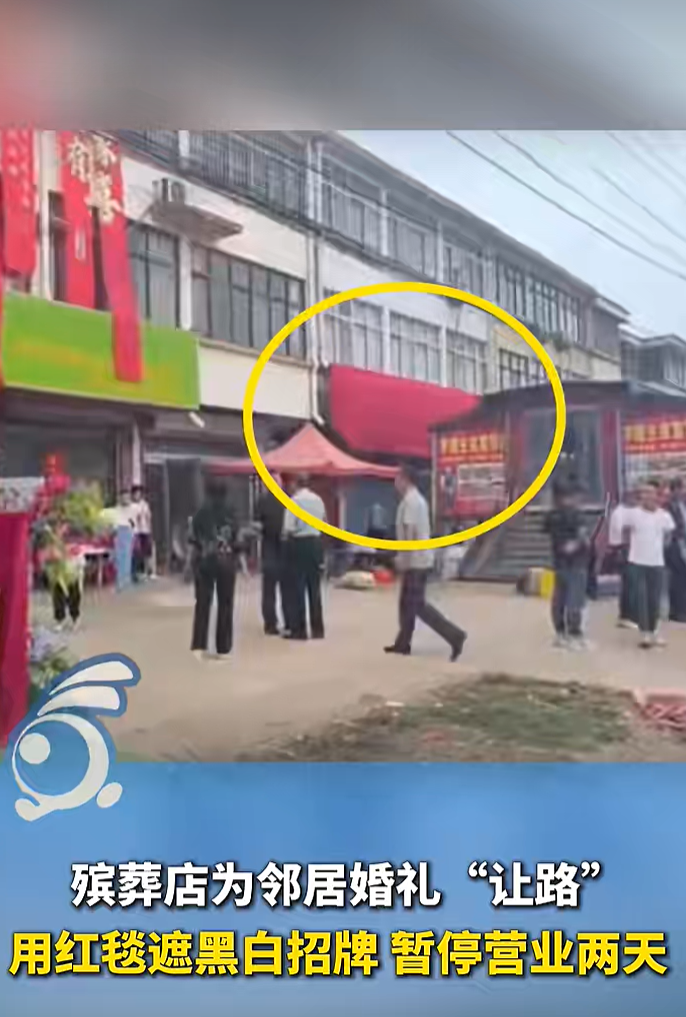
The sign outside a funeral goods store in Suqian, in Jiangsu province, follows the trade's convention: black background, white lettering. On Saturday it disappeared under a roll of red carpet, because the apartment upstairs belonged to a family with a daughter getting married — and the wedding stage, the camera positions and the catering truck were all to be set up facing his shopfront. The owner, a man surnamed Ding, covered the sign and closed the store for two days (The Paper).
The arrangement, as Ding tells it, was worked out in advance and on friendly terms. The neighbours raised the matter with him first, worried about the truck and the stage; he went further than they asked, proposing that the family buy a red carpet to hide the sign entirely, and closed the shop without being asked to. A close neighbour, he noted, is worth more than a distant relative (远亲不如近邻). "A girl's wedding is a once-in-a-lifetime event. I'm only out two days of business," he said — and for urgent customers during the closure, the back door stays open.
The colours are the whole story. In Chinese custom, weddings are red events (红事) and funerals are white events (白事), and a black-and-white funeral signboard looming over wedding decorations is exactly the clash folk belief calls unlucky — 晦气, the taint of inauspiciousness that clings to anything associated with death. The collision is common enough to have a case file. Funeral parlour routes get blocked by neighbours, and The Paper's commentary recalls legally operating funeral businesses that have endured garbage thrown at their doors and signs smashed over the same belief, with the law on the shop's side and sentiment against it.
That commentary — the headline of which translates roughly as "short words, long meaning" — judged the Suqian standoff the optimal solution: neighbourly harmony found a form both sides could live with, and nobody had to be sued into tolerance (The Paper). The story's travelled beyond Jiangsu, too: it charted on Baidu's national trending board, a gentle item in a news cycle otherwise given over to trade talks and the Asian Games (Baidu).
The wedding went ahead with the stage facing a shopfront dressed in red. Two days on, the black-and-white sign comes back out — the ordinary look of a business that, as its owner put it, can afford a neighbour's once-in-a-lifetime event the loss of two days' trade.