China Marks the 160th Anniversary of Sun Yat-sen, and the Argument Is About Taiwan
A state commemoration in Beijing that ranked first on Baidu used the founder of the Chinese republic to argue for reunification — and Taiwan's Central News Agency covered it as a political message.
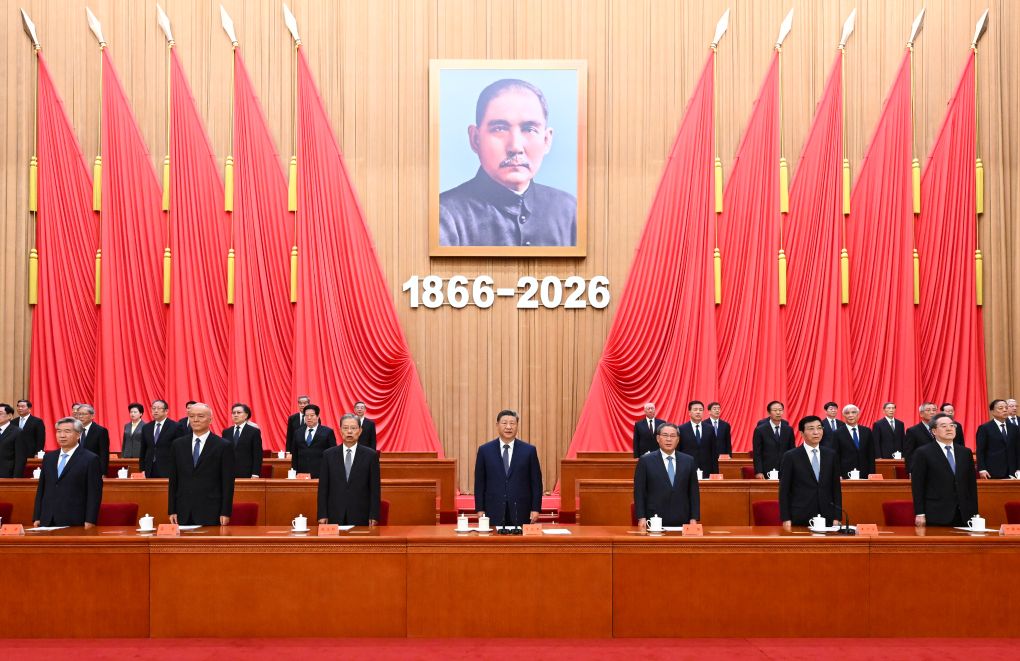
China marked the 160th anniversary of Sun Yat-sen's birth on Wednesday with a ceremony in the Great Hall of the People, where President Xi Jinping praised the founder of the Chinese republic as a forerunner of national rejuvenation and called on "all sons and daughters of the Chinese nation" to unite in the cause of national reunification. The event was broadcast nationally and dominated Chinese social media through the day, but the sharper argument was happening at the edges of it — in Taiwan, where commentators read the same commemoration as a political message aimed at the island.
Sun Yat-sen occupies a peculiar position in Chinese political culture. The man who led the 1911 revolution that ended two thousand years of imperial rule, and who founded the republic that the Communist Party superseded in 1949, is honoured by the Party as a forerunner of its own revolution. His portrait appears on Tiananmen Square every May 1 and October 1, facing Mao's across the crowds. The 160th anniversary of his birth — he was born on November 12, 1866 — is the kind of round number the Party uses to make statements about where it is going. CCTV's report of the speech carried the full text, with the ceremony ranking first on Baidu's search board and the news flash from Xinhua circulating as the day's most shared post.
The Taiwan angle is the politically charged one. Taiwan's Central News Agency covered the ceremony with a piece describing the mainland's commemoration as an attempt to "shape Sun Yat-sen's political message", quoting a scholar who called the event a "deliberately distorted political manoeuvre". The same agency reported that the Hong Kong government held its own commemoration, where Chief Executive John Lee said the best memorial to Sun was to carry on his patriotic spirit. The island's reading is the mirror image: the mainland's commemorations reassert the claim that Taiwan and the mainland share a single national history, and the island's ruling party has spent two decades removing Sun's statue from public spaces.
The argument over Sun's legacy is also a fight about history education. A Baidu search item that charted alongside the ceremony described the family's response to a viral complaint: a descendant of Sun lamented that Taiwanese children no longer learn Chinese history, and that many students who see a statue of Sun Yat-sen on the island do not know who he is. The Paper, the Shanghai news outlet, ran a long feature on Sun's visits to Taiwan under the title "a shared historical memory that cannot be cut" — the kind of framing an international reader might not expect, given that the island's ruling party has spent two decades removing Sun's statue from public spaces.
The commemoration also produced material culture. China Post issued a commemorative stamp sheet, an official gesture that keeps the anniversary in the physical economy of the state — and the kind of small detail that reveals how the anniversary is being woven into the country's everyday life.
What the ceremony is really about is the Party's claim to a lineage it once fought. Xi's speech, by hailing the founder of the republic that the Party's army defeated in 1949, frames the Party as the inheritor of the republican revolution rather than its negation. The claim is not new, but it has been sharpened by the 160th anniversary and by the state of cross-strait relations. A century after Sun's death, the Party is still arguing with the island about which of them deserves his legacy.