The 2026 Nobel Physics Prize Goes to Francis Halzen, Who Turned Antarctic Ice Into a Telescope
The Royal Swedish Academy of Sciences awarded the 2026 Nobel Prize in Physics to Francis Halzen, builder of the IceCube observatory buried under the South Pole. Chinese readers immediately asked why their own neutrino labs — Daya Bay and Jiangmen — were not part of the story.
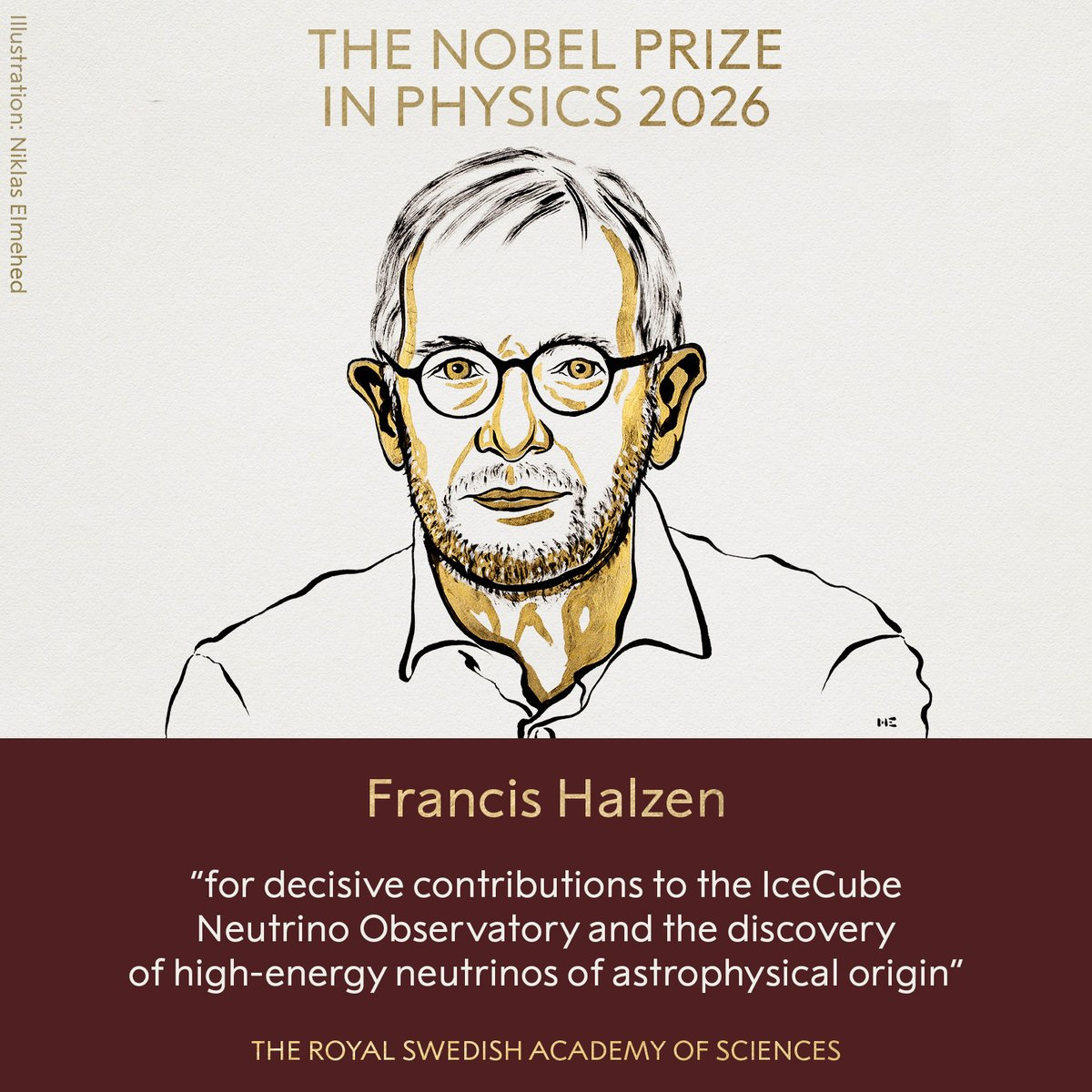
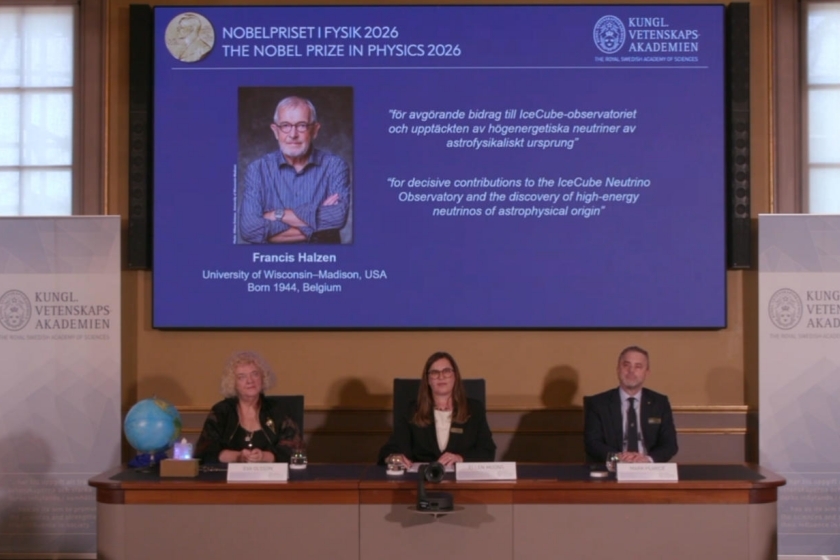
The 2026 Nobel Prize in Physics went on Tuesday to a single scientist: Francis Halzen, the Belgian-born University of Wisconsin–Madison physicist who persuaded the world to turn a cubic kilometre of Antarctic ice into a telescope. The Royal Swedish Academy of Sciences credited him with "decisive contributions" to the IceCube Neutrino Observatory and for the discovery of high-energy neutrinos from space — work that founded a new astronomy, one that looks at the universe without using light.
Neutrinos are the most aloof particles known. Nearly massless, electrically neutral, they interact with matter so rarely that trillions slip through a human body every second without leaving a trace — hence the nickname 幽灵粒子, "ghost particles," which trended across Chinese science feeds on Tuesday. That indifference is also their value: they fly out of the universe's most violent places — black holes, colliding galaxies, neutron-star mergers — where photons get absorbed and never reach us. IceCube, completed in 2011, buried thousands of light sensors in holes drilled up to 2.5 kilometres into the ice beneath the South Pole, waiting years for the rare neutrino that happens to strike an atom and flash. It found them, proving cosmic accelerators a million times more powerful than anything on Earth.
The prize dominated news boards well beyond science desks — it led Baidu's hot list and Caixin's home page within the hour — but the argument Chinese readers took up was a home-grown one. On Zhihu, the day's most-asked science question was why China's own neutrino projects went unmentioned: Daya Bay's reactor experiment near Shenzhen measured in 2012 the last unknown mixing angle of neutrino oscillation, a result that reshaped the field, and its successor, the Jiangmen Underground Neutrino Observatory, is now chasing precision measurements deep under a granite hill in Guangdong. The consensus in the replies was careful: IceCube won for opening astronomy with neutrinos, not for measuring them, and China's labs are positioned for exactly that kind of leap next.
Chinese voices also carried a personal connection. Xu Donglian of Shanghai Jiao Tong University, who has worked on IceCube, described Halzen as someone who "always puts science first, and always supports young people." A widely shared explainer by the engineer-blogger Zhu Yulong put the achievement in plain terms: "Until now we watched the universe with light — visible, infrared, X-ray. But in the most violent cosmic events, light never gets out."
Halzen, born in 1944, said through the academy that the idea was once dismissed as fantasy. The award — raised this year to 12 million Swedish kronor, a record — is the second of the week; Monday's medicine prize went to the optogenetics pioneers, with Chinese labs named among their heirs. The chemistry prize is announced Wednesday, and China's physics community will be watching for the same question it asked on Tuesday, only in reverse.