Officials Say the Brown Bear Begging From Tourists at Kanas Was Pure AI Fabrication
A video of a brown bear begging from tourists at a Xinjiang scenic area alarmed millions this week until park officials confirmed nothing of the kind ever happened — every frame was AI-generated.
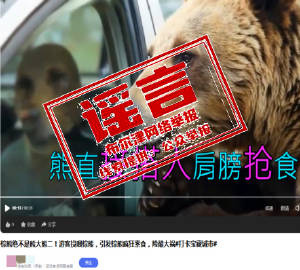
The video looked like every warning ever issued about feeding wild animals: a brown bear at the window of a car in Xinjiang's Kanas scenic area, then — in the version that spread furthest — a bear rising up to drape itself over a tourist's shoulders, pawing for food while onlookers laughed, "nearly causing a disaster." The frames carried their own caption: "The bear pounces directly at a person's shoulder to grab food."
None of it happened. On September 30, and again on Thursday as the clip resurfaced, the Kanas Scenic Area Management Committee stated that no tourist has fed a brown bear and no bear has rampaged: the entire series of images and videos was "generated by the poster using AI technology, entirely fabricated, with no connection whatsoever to the scenic area's actual operations, ecological environment, or wildlife management."
The debunk then rode the machinery Chinese internet governance has built for exactly this. The national refutation platform piyao.org.cn carried it, and provincial network-reporting accounts and Weibo's own rumor channel republished it in a joint refutation. The day's bulletin arrived in its standard format — one AI hoax, one seasonal superstition, one health scare. Alongside the bear it debunked the annually recurring claim that a "once-in-60-years cold winter" is coming (a cold winter, the bulletin notes, can only be declared after the winter ends) and the viral suggestion that high-speed-rail seats are an "HPV infection hotspot," which a Beijing infectious-disease specialist dismantled: the virus barely survives on surfaces, and a disposable seat cover does almost nothing.
Why a bear? Kanas is one of China's most photographed landscapes, its alpine lakes and horse trails a staple of the western tourism boom. A fake bear-feeding video works twice over: it defames a park whose business is pristine wilderness, and it models a behavior — feeding wild bears — that the real park spends real money trying to stop. Engagement-farming accounts learned long ago that animals plus danger travels; generative tools have now removed the last production cost.
For readers, the line that travels with every such debunk has become almost liturgy: "Seeing is no longer believing; rationality is the best filter" (眼见未必为实,理性才是最好的过滤器). The site has tracked this terrain before — China's fact-checkers took apart Xiaohongshu's fake foreign "princes and princesses" this week — and the pattern holds: the fake keeps getting cheaper, the refutation apparatus keeps getting more routine, and the race is run daily. The account that generated the bear, and any penalty it faces, had not been announced by the time the bulletin went out.