# The latest discovery of SkyQuest #
In a groundbreaking development for planetary science, an international collaborative research team led by China's National Astronomical Observatory has uncovered evidence of a sedimentary sequence altered by the Martian paleowind field in the Zhurong landing zone. This discovery confirms that wind and sand activity recorded changes in the Martian palaeoenvironment with the planet's rotation axis and glacial periods, underscoring Mars' resemblance to Earth.
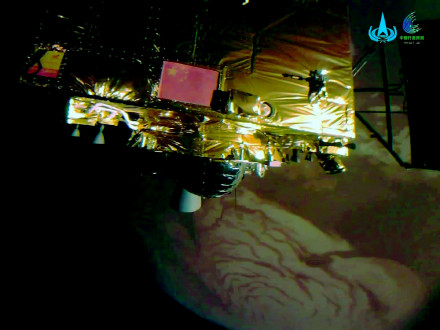
The findings suggest that Mars is the most similar to our own planet among the celestial bodies in our solar system. This proximity has led scientists to view the Red Planet as a potential proxy for understanding Earth's future climate and evolutionary history, sparking curiosity about other "secrets" hidden within the Martian terrain.
As an exciting new discovery, researchers have identified a global climate shift in Mars, which may provide valuable insights for humanity to study and prepare for our planet's future climate. The Utopian Plain, where Xiaodian was located (Figure ②), served as the landing zone for the Zhu Rong rover, enabling scientists to unravel this critical piece of information about Mars' past and present state.
This latest discovery further underscores the importance of continued exploration and collaboration in space research, as it offers a glimpse into our planetary neighbors and provides valuable lessons for Earth's inhabitants.